From the only original and legitimate Battlestar Wiki: the free-as-in-beer, non-corporate, open-content encyclopedia, analytical reference, and episode guide on all things Battlestar Galactica. Accept neither subpar substitutes nor subpar clones.
Colonial military flight crews wear '''flight suits'''<ref>{{bsgwiki term}}</ref>, sometimes referred to as "jock smocks"<ref>This term is first used by {{callsign|Starbuck}} in "[[He That Believeth in Me]]" when she asks [[Samuel Anders]] why he wears a flight suit.</ref>.
The flight suit is an airtight, one-piece jumpsuit with a single front zipper that runs from neck to waist; a detachable two-piece vest covering the chest is affixed by snaps across the shoulders and chest. Pressure gloves are attached by soft pressure seals incorporated in the sleeves, with a cuff itself featuring an integrated digital watch, its location based on the pilot's preference {{TRS|33}}. The arms and legs of the suit feature various zippered and flap pockets, as well as pouch compartments, for stowage of equipment such as [[Atmosphere test capsule|atmosphere test capsules]] and oxygen gauges {{TRS|You Can't Go Home Again|Resurrection Ship, Part II}}.
=== Pre-Armistice ===
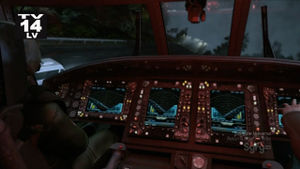
[[Caprican Marine Corps]] pilots wear flight suits<ref>The cockpit insert shot is entirely CGI, and makes use of APH-6-style helmets with persons wearing flight suits from the post-Armistice era. See: [[Flight suit#Notes|Notes]].</ref> in [[Blackhawk]] [[w:VTOL|VTOL]] craft circa {{BCH|58}} {{CAP|End of Line}}.
[[Air Force Viper]] pilots also wear variants of flight suits, with [[Zoe Graystone|Zoe-A]] and [[Philomon]] wearing flight suit coveralls with gear harnesses {{CAP|The Imperfections of Memory}}.
=== Cylon War ===
[[File:Cylon Facility - Razor Flashbacks.jpg|thumb|{{Callsign|Husker}} in his flight suit while investigating a [[Cylons (RDM)|Cylon]] research facility on an [[ice planet]] before the [[Cimtar Peace Accord]] {{TRS|Razor Flashbacks}}.]]
During the Cylon War, flight suits were one-piece jumpsuits with square silver-patterned cuffs, featuring a full upper torso over-vest that buckled under the strenum. Helmets worn by [[Colonial Fleet (TRS)|Colonial Fleet]] often featured a hawk-like emblem at the front of the dome {{TRS|Razor Flashbacks|Blood and Chrome}}.
They could not handle hard radiation {{CAP|Blood and Chrome}}, but contained survival equipment, including a parachute for planetary ejections {{TRS|Razor Flashbacks}}.
=== Post Armistice ===
The flight suit, sometimes referred to as a "jock smock"<ref>This term is first used by {{callsign|Starbuck}} in "[[He That Believeth in Me]]" when she asks [[Samuel Anders]] why he wears a flight suit.</ref>, is an airtight, one-piece jumpsuit with a single front zipper that runs from neck to waist; a detachable two-piece vest covering the chest is affixed by snaps across the shoulders and chest. Pressure gloves are attached by soft pressure seals incorporated in the sleeves, with a cuff itself featuring an integrated digital watch, its location based on the pilot's preference {{TRS|33}}. The arms and legs of the suit feature various zippered and flap pockets, as well as pouch compartments, for stowage of equipment such as [[Atmosphere test capsule|atmosphere test capsules]] and oxygen gauges {{TRS|You Can't Go Home Again|Resurrection Ship, Part II}}.
[[File:TRS - Miniseries - Boomer and Helo's Flight Suit Indicators.jpg|thumb|[[Sharon Valerii|Sharon "Boomer" Valerii]]'s and [[Karl Agathon|Karl "Helo" Agathon]]'s [[flight suit]] indicators; Boomer's being green while Helo's is red after the shrapnel punctures his suit {{TRS|Miniseries, Night 1}}.]]
[[File:TRS - Miniseries - Boomer and Helo's Flight Suit Indicators.jpg|thumb|[[Sharon Valerii|Sharon "Boomer" Valerii]]'s and [[Karl Agathon|Karl "Helo" Agathon]]'s [[flight suit]] indicators; Boomer's being green while Helo's is red after the shrapnel punctures his suit {{TRS|Miniseries, Night 1}}.]]
The suit is attached to the flight helmet by a hard metal collar; the helmet receives pressurizing air through a hose at the back of the helmet. The suit's basic environmental adjustments are managed by a small series of buttons on the left forearm, featuring a strip of indicator lighting through a covered window. When fully pressurized, the indicator strip illuminates green; it is lit red when the suit is compromised. As the pilot begins the process of removing their suit, this indicator's LED strip begins deactivating in sequence from left to right before powering off {{TRS|Miniseries, Night 1}}.
The suit is attached to the flight helmet by a hard metal collar; the helmet receives pressurizing air through a hose at the back of the helmet. The suit's basic environmental adjustments are managed by a small series of buttons on the left forearm, featuring a strip of indicator lighting through a covered window. When fully pressurized, the indicator strip illuminates green; it is lit red when the suit is compromised. As the pilot begins the process of removing their suit, this indicator's LED strip begins deactivating in sequence from left to right before powering off {{TRS|Miniseries, Night 1}}.
Line 72:
Line 83:
Flight suits are also fitted with a backpack featuring a parachute {{TRS|You Can't Go Home Again}} and an air tank with a limited supply {{TRS|You Can't Go Home Again|Resurrection Ship, Part II|Razor}}.
Flight suits are also fitted with a backpack featuring a parachute {{TRS|You Can't Go Home Again}} and an air tank with a limited supply {{TRS|You Can't Go Home Again|Resurrection Ship, Part II|Razor}}.
When pilots are deployed, a separate zippered satchel with survival equipment is affixed to the backpack. Equipment within the satchel includes tape, water packets, and other survivalist tools {{TRS|You Can't Go Home Again}}.
When pilots are deployed, a separate zippered satchel with survival equipment is affixed to the backpack. Equipment within the satchel includes tape, water packets, and other survivalist tools {{TRS|You Can't Go Home Again}}. {{Clear}}
{{Clear}}
=== Utility Belt ===
=== Utility Belt ===
Line 92:
Line 102:
==Notes==
==Notes==
*In the episodes "[[You Can't Go Home Again]]" and "[[Act of Contrition]]," {{callsign|Starbuck}} uses her flight suit to its fullest, from her ejection from her wayward Viper to her parachute landing, and monitoring of life support mechanisms using the gauges built into the suit.
*[[File:Caprica.S01E09.720p.CMoDVTOLcockpit.jpg|thumb|A [[Caprican Marine Corps]] pilot in a Re-imagined Series (post-Armistice era) flight suit {{CAP|End of Line}}.]]In the episodes "[[You Can't Go Home Again]]" and "[[Act of Contrition]]," {{callsign|Starbuck}} uses her flight suit to its fullest, from her ejection from her wayward Viper to her parachute landing, and monitoring of life support mechanisms using the gauges built into the suit.
*The suits are designed to keep a pilot who has ejected from his Viper alive in a vacuum for a limited amount of time, such as when Lee Adama has to eject from the [[Blackbird]] in "[[Resurrection Ship, Part II]]".
*The suits are designed to keep a pilot who has ejected from his Viper alive in a vacuum for a limited amount of time, such as when Lee Adama has to eject from the [[Blackbird]] in "[[Resurrection Ship, Part II]]".
*It appears that ''Galactica'' rarely has the opportunity for [[SAR]] operations to retrieve pilots after combat with Cylon forces. Often the battlestar must retreat with the [[The Fleet (RDM)|Fleet]], leaving any surviving Viper pilots to either be captured by the Cylons or die once their oxygen runs out.
*It appears that ''Galactica'' rarely has the opportunity for [[SAR]] operations to retrieve pilots after combat with Cylon forces. Often the battlestar must retreat with the [[The Fleet (RDM)|Fleet]], leaving any surviving Viper pilots to either be captured by the Cylons or die once their oxygen runs out.
*The flight suits were designed by Deborah Everton, and were constructed from materials produced by Sommers Plastic Products.<ref>http://www.scifihero.net/forums/index.php?showtopic=117&pid=4039&mode=threaded&start=</ref>
*The flight suits were designed by [[Deborah Everton]], and were constructed from materials produced by Sommers Plastic Products.<ref>http://www.scifihero.net/forums/index.php?showtopic=117&pid=4039&mode=threaded&start=</ref>
*The computer-generated scene of the [[Blackhawk]] cockpit features a pilot wearing a post-Armistice flight suit from the [[Re-imagined Series]] in {{CAP|End of Line|prose=Y}}.
During the Cylon War, flight suits were one-piece jumpsuits with square silver-patterned cuffs, featuring a full upper torso over-vest that buckled under the strenum. Helmets worn by Colonial Fleet often featured a hawk-like emblem at the front of the dome (TRS: "Razor Flashbacks" and "Blood and Chrome").
They could not handle hard radiation (CAP: "Blood and Chrome"), but contained survival equipment, including a parachute for planetary ejections (TRS: "Razor Flashbacks").
The flight suit, sometimes referred to as a "jock smock"[3], is an airtight, one-piece jumpsuit with a single front zipper that runs from neck to waist; a detachable two-piece vest covering the chest is affixed by snaps across the shoulders and chest. Pressure gloves are attached by soft pressure seals incorporated in the sleeves, with a cuff itself featuring an integrated digital watch, its location based on the pilot's preference (TRS: "33"). The arms and legs of the suit feature various zippered and flap pockets, as well as pouch compartments, for stowage of equipment such as atmosphere test capsules and oxygen gauges (TRS: "You Can't Go Home Again" and "Resurrection Ship, Part II").
The suit is attached to the flight helmet by a hard metal collar; the helmet receives pressurizing air through a hose at the back of the helmet. The suit's basic environmental adjustments are managed by a small series of buttons on the left forearm, featuring a strip of indicator lighting through a covered window. When fully pressurized, the indicator strip illuminates green; it is lit red when the suit is compromised. As the pilot begins the process of removing their suit, this indicator's LED strip begins deactivating in sequence from left to right before powering off (TRS: "Miniseries, Night 1").
Suit footwear is capable of magnetic attachment to surfaces for situations requiring EVAs, such as SARs(TRS: "A Day in the Life" and "Razor").
The flight suit appears suitable as all-weather gear when in rainy or cool conditions, but its lack of armor provides no significant protection during hand-to-hand or fire team combat situations (TRS: "33" and "Valley of Darkness").
When not in ready status, the suit can be worn unzipped for comfort, with the top half of the suit rolled down. Standard uniform undershirts are worn underneath the flight suit. Flight suits are worn with utility belts to carry a variety of gear, including sidearms.
The basic flight suit design has remained the same since the First Cylon War without major changes, aside from minor changes in material and vest configuration.
The left leg of the flight suit features a windowed pocket containing a checklist card, oriented to be readable by the wearer when in the seated position. The card for the viper pilots read as follows:
Viper Pre Flight Checklist
1. Pre Flight
External Inspection.....................................Okay
Flight Controls............................................Okay
Tanks filled ................................................Okay
Canopy Locks and explosive bolts to safe.....Okay
Seat Motors ...............................................Okay
Weapons to safe ........................................Okay
2. Start Check
Viper Pre Flight Checklist
Area..........................................................Clear
Comms......................................................Up
Tacom/Satnav.............................................Up
Canopy Bolts..............................................Armed
Escape Seat...............................................Armed
Engine Systems in the Green.......................Green
Weapons in the Green..........Weapons set to Armed
3. Launch Tube Check
Area............................................................Clear
Blast Doors..................................................Open
Heads Up Display.........................................On
Tac/Nav........................................................To Active
Flaps...........................................................15 degrees down angle
Engines........................................................85%
Assume Launch Position................................Okay
LSO Launch Signal........................................Okay
Master Caution Cold Shot Warning..................Set
Flight suits can be modified as manned maneuvering units (MMUs) in space, with reaction control thrusters mounted on the shoulders atop the vest (TRS: "Razor").
When pilots are deployed, a separate zippered satchel with survival equipment is affixed to the backpack. Equipment within the satchel includes tape, water packets, and other survivalist tools (TRS: "You Can't Go Home Again").
Humanoid Cylons piloting Heavy Raiders wear all-black flight suits made of a sleek material (TRS: "The Hub"). It is unknown whether or not these flight suits have hard seals or helmets.
The suits are designed to keep a pilot who has ejected from his Viper alive in a vacuum for a limited amount of time, such as when Lee Adama has to eject from the Blackbird in "Resurrection Ship, Part II".
It appears that Galactica rarely has the opportunity for SAR operations to retrieve pilots after combat with Cylon forces. Often the battlestar must retreat with the Fleet, leaving any surviving Viper pilots to either be captured by the Cylons or die once their oxygen runs out.
The flight suits were designed by Deborah Everton, and were constructed from materials produced by Sommers Plastic Products.[4]
↑In the Original Series, a space suit was available for emergencies aboard their battlestar. However, Colonial Warriors never wore any pressure suit during their Viper flights, making in-space search-and-rescues likely impossible if cockpit decompressions occurred.
↑The cockpit insert shot is entirely CGI, and makes use of APH-6-style helmets with persons wearing flight suits from the post-Armistice era. See: Notes.