


|
This article on Leonis is a shard, or a part, of a larger article (The Twelve Colonies of Kobol). Please direct all edits there.
|
|


Ancient Name: Leo
Population: 2.6 billion
Patron God: Artemis
Official Language: Leonese
Capital: Luminere
Major Cities: Luminere, Hedon
Attractions: Royal Palace of Leonis, Hedon Grand Casino
Pyramid Teams: Leonis Wildcats, Hedon Suns
Leonis is the second planet in the Helios Beta system, and was geographically known for its open plains (TRS: "The Plan"). The planet itself has no axial tilt, which supports a mild and predictable climate. It was a major hub for both education and industry, and despite Colonial unification, it was able to maintain its own language and culture.
In the era prior to the First Cylon War circa YR42, it was known for its opulence in the form of the Hedon Grand Casino, which hosted a well-known event, Hedon Film Festival.
Leonis produced and exported a popular energy drink named Leonis Red pre-First Cylon War[1], as well as Leonis Estates Sparkling Wine that survives briefly after the Fall (TRS: "Flight of the Phoenix"). Hawryliw beer originates from the city of Vislovka (TRS: "Colonial Day").
During the aforesaid attack, Leonis is struck with at least one low-yield nuclear device, that was able to stun its residents and disable any means of escape. Those who survived the blast, are then seen being systematically eliminated by both ground and air forces (TRS: "The Plan"). It is unknown if any are collected and used in the Four's various farms.
Safiya Sanne is the Leonan representative on the first Quorum of Twelve after the Fall (TRS: "Colonial Day").
References
edit- ↑ Cite error: Invalid
<ref>tag; no text was provided for refs namedcapricanvacations

Leonis Estates Sparkling Wine is a sparkling wine that was produced on the colony of Leonis.
The Blackbird is christened with a bottle of it by Laura Roslin (TRS: "Flight of the Phoenix").
Kara Thrace uses such a bottle to pour Louanne Katraine her first top gun mug and then toasts Galactica's fallen pilots with it (TRS: "Scar").
Additional Images
edit-
 Thrace drinking (Scar).
 -
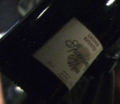 Closeup of the label (Scar).


Notes
edit- A bar code is visible on the other side of the bottle.

Pyramid[1] is a popular professional-league sport watched throughout the Twelve Colonies of Kobol (TRS: "Miniseries") and is also popular aboard Colonial warships (TRS: "Litmus"). Teams include the Caprica Buccaneers, Picon Panthers and Tauron Bulls; its players, such as the Buccaneers's Sue-Shaun and Samuel Anders, are considered sports heroes.
Rules and Regulations
editPlaying Regulations
editPyramid is a close quarters ball game played on a pyramid-shaped court, hence the name of the game. The objective is apparently to score points by getting the ball into a goal at the top of the pyramid. Pyramid can be played one-on-one or in teams.
Players can take no more than "three paces" without passing, shooting, or rebounding the ball off of one of the walls. The outlined areas in the corners and the center of the arena are "neutral zones". When a player places the ball in these zones, other players must back off and may not make contact[2].
Full contact is allowed (when the ball is not in a neutral zone), and once a player has been tackled, they must pass the ball. How this is handled in one-on-one games is left unspecified. The game is won by the team with the most points at the end. However, under what circumstances the games ends is also left unspecified[3].
There are versions of pyramid for one, three or five players from each team on the court at once[4]. The play area is consistently referred to as an "arena" and the corner with the goal as the "head". Apparently each team starts out in one of the corners besides the head and then vie for control of the ball. The initial ball placement is not defined, but a face-off is mentioned tangentially later in the article with no details.
Court and Team Sizes
editDespite the small size of the regulation pyramid court at Delphi Union High School (TRS: "Resistance") and the practice field used by the Caprica Buccaneers team just before the Fall of the Twelve Colonies (TRS: "The Plan"), the home of the Buccaneers fifty-eight years earlier, Atlas Arena, offered a much larger professional playing area. The relationship between the two is unclear, but it is possible that the regulation court may be considered a segment of the larger professional field. If this is true, while teams consist of over eight people, it is probable that the sport rotates players on and off the smaller court between plays. Three players per side within this area are a probable arrangement. Non-professional play (high school and collegiate, for instance) may have fewer players than the professional teams, indicating a skill factor needed to play with a large number of athletes.
Positions
edit- serger: the top-most attacking position, perhaps akin to a striker (center forward) in association football
- In 58 BCH (42YR), Kevin Kovat is the serger for the Caprica Buccaneers.
Equipment
edit
Teams
edit- For purposes of clarity, this section is split up into pre-Cylon War and post-Armistice. This is due to the fact that some teams may not have survived beyond the end of the Armistice, given the scope and depth of the Cylon War and its affect on all aspects of Colonial civilization.
Pre-Cylon War
editThe following Colonial Pyramid League[5] (CPL) teams are professional pyramid teams that are known to have existed 58 years prior to the Fall of the Twelve Colonies and played for the CPL Kobol Cup. It is not known whether these teams existed after the end of the first Cylon War.
- Boskirk All Reds hail from Virgon.
- Canceron Hydras hail from Canceron.
- Delphi Legion hail from the Caprican city of Delphi.
- The Delphi Legion are scheduled to play the Caprica Buccaneers at Atlas Arena when U-87s attached to the Caprican Marines land at the stadium in their first public combat role, attempting to stop a Soldiers of the One terror attack (CAP: "Apotheosis").
- Gemenon Twins hail from Gemenon (CAP: "Unvanquished").
- Hades Vice hail from Canceron.
- Leonis Wildcats hail from Leonis.
- Mangala Krill hail from Canceron.
- Olympian Stallions hail from Tauron.
- A month after the Lev bombing, they face off against the Caprica Buccaneers in a long awaited game at Caprica City's Atlas Arena. It is the first game after a "controversial victory" involving the teams that transpired over one year prior, as well as the first game that Daniel and Amanda Graystone spectate after the bombing (CAP: "Rebirth").
- Sagittaron Archers hail from Sagittaron.
- Tauron Bulls hail from Tauron.
- Baxter Sarno mentions a game between the Caprica Buccaneers and the Bulls on his show, Backtalk with Baxter Sarno (CAP: "Know Thy Enemy"). The Caprican later clarified this as "Bucs and the [Tauron] Bulls".
Post-Armistice to Pre-Fall
edit- Caprica Buccaneers hail from Caprica City.
- Main article: Caprica Buccaneers
- Existing for nearly a century before the Fall, the Buccaneers (also known as the "Bucs" or "C-Bucs") played in the CPL Inner Conference Alpha Division and was purchased by Daniel Graystone and, later, Tomas Vergis, both contributors to the creation of the Cylons. The team would later be captained by one of the Final Five Cylons prior to the Fall.
- Picon Panthers hail from Picon.
- The Picon Panthers were rivals of the Caprica Buccaneers. Moments after C-Bucs player Samuel Anders disembarks from the Raptors that rescues he and his resistance group from occupied Caprica, Admiral William Adama playfully tells him that the Panthers were his favorite (TRS: "Lay Down Your Burdens, Part II").
- Sharon "Athena" Agathon yells "Go Panthers!" while in Breeders Canyon on New Caprica to ascertain that the people approaching her position are Samuel Anders and the rendezvous party. Anders replies by yelling "C-Bucs rule!" (TRS: "Exodus, Part I").
- An unnamed professional Pyramid team from Aerilon played against the Caprica Buccaneers in one of the last games before the Cylon attack.
Tie Ins
editPyramid X
editA game called "Pyramid X"[6] which looks like the pyramid goal is set up in Joe's bar. Samuel Anders comments that it is nothing like the real thing.
Additional Imagery
edit-
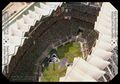 An aerial view of the Atlas Arena field (CAP: "Unvanquished")
 -
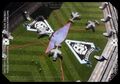 Closer view of the field during the Battle of Atlas Arena (CAP: "Apotheosis")


Notes
edit- The producers originally intended to show a full, professional pyramid game in the pilot episode, with Daniel Graystone and Joseph Adama sitting courtside. The sequence was cut for budgetary reasons, but the idea was revisited for the broadcast version of the pilot.[7]
- In the Original Series, pyramid referred to the poker-like card game often played by the Viper pilots. This became "triad" in the Re-imagined Series, and the Original Series game known as triad was renamed "pyramid". This was the result of a mix-up by Ronald D. Moore, as he explains in his podcast for the episode "Kobol's Last Gleaming, Part I":
...somewhere along the line I transposed the names. I misremembered what they called it and I- the sort of racquet-ball slash basketball game that they played in the original and that we referred to in this series, I now call Pyramid, and the name of that game in the original which was Triad is now what we sort of call our poker game. So it's one of those "Oh, it's one of the charming differences between the old and the new.," it's either that or it's just a stupid error that the writer made.
See Also
edit- Triad, the Original Series' counterpart to Pyramid.
- Pyramid, the Original Series' card game.
- Triad, the Re-imagined Series' card game.
References
edit- ↑ The game was derived by the Re-imagined Series writers from the triad games played in the Original Series, viewed as a cross between basketball, rugby and lacrosse.
- ↑ This may be a rule somewhat like the NCAA's old "halo" rule on the declaration of a fair catch of a kick off in American football.
- ↑ Perhaps, like basketball, a pick-up game could be played to a certain number of points, while professional (or otherwise more official) games have a clock or other timer.
- ↑ Battlestar Galactica: The Official Magazine, issue 1, pp. 28-29
- ↑ While the initialism is derived from The Caprican articles, it is never formally defined, and thus this can be considered a Battlestar Wiki term.
- ↑ David Eick's video blog, "Taking a Break From All Your Worries" (backup available on Archive.org) (in ).
- ↑ Podcast for Caprica pilot, timestamp 00:50:07


