
Arts and Literature of the Twelve Colonies: Difference between revisions


More languages
More actions
April Arcus (talk | contribs) No edit summary |
m Adding French link |
||
| (215 intermediate revisions by 30 users not shown) | |||
| Line 1: | Line 1: | ||
{{ | {{disline|This article discusses an aspect of the [[Re-imagined Series]] version of the Twelve Colonies. For information on the [[Original Series]] version, see [[The Twelve Colonies of Man]].}} | ||
'' | The [[The Twelve Colonies of Kobol|Twelve Colonies]], like most civilizations, have a rich historical record of '''arts and literature''' as well as other works. Their [[Government of the Twelve Colonies|democratic republic]] gives its citizens many freedoms of expression in addition to freedom of the press. Colonials have paintings, abstract designs and a variety of musical traditions. | ||
Additionally, many functional items produced on the Colonies adhere to an aesthetic, even at a cost to efficiency. | |||
{{RDM twelve colonies series}} | |||
__TOC__ | |||
==Literature== | |||
=== | === Autobiographical === | ||
==== ''The Man Who Could See the Future'' ==== | |||
== | ''The Man Who Could See the Future'' is the autobiography of [[Daniel Graystone]], published as of [[YR42]]. | ||
=== | |||
'' | [[Baxter Sarno]] references it [[Backtalk with Baxter Sarno|in his show's monologue]], joking that it should have instead been titled ''Wow, I Didn't See That Coming'' following the public revelation regarding [[Zoe Graystone]]'s involvement in the [[Maglev 23]] bombing {{CAP|Reins of a Waterfall}}. | ||
===Religion=== | |||
==== ''My Place in Heaven'' ==== | |||
[[File:Caprica - Pilot - My Place in Heaven.png|thumb|[[Lacy Rand]] moves aside a copy of ''My Place in Heaven'' while searching through [[Zoe Graystone]]'s desk {{CAP|Pilot (Caprica)}}.]] | |||
A copy of ''My Place in Heaven'' resides on [[Zoe Graystone]]'s desk, and is often moved aside by [[Lacy Rand]] when attempting to find the [[e-sheet]] that allows her to access the [[V-Club]] and [[Zoe-A|the last remnant of Zoe]] {{CAP|Pilot (Caprica)}}. | |||
==== ''The Physics of Religion and Spirituality'' ==== | |||
A copy of ''The Physics of Religion and Spirituality'' is included in the package of [[Zoe Graystone]]'s personal effects that [[Natalie Stark]] gives to [[Amanda Graystone]] at [[Apollo Park]] {{CAP|Rebirth}}. | |||
===Political=== | |||
==== Tom Zarek's book ==== | |||
'''Tom Zarek's book''' is a political book of [[Tom Zarek]]'s beliefs, which he wrote while imprisoned. The manuscript is smuggled from his prison and published, but due to its yet-unspecified content, the book became banned in certain places throughout the Twelve Colonies, particularly the fleet academy. | |||
During the incident on the ''[[Astral Queen]]'', Captain {{callsign|Lee Adama}} tells Zarek that he read the book and that it challenged the way he thought about things on the Colonies {{TRS|Bastille Day}}. | |||
==== ''My Triumphs, My Mistakes'' ==== | |||
{{mainarticle|My Triumphs, My Mistakes}} | |||
After returning to the [[The Fleet (RDM)|The Fleet]] months after the exodus from [[New Caprica]], [[Gaius Baltar]] wrote his manifesto, in which he criticizes the Colonial government system and highlights the class factions between the "{{RDM|Caprica}}n elite" and the lower classes in the Colonies. Much like Tom Zarek's book, Baltar's manifesto was smuggled out by his [[Alan Hughes|lawyer]] and published, despite attempts to ban and destroy the book by [[Laura Roslin]] and her supporters {{TRS|Dirty Hands|The Son Also Rises}}. | |||
===Prose=== | |||
====''Dark Day''==== | |||
[[Edward Prima]] is the author of the novel ''Dark Day''. | |||
[[William Adama]], who had ''Dark Day'' in his personal library on ''{{RDM|Galactica}}'', gives it to [[Laura Roslin]] as a gift {{TRS|Water}}. She considers it to be "one of those classics I've never gotten around to reading." Given the context of their conversation, notably Roslin's reference to ''A Murder on Picon'', it is likely a mystery. | |||
Roslin returns the book, to Adama's consternation, after the prognosis of her illness sharply worsens {{TRS|Flight of the Phoenix}}. | |||
====''The French Lieutenant's Woman''==== | |||
[[File:The French Lieutenant's Woman.jpg|thumb|A copy of ''The French Lieutenant's Woman''.]] | |||
'''''The French Lieutenant's Woman'''''<ref group="continuity" name="french_lieutenants_woman_gaffe_never_intended_seen">{{cite_web|url=https://wiki.battlestarwiki.org/Continuity_errors_(RDM)#:~:text=This%20is%20likely%20a%20gaffe%20and%20never%20intended%20to%20be%20seen|title=Continuity errors (RDM)|website=Battlestar Wiki|accessdate=6 August 2025|note=This is likely a gaffe and never intended to be seen on screen in detail}}</ref> is part of William Adama's formidable library of books on ''Galactica''. | |||
It is located on the shelf behind the couch in Adama's quarters {{TRS|Black Market}}. | |||
====''A Murder on Picon''==== | |||
'''''A Murder on Picon''''' is a mystery novel, apparently taking place on [[Picon (RDM)|Picon]]. | |||
[[Laura Roslin]] brought the book with her on the trip to ''{{RDM|Galactica}}'' prior to its decommissioning ceremonies {{TRS|Miniseries|Water}}. | |||
==== ''Blood Runs at Midnight'' ==== | |||
A mystery novel given to William Adama by President Roslin as a gift {{TRS|A Day in the Life}}. | |||
==== ''Love and Bullets'' ==== | |||
A murder mystery written by Nick Taylo that is set in [[Caprica City]]. Adama reads part of the book to Roslin when she lies in ''Galactica'''s [[sickbay]] to receive [[Doloxan]] treatments {{TRS|The Ties That Bind}}. | |||
:''See [[The Ties That Bind#Noteworthy Dialogue]] for an excerpt.'' | |||
==== ''Searider Falcon'' ==== | |||
[[File:Searider Falcon.jpg|thumb|Adama's singed copy of ''Searider Falcon'' {{TRS|Sine Qua Non}}.]] | |||
Another book Adama reads to Roslin. Adama calls it a classic, and both say that it is one of their favorites {{TRS|Escape Velocity}}. Roslin takes it with her when she visits the rebel baseship {{TRS|Guess What's Coming to Dinner}} and Adama finds it shortly later in a derelict Raptor that escaped from a battle with the Cylons. When Adama decides to stay behind the Fleet in a Raptor in order to find Roslin, he takes the book with him {{TRS|Sine Qua Non}}. | |||
:''The raft was not as seaworthy as I'd hoped. The waves repeatedly threatened to swamp it. I wasn't afraid to die. I was afraid of the emptiness that I felt inside. I couldn't feel anything. And that's what scared me. You came into my thoughts. I felt them. It felt good.'' | |||
===Poetry=== | |||
====''A Poet's Dream''==== | |||
[[File:A Poet's Dream - Kataris - watermarked.jpg|thumb|''A Poet's Dream'', Kataris' memorable collections of poetry.]] | |||
'''A Poet's Dream''' is a compilation of poems from the [[Caprica (RDM)|Caprican]] poet [[Kataris]]. Lieutenant [[Joe Palladino|Palladino]] owns a bound edition of this book and threatens Colonel [[Saul Tigh|Tigh]] with lines from a poem within: | |||
<blockquote>From the darkness you must fall<br /> | <blockquote>From the darkness you must fall<br /> | ||
Failed and weak, to darkness all.</blockquote> | Failed and weak, to darkness all.</blockquote> | ||
At least one of the poems from this compilation is quite well-known amongst Colonials. {{callsign|Starbuck}} recognizes the above quotation, recalls from which piece it comes, and knows the poem's quality relative to his other works. [[D'Anna Biers]] identifies Palladino's copy on sight in a recording she is editing {{TRS|Final Cut}}. Later, [[Gaius Baltar]] has a copy of this book in his cell on ''{{RDM|Galactica}}'' {{TRS|Dirty Hands}}. | |||
{{clear}} | |||
===Children=== | |||
====''Muffit's Really Big Adventure''==== | |||
[[File:Muffit's Really Big Adventure.jpg|thumb|A copy owned by [[Clarice Willow]]'s family.]] | |||
Featuring the character of [[Muffit]], this book was written by Vincent Uytdehaag and illustrated by Shay Hilliard {{CAP|False Labor}}. | |||
{{clear}} | |||
====''Dragon Fighters of Kobol''==== | |||
A fantasy book, ''[[Dragon Fighters of Kobol]]'' featured dangerous monsters as part of its story. [[Zoe Graystone]] was a fan of the book as a child {{CAP|Here Be Dragons}}. | |||
{{clear}} | |||
===Periodicals=== | |||
==== Pre-Armistice ==== | |||
===== ''True Confessions'' ===== | |||
[[File:Caprica - Rebirth - True Confessions.png|thumb|A copy of the ''True Confessions'' periodical in [[Clarice Willow]]'s hands circa {{YR|42}} {{CAP|Rebirth}}.]] | |||
A periodical of interest to [[Clarice Willow]], who picks up a copy at a news stand across from a dive bar {{CAP|Rebirth}}. | |||
==== Post-Armistice ==== | |||
*[[Aerelon Gazette]] | |||
*[[Caprica Times]] | |||
*[[Caprican Life]] | |||
*[[Nymph]] | |||
*[[Picon Star Tribune]] | |||
*[[Scorpia Paragliding]] | |||
===Law books=== | |||
''Caprican Criminal Codes'' is a multi-volume collection of Caprican law {{TRS|A Day in the Life}}. | |||
''[[Trial Tactics and Strategies]]'' and ''[[Law and Mind: The Psychology of Legal Practice]]'' are two books about the the practice of law, written by [[Joseph Adama]], [[William Adama]]'s father {{TRS|The Son Also Rises|Crossroads, Part I}}. | |||
==Visual Arts== | |||
===Representationalist=== | |||
====Monclair==== | |||
[[File:Monclair2.jpg|thumb|right|A Monclair original.]] | |||
'''Monclair''' was a [[Colonial]] painter. One of his original paintings, a stylized depiction of the [[Cylon War]], adorns [[William Adama]]'s quarters on ''{{RDM|Galactica}}''. He is apparently of considerable renown, given [[Gaius Baltar]]'s impressed reaction to the piece {{TRS|Bastille Day}}. | |||
===== Notes ===== | |||
* In ''[[Battlestar Galactica: Season Zero 4]]'' (which exists in a [[BW:SC|separate continuity]]), [[Colonial Intelligence]] agent [[Levin]] comments on the painting, noting Adama's "expensive tastes". Additionally, Levin knowingly mentions that the painting was a gift from [[Julian DiMarco]], Adama's friend and former commander. | |||
* According to ''[[Battlestar Galactica: The Official Companion]]'', the painting hanging in Adama's quarters was made by additional art director [[Ken Rabehl]].<ref group="production" name="official_companion_monclair_painting_ken_rabehl">{{cite_book|title=Battlestar Galactica: The Official Companion|author=David Bassom|publisher=Titan Books|page=140|year=2005|note=The painting hanging in Adama's quarters was made by additional art director Ken Rabehl}}</ref> | |||
{{clear}} | |||
===Abstract=== | |||
====Kara Thrace==== | |||
[[File:Valley_of_Darkness-Starbuck_Helo.jpg||thumb|right|Abstract paintings by Kara Thrace. ]] | |||
Between tours of duty, {{callsign|Starbuck}} was an enthusiastic painter. {{callsign|Karl Agathon}} is surprised to discover this side of her when they visit her apartment in [[Delphi]] {{TRS|Valley of Darkness}}. Curiously, a specific design that Thrace has doodled as a child would be found more than two years later inside an [[Temple of Five|ancient temple]] of the [[Thirteenth Tribe (RDM)|Thirteenth Tribe]], without Thrace or Helo understanding why she would be aware of the design {{TRS|Rapture}}. | |||
{{clear}} | |||
===Film=== | |||
====''The Tauron Line''==== | |||
'''''The Tauron Line''''' is a war film produced several decades before the [[Fall of the Twelve Colonies]]. It is possibly set during the [[Tauron Civil War]]. | |||
The plot of the film is unknown. At one point in the film, the antagonists booby-trap an item with explosives, then wait for the protagonists to pick it up and take it somewhere before detonating it. Samuel Anders uses this scene as inspiration for the [[Caprica Resistance]]'s first attack on the Cylons {{TRS|The Plan}}. | |||
According to [[archive:https://twitter.com/SergeGraystone/status/10142203820|Serge's Twitter Account]], [[Daniel Graystone|Daniel]] and [[Amanda Graystone]] are fans of the film.<ref group="social" name="serge_twitter_daniel_amanda_graystone_tauron_line_fans">{{cite_web|url=https://twitter.com/SergeGraystone/status/10142203820#:~:text=Daniel%20and%20Amanda%20Graystone%20are%20fans%20of%20the%20film|title=Serge's Twitter Account|author=Serge|website=Twitter|date=2010|accessdate=6 August 2025|archive=Y}}</ref> | |||
===Tattoos=== | |||
====[[Tauron]] Tattoos==== | |||
[[File:Caprica - Ruth's Tattoos.png|thumb|[[Ruth]]'s tattoos on her right upper forearm, signifying her children and grandchildren as of [[YR42]] {{CAP|Reins of a Waterfall|del1=Y}}.]] | |||
Many Taurons sport tattoos, from which can be read essential aspects of their life stories, including familial connections. The most extensive tattoos are found among members of the [[Ha'la'tha]] crime syndicate, and many Capricans associate the practice with the Ha'la'tha {{CAP|Gravedancing}}. However, members of the [[Heracleides]] militia were also illustrated {{CAP|The Dirteaters}}. | |||
{{clear}} | |||
===={{callsign|Starbuck}} & [[Samuel Anders]]==== | |||
[[File:Anders and Thrace wedding tattoo.jpg|thumb|left|[[Samuel Anders]] and {{callsign|Starbuck}}'s wedding band.]] | |||
Instead of wearing wedding rings, Samuel Anders and Kara Thrace<ref group="continuity" name="katee_sackhoff_personal_tattoos_covered_filming">{{cite_web|url=https://wiki.battlestarwiki.org/Katee_Sackhoff#:~:text=Actress%20Katee%20Sackhoff%20has%20a%20number%20of%20personal%20tattoos|title=Katee Sackhoff|website=Battlestar Wiki|accessdate=6 August 2025|note=Actress Katee Sackhoff has a number of personal tattoos on her body. The crew uses various means to cover or block these tattoos from view during filming, but the results are not always perfect}}</ref> created tattoos on their arms that, when they embrace, form a unified circle with wings. The symbol for the colony of {{RDM|Caprica}} is also in view<ref group="production" name="katee_sackhoff_tv_guide_wedding_tattoo_interview">{{cite_web|url=https://www.tvguide.com/news/katee-sackhoff-starbuck-tattoo/#:~:text=when%20he's%20holding%20me%20the%20rings%20match%20up%20and%20it%20becomes%20one%20ring%20with%20two%20wings|title=TV Guide Photoshoot Video Interview|author=Katee Sackhoff|website=TV Guide|accessdate=6 August 2025|note=In a TV Guide photoshoot video interview, Katee Sackhoff comments on the wedding tattoos and their symbolism}}</ref>. | |||
From a behind-the-scenes perspective, [[Michael Trucco]] adds that it is their wedding band, but that this is never fully explained in the show. Further, these matching tattoos are applied by the makeup department. | |||
<br clear="all" /> | |||
==== Other ==== | |||
[[Felix Gaeta]] displays a tattoo of a rather large tiger during his interview with [[D'Anna Biers]] {{TRS|Final Cut}}. Gaeta indicated he was quite inebriated with [[ambrosia]] to minimize the pain of the tattoo. | |||
[[Socinus]] has a tattoo of an [[Wikipedia:Aries|Aries]] design on his right arm {{TRS|Kobol's Last Gleaming, Part I}}.<ref group="continuity" name="socinus_aries_tattoo_actor_character_born_under_sign">{{cite_web|url=https://wiki.battlestarwiki.org/Socinus#:~:text=It%20is%20not%20yet%20known%20if%20the%20tattoo%20belongs%20to%20Alonso%20Oyarzun|title=Socinus|website=Battlestar Wiki|accessdate=6 August 2025|note=It is not yet known if the tattoo belongs to Alonso Oyarzun or if it is purely for the character of Socinus, as both the actor was born under the sign of Aries and the character is a colonist of Aerelon}}</ref> | |||
An unnamed [[Tattooed pilot|pilot]] has many tattoos on both upper arms, depicting a tiger and a dragon, among other things. | |||
[[Vireem]], specialist aboard the battlestar ''[[Pegasus (RDM)|Pegasus]]'', has a complex tattoo on his left bicep, featuring a Chinese-style dragon and glyph {{TRS|Pegasus|Resurrection Ship, Part II}}<ref group="continuity" name="vireem_chinese_dragon_tattoo_actor_derek_delost">{{cite_web|url=https://wiki.battlestarwiki.org/Vireem#:~:text=Visible%20on%20his%20Vireem's%20left%20bicep%20in%20both%20the%20little%20robot%20girl%20sequence|title=Vireem|website=Battlestar Wiki|accessdate=6 August 2025|note=Visible on his Vireem's left bicep in both the "little robot girl" sequence and the subsequent brig beating sequence, his tattoo (likely the actor's own) is that of a Chinese-style dragon and the 吉 Chinese glyph over a spiral background likely that of a whirlpool}}</ref>. | |||
<gallery mode="slideshow"> | |||
File:Gaeta tiger tatoo.jpg|Gaeta's tiger tattoo {{TRS|Final Cut}}. | |||
File:SocinusTatoo KLGp1.JPG|Socinus's tattoo {{TRS|Kobol's Last Gleaming, Part I}}. | |||
File:TRS-Tattooed Pilot.png|The unnamed [[tattooed pilot]] seen throughout the series. | |||
File:TRS - Resurrection Ship pt II - Vireem's Tattoo.jpg|[[Vireem]]'s tattoo {{TRS|Resurrection Ship, Part II}}. | |||
</gallery> | |||
==Sculpture== | |||
In addition to the [[Arrow of Apollo]], the [[Delphi Museum of the Colonies]] contains a large collection of ancient pottery. Located in numerous display cases in the exhibit halls spanning the museum's levels, this large collection of vases, jars, pots and stone fragments form a rough outline of the Colonials' artistic history. Many of the artifacts and art pieces are quite elaborate and appear to be in the detailed Corinthian Style. | |||
==Music== | |||
===Dreilide Thrace=== | |||
[[Dreilide Thrace]] was a pianist. His daughter [[Kara Thrace|Kara]] kept recordings of some of his piano arrangements in her Delphi apartment {{TRS|Valley of Darkness}}.<ref group="production" name="bear_mccreary_dreilide_thrace_philip_glass_metamorphosis">{{cite_web|url=https://bearmccreary.com/blog/#:~:text=According%20to%20Battlestar%20Galactica%20composer%20Bear%20McCreary%2C%20the%20piece%20attributed%20to%20Thrace's%20father%20is%20actually%20Metamorphosis%20Five|title=Bear McCreary's Blog|author=Bear McCreary|website=BearMcCreary.com|accessdate=6 August 2025|note=According to Battlestar Galactica composer Bear McCreary, the piece attributed to Thrace's father is actually Metamorphosis Five, composed by Philip Glass, from his 1989 album Solo Piano}}</ref> At some point in his career, he recorded an album, ''Dreilide Thrace: Live at the Helice Opera House'' {{TRS|Someone to Watch Over Me}}. | |||
===Colonial Anthem=== | |||
The [[Colonial anthem]] is heard as a short fanfare over the Viper flyby during ''Galactica''{{'|s}} decommissioning ceremony and as a background music at the beginning of Baltar's television interview {{TRS|Miniseries}}. Its third, and longer, appearance is as background music for the rousing closing speech of [[D'anna Biers]]{{'|s}} documentary on the Colonial military {{TRS|Final Cut}}.<ref group="production" name="stu_phillips_bear_mccreary_colonial_anthem_original_series">{{cite_web|url=https://bearmccreary.com/blog/#:~:text=In%20reality%2C%20this%20is%20the%20Original%20Series%20theme%20by%20Stu%20Phillips|title=Bear McCreary's Blog|author=Bear McCreary|website=BearMcCreary.com|accessdate=6 August 2025|note=In reality, this is the Original Series theme by Stu Phillips. For Final Cut, the piece was specially re-arranged by Bear McCreary}}</ref> | |||
===''Caprica''-Era Musical Traditions=== | |||
During the pre-Fall period on {{RDM|Caprica}}, distinct musical traditions developed that reflected the planet's sophisticated urban culture. Composer [[Bear McCreary]] noted that Caprican society represented a civilization "at its most decadent and opulent peak," which influenced the musical styles of the era.<ref group="production" name="mccreary_blog_caprica_musical_traditions_decadent_opulent">{{cite_web|url=https://bearmccreary.com/caprica-pilot/#:~:text=Caprica%20City%20is%20a%20familiar%20society%20at%20its%20most%20decadent%20and%20opulent%20peak|title=Caprica: Pilot|author=Bear McCreary|website=BearMcCreary.com|date=22 January 2010|accessdate=6 August 2025}}</ref> | |||
The musical palette of ''Caprica'' was deliberately crafted to contrast with the "urgent, tribal, primitive and mystical elements" that would later characterize the post-Fall period during the ''Battlestar Galactica'' era. Instead, Caprican musical culture was characterized by: | |||
* '''Chamber Orchestra Traditions:''' The sophisticated urban environment of [[Caprica City]] supported intimate, contemporary chamber orchestras that performed at venues like concert halls and private gatherings.<ref group="production" name="mccreary_blog_caprica_chamber_orchestra_intimate_contemporary">{{cite_web|url=https://bearmccreary.com/caprica-pilot/#:~:text=intimate%2C%20contemporary%20chamber%20orchestra%20recorded%20at%20the%20Warner%20Bros|title=Caprica: Pilot|author=Bear McCreary|website=BearMcCreary.com|date=22 January 2010|accessdate=6 August 2025}}</ref> | |||
* '''Lyrical Harmonic Language:''' Caprican compositions featured rich, lyrical harmonies that were "far more lyrical and rich than the simple drones and dissonant clusters" that would emerge during the survival-focused post-Fall period.<ref group="production" name="mccreary_blog_caprica_lyrical_rich_harmonies_drones_clusters">{{cite_web|url=https://bearmccreary.com/caprica-pilot/#:~:text=far%20more%20lyrical%20and%20rich%20than%20the%20simple%20drones%20and%20dissonant%20clusters|title=Caprica: Pilot|author=Bear McCreary|website=BearMcCreary.com|date=22 January 2010|accessdate=6 August 2025}}</ref> | |||
* '''Gamelan Influences:''' Traditional Caprican music incorporated gamelan instruments alongside Western orchestral elements, creating a unique cultural fusion that reflected the planet's cosmopolitan nature.<ref group="production" name="mccreary_blog_caprica_gamelan_western_orchestral_fusion">{{cite_web|url=https://bearmccreary.com/caprica-pilot/#:~:text=Traditional%20Caprican%20music%20incorporated%20gamelan%20instruments%20alongside%20Western%20orchestral%20elements|title=Caprica: Pilot|author=Bear McCreary|website=BearMcCreary.com|date=22 January 2010|accessdate=6 August 2025}}</ref> | |||
====Tauron Folk Music==== | |||
Musical traditions from [[Tauron]] maintained a distinctly ethnic, modal character that drew inspiration from Russian folk music traditions. These pieces were typically performed on acoustic fiddle or Chinese membrane flute, creating what composer Bear McCreary described as music intended to "capture the mood of Tauron" in the same way that Nino Rota's "Godfather" theme evokes Italy.<ref group="production" name="mccreary_blog_caprica_tauron_folk_russian_godfather_italy">{{cite_web|url=https://bearmccreary.com/caprica-pilot/#:~:text=capture%20the%20mood%20of%20Tauron%20in%20the%20same%20way%20that%20Nino%20Rota's%20Godfather%20theme%20evokes%20Italy|title=Caprica: Pilot|author=Bear McCreary|website=BearMcCreary.com|date=22 January 2010|accessdate=6 August 2025}}</ref> | |||
The Tauron musical style represented the ancestral heritage and cultural identity that [[Joseph Adama]] and his family maintained despite their integration into Caprican society. This musical tradition served as a connection to the "old country" and the values of Tauron culture. | |||
====Cultural Evolution==== | |||
The musical sophistication of pre-Fall Caprica was part of a broader cultural phenomenon. McCreary noted that the restrained, elegant musical style reflected how "Daniel Graystone and Joseph Adama are restrained characters, even during the most turbulent of family crises," with emotions "kept hidden, out of sight from their peers and visible only to those closest to them."<ref group="production" name="mccreary_blog_caprica_restrained_characters_emotions_hidden">{{cite_web|url=https://bearmccreary.com/caprica-pilot/#:~:text=Daniel%20Graystone%20and%20Joseph%20Adama%20are%20restrained%20characters%2C%20even%20during%20the%20most%20turbulent%20of%20family%20crises|title=Caprica: Pilot|author=Bear McCreary|website=BearMcCreary.com|date=22 January 2010|accessdate=6 August 2025}}</ref> This musical restraint represented the controlled, civilized surface of Caprican society that concealed deeper moral and emotional complexities. | |||
The eventual transformation from this sophisticated musical culture to the more primitive, percussion-heavy traditions of the post-Fall period represents one of the many cultural losses suffered during the [[Fall of the Twelve Colonies]]. | |||
===Popular music=== | |||
Popular Colonial music can be heard in Boomer's apartment on Caprica in the episode "[[Downloaded]]" and in [[Joe's bar]] in "[[Taking a Break From All Your Worries]]". Another song is playing as Lee Adama enters the bar on ''[[Prometheus (ship)|Prometheus]]'' {{TRS|Black Market}}<ref group="production" name="bear_mccreary_prometheus_bar_song_season_two_soundtrack">{{cite_web|url=https://bearmccreary.com/blog/#:~:text=This%20is%20only%20a%20small%20part%20of%20the%20song%20that%20was%20composed%20for%20the%20episode|title=Bear McCreary's Blog|author=Bear McCreary|website=BearMcCreary.com|accessdate=6 August 2025|note=This is only a small part of the song that was composed for the episode by Bear McCreary. The full 5 minute long version is available on the Season 2 soundtrack}}</ref>. | |||
In addition, a popular sing-a-long song is "99 Bottles of Ambrosia"<ref group="continuity" name="ninety_nine_bottles_ambrosia_colonial_version_beer">{{cite_web|url=https://en.wikipedia.org/wiki/99_Bottles_of_Beer#:~:text=This%20is%20clearly%20the%20Colonial%20version%20of%2099%20Bottles%20of%20Beer|title=99 Bottles of Beer|website=Wikipedia|accessdate=6 August 2025|note=This is clearly the Colonial version of 99 Bottles of Beer}}</ref>, which [[Marcia Case]] throws out there as a recommendation after {{callsign|Starbuck}} comments on the humdrum of their up-until-then-uneventful search and rescue mission for a missing [[Raptor]] {{TRS|Razor}}. | |||
Roughly 60 BCH, musical styles emerged on {{RDM|Caprica}} and [[Tauron]], themselves later repeated more than 150,000 years later on the second [[Earth (RDM)|Earth]]; these include alternative hip-hop, of which the only known artists are Tauron {{CAP|Reins of a Waterfall}} as well as forms of punk rock and dance music {{CAP|Pilot (Caprica)}}.<ref group="production" name="mccreary_blog_caprica_themes_hip_hop_punk_dance_music">{{cite_web|url=http://www.bearmccreary.com/blog/?p=1903#:~:text=these%20include%20alternative%20hip-hop%2C%20of%20which%20the%20only%20known%20artists%20are%20Tauron|title=The Themes of "Caprica"|date=23 April 2009|accessdate=26 February 2010|last=McCreary|first=Bear|website=BearMcCreary.com}}</ref> | |||
===Scoring Philosophy and Techniques=== | |||
The episode "[[33 (episode)|33]]" provided an early showcase for Bear McCreary's approach to combining action and drama through music. McCreary explained his technique for the climactic destruction of the ''Olympic Carrier'': "At a surface level, that sequence looks like an action scene, so I put it against a backdrop of driving frame drums and taikos. But as the scene ultimately boils down to the terrifying decision that the main characters must make, I layered in dark orchestral textures and ambient soloists to play more to the drama and less to the spectacle. The result was one of my favorite cues for the entire series."<ref group="production" name="official_companion_bear_mccreary_33_olympic_carrier_frame_drums_taikos">{{cite_book|title=Battlestar Galactica: The Official Companion|author=David Bassom|publisher=Titan Books|page=47|year=2005|note=Bear McCreary's approach to scoring the Olympic Carrier destruction scene in '33'}}</ref> | |||
==Aesthetics== | |||
===Production Design and Philosophy=== | |||
The overall aesthetic of ''Caprica'' was guided by a philosophy of realism and dramatic focus. Executive producer [[Ronald D. Moore]] stated that they wanted to carry over the sense of truth from ''Battlestar Galactica'' and avoid distracting sci-fi elements like "silly chairs and silly hair," ensuring the show was a "drama first and foremost."<ref group="production" name="podcast_caprica_pilot_ron_moore_drama_first_foremost">{{cite_web|url=https://www.syfy.com/sites/syfy/files/podcast_caprica_pilot.mp3#:~:text=drama%20first%20and%20foremost|title=Podcast for ''Caprica'' pilot|publisher=Syfy|accessdate=6 August 2025|note=timestamp 00:05:34|archive=Y}}</ref> This approach influenced several key visual choices: | |||
* '''Period Piece Feel:''' The show was designed to feel like a period piece relative to ''Battlestar Galactica''. This is reflected in the fashion, such as the prevalence of hats and suits in Joseph Adama's world, creating a sense of an older, more formal society.<ref group="production" name="podcast_caprica_pilot_period_piece_hats_suits_formal">{{cite_web|url=https://www.syfy.com/sites/syfy/files/podcast_caprica_pilot.mp3#:~:text=feel%20like%20a%20period%20piece%20relative%20to%20Battlestar%20Galactica|title=Podcast for ''Caprica'' pilot|publisher=Syfy|accessdate=6 August 2025|note=timestamp 00:10:29|archive=Y}}</ref> | |||
* '''Grounded Technology:''' The production team deliberately chose to use recognizable, real-world cars rather than futuristic "air cars" to maintain a "touchstone of familiarity." The mandate was to use exotic or vintage models that would look unfamiliar to American audiences.<ref group="production" name="podcast_caprica_pilot_grounded_technology_touchstone_familiarity">{{cite_web|url=https://www.syfy.com/sites/syfy/files/podcast_caprica_pilot.mp3#:~:text=touchstone%20of%20familiarity%20The%20mandate%20was%20to%20use%20exotic%20or%20vintage%20models|title=Podcast for ''Caprica'' pilot|publisher=Syfy|accessdate=6 August 2025|note=timestamp 00:09:22|archive=Y}}</ref> | |||
* '''Formal Cinematography:''' Director [[Jeffrey Reiner]] employed a more staid and formal camera style compared to the visceral, handheld look of ''Battlestar Galactica''. This was intended to visually represent the stability of Caprican society before its eventual fall.<ref group="production" name="podcast_caprica_pilot_jeffrey_reiner_formal_camera_stability">{{cite_web|url=https://www.syfy.com/sites/syfy/files/podcast_caprica_pilot.mp3#:~:text=more%20staid%20and%20formal%20camera%20style%20compared%20to%20the%20visceral%2C%20handheld%20look|title=Podcast for ''Caprica'' pilot|publisher=Syfy|accessdate=6 August 2025|note=timestamp 00:18:12|archive=Y}}</ref> | |||
* '''V-Club Inspiration:''' The visual design of the V-Club was inspired by a photograph from [[w:David LaChapelle|David LaChapelle]], which had a "sacred vibe with almost an apocalyptic party feel to it."<ref group="production" name="podcast_caprica_pilot_vclub_david_lachapelle_apocalyptic_party">{{cite_web|url=https://www.syfy.com/sites/syfy/files/podcast_caprica_pilot.mp3#:~:text=sacred%20vibe%20with%20almost%20an%20apocalyptic%20party%20feel%20to%20it|title=Podcast for ''Caprica'' pilot|publisher=Syfy|accessdate=6 August 2025|note=timestamp 00:08:47|archive=Y}}</ref> | |||
====Musical Aesthetic Philosophy==== | |||
The musical aesthetic of ''Caprica'' reflected director [[Jeffrey Reiner]]'s overall vision for the series' emotional landscape. Reiner emphasized the importance of music that could "drive the story in an unrelenting manner, but evoke the inner emotions of the characters without falling into schmaltz."<ref group="production" name="mccreary_blog_caprica_jeffrey_reiner_unrelenting_emotions_schmaltz">{{cite_web|url=https://bearmccreary.com/caprica-pilot/#:~:text=drive%20the%20story%20in%20an%20unrelenting%20manner%2C%20but%20evoke%20the%20inner%20emotions|title=Caprica: Pilot|author=Bear McCreary|website=BearMcCreary.com|date=22 January 2010|accessdate=6 August 2025}}</ref> | |||
This aesthetic philosophy resulted in musical choices that were: | |||
* '''Restrained and Subtle:''' Rather than making "overt or obvious emotional statements," the music allowed "the drama on screen to unfold naturally," matching the reserved nature of characters like Daniel Graystone and Joseph Adama.<ref group="production" name="mccreary_blog_caprica_restrained_subtle_drama_unfold_naturally">{{cite_web|url=https://bearmccreary.com/caprica-pilot/#:~:text=overt%20or%20obvious%20emotional%20statements%20the%20music%20allowed%20the%20drama%20on%20screen%20to%20unfold%20naturally|title=Caprica: Pilot|author=Bear McCreary|website=BearMcCreary.com|date=22 January 2010|accessdate=6 August 2025}}</ref> | |||
* '''Bittersweet and Elegant:''' The score captured the moral ambiguity of the characters through harmonic progressions that had a "slippery, seductive quality" where "you can never quite tell where it's going emotionally."<ref group="production" name="mccreary_blog_caprica_bittersweet_elegant_slippery_seductive">{{cite_web|url=https://bearmccreary.com/caprica-pilot/#:~:text=slippery%2C%20seductive%20quality%20where%20you%20can%20never%20quite%20tell%20where%20it's%20going%20emotionally|title=Caprica: Pilot|author=Bear McCreary|website=BearMcCreary.com|date=22 January 2010|accessdate=6 August 2025}}</ref> | |||
* '''Strategically Emotional:''' Sweeping, emotional phrases were reserved "for only the most important moments," creating greater impact when they occurred.<ref group="production" name="mccreary_blog_caprica_strategically_emotional_important_moments_impact">{{cite_web|url=https://bearmccreary.com/caprica-pilot/#:~:text=for%20only%20the%20most%20important%20moments%20creating%20greater%20impact%20when%20they%20occurred|title=Caprica: Pilot|author=Bear McCreary|website=BearMcCreary.com|date=22 January 2010|accessdate=6 August 2025}}</ref> | |||
This musical aesthetic directly supported the series' exploration of characters who were "deeply flawed" with "no 'hero,' in the traditional sense," requiring music that could reach "beneath their muted exteriors and reveal the longing, brooding emotions within."<ref group="production" name="mccreary_blog_caprica_deeply_flawed_no_hero_muted_exteriors">{{cite_web|url=https://bearmccreary.com/caprica-pilot/#:~:text=deeply%20flawed%20with%20no%20hero%20in%20the%20traditional%20sense|title=Caprica: Pilot|author=Bear McCreary|website=BearMcCreary.com|date=22 January 2010|accessdate=6 August 2025}}</ref> | |||
===Colonial Heraldry and Symbolism=== | |||
====Flags of the Twelve Colonies==== | |||
The flags of the [[Twelve Colonies of Kobol|Twelve Colonies]] represent a sophisticated heraldic tradition that reflects both individual colonial identity and shared cultural heritage. Each colony's flag follows a consistent design template featuring a circular emblem at the top containing what appears to be a stylized representation of the [[Sacred Scrolls]]' sacred symbols, with each colony's unique identifying symbol displayed prominently on the banner below.<ref group="production" name="official_companion_colonial_day_flags_early_concept_designs">{{cite_book|title=Battlestar Galactica: The Official Companion|author=David Bassom|publisher=Titan Books|page=86|year=2005|note=Early concept designs for the flags of the Twelve Colonies of Kobol are shown in relation to the 'Colonial Day' episode}}</ref> | |||
The flags were created to represent: | |||
* '''[[Virgon (RDM)|Virgon]]''' - Features a geometric angular design | |||
* '''[[Picon (RDM)|Picon]]''' - Displays a stylized temple or building structure | |||
* '''[[Caprica (RDM)|Caprica]]''' - Shows what appears to be a phoenix or bird motif | |||
* '''[[Tauron]]''' - Contains a bull's head or horned design reflecting the colony's name | |||
* '''[[Gemenon]]''' - Features twin or paired symbols | |||
* '''[[Scorpia]]''' - Displays a scorpion-like design matching the colony's astrological association | |||
* '''[[Aerilon]]''' - Features an agricultural or farming motif | |||
* '''[[Leonis]]''' - Shows a lion-related heraldic design | |||
* '''[[Canceron]]''' - Contains a crab or crustacean symbol | |||
* '''[[Sagittaron]]''' - Features an archer or bow design | |||
* '''[[Libran]]''' - Shows balanced scales representing justice | |||
* '''[[Aquarion]]''' - Displays water-bearer or aquatic symbolism | |||
These flags first appeared prominently during the [[service for the dead]] in the [[Miniseries]] and, later, [[Colonial Day]] ceremonies held aboard the luxury liner ''[[Cloud Nine]]'', marking both a celebration of colonial unity and a forum for political discourse within [[The Fleet (TRS)|the Fleet]].<ref group="production" name="official_companion_colonial_day_cloud_nine_political_forum">{{cite_book|title=[[Battlestar Galactica: The Official Companion]]|author=David Bassom|publisher=Titan Books|page=84|year=2005|note=Colonial Day was set largely on the Cloud Nine to provide a lighter visual style and serve as a forum for political discourse}}</ref> | |||
===Octagons=== | |||
Colonial printouts, photographs, videos, and [[Computers in the Re-imagined Series#Data discs|data discs]] are rarely rectangular; the corners are trimmed at 45 degree angles, creating snub rectangles, i.e. octagons. This design choice developed out of discussions between production designer [[Richard Hudolin]], [[Ronald D. Moore]], [[David Eick]], and director [[Michael Rymer]], who felt that cutting the corners of most documents was an easy way to make the look "a bit unconventional and unfamiliar" to audiences. The reasoning for this within the Colonial universe is likely based on their cultural aversion to right angles, as rectangles are, particularly for paper, more efficient from a practical standpoint.<ref group="production" name="official_companion_richard_hudolin_clipped_corners_unconventional">{{cite_book|title=[[Battlestar Galactica: The Official Companion]]|author=David Bassom|publisher=Titan Books|page=140|year=2005|note=This developed out of a discussion between Richard Hudolin, Ron Moore, David Eick and Michael Rymer. It was felt that cutting the corner of most documents is an easy way to make the look a bit unconventional and unfamiliar. Hudolin also states that not all documents are clipped, but that classified ones definitely are}}</ref> | |||
This design choice is also evident in Colonial [[Computers in the Re-imagined Series|computer systems]] with windows and menus often having clipped corners. | |||
===Hexagons=== | |||
In the [[Battlestar Galactica (RDM)|Re-imagined Series]], hexagons feature significantly as [[dog tags]], [[Triad (RDM)|playing cards]], glass bottles and many other objects. This likely reflects both the dislike of right angles and the simplicity of polygons over curved shapes. | |||
===Pentagons=== | |||
While not a part of Colonial society ''per se'', pentagons play a large part in the architecture of the lone Thirteenth Tribe structure encountered by the Colonials thus far, the [[Temple of Five]]. Much like the Colonials, it appears at least the ancient members of the Thirteenth Tribe were also wary of right angles. | |||
==Architecture== | |||
===Federal Period=== | |||
[[File:Mini-Caprica City.jpg|thumb|right|Some Federal Period architecture in Caprica City]] | |||
This style was mix of older and newer trends, utilizing traditional stone facades along with glass and steel. This architecture was found throughout [[Caprica City]], [[Delphi]], and other [[Unnamed cities of Caprica|unnamed cities]] prior to the Cylon attack. | |||
Several buildings in Caprica City had the form of a pyramid, but the cultural significance of this design choice is unknown<ref group="continuity" name="caprica_pyramid_buildings_original_series_egyptian_reference">{{cite_web|url=https://wiki.battlestarwiki.org/File:Capricaattack.jpg#:~:text=This%20is%20a%20reference%20to%20the%20Caprica%20of%20the%20Original%20Series|title=Caprica attack image|website=Battlestar Wiki|accessdate=6 August 2025|note=This is a reference to the Caprica of the Original Series, which was influenced by Egyptian mythology and symbolism}}</ref>. | |||
===Ancient Kobol=== | |||
[[File:City of the Gods.jpg|thumb|right|Bird's eye view of the [[City of the Gods]] and its architecture]] | |||
[[File:Opera House ruins.jpg|thumb|right|The stone ruins of the Opera House]] | |||
In "[[Kobol's Last Gleaming, Part I]]," Roslin looks at schematics for the [[City of the Gods]] on {{RDM|Kobol}}. Its buildings, such as the [[Temple]], [[Forum]], and the [[Opera House]], were made of stone and range in shape and size, and resemble classical Greco-Roman architecture. | |||
Later, the ruins of the Opera House are seen when [[Gaius Baltar]] and others crash-land nearby. The building was made of stone and utilized decorative columns and pillars. While there, Baltar has a vision which may have represented the original appearance of the Opera House before it fell into disrepair. | |||
===Polygonal Architecture=== | |||
Many places and objects within ''Galactica'' reflect early aesthetic choices that eschew right-angular forms. Many corridors, including ship bulkhead doors, are hexagonal. [[CIC]] elements, particularly the Command & Control Center table, the tactical station table, and even the alignment of the displays of the [[DRADIS]] console, form a hexagonal appearance. | |||
This aesthetic appears to have waned during the construction of more advanced battlestars such as ''[[Pegasus (RDM)|Pegasus]]'', which uses far fewer hexagonal shapes.<ref group="production" name="pegasus_sets_lost_in_space_pilot_rectangular_design">{{cite_web|url=https://wiki.battlestarwiki.org/Pegasus_(RDM)#:~:text=The%20sets%20for%20Pegasus%20were%20purchased%20from%20a%20failed%20series%20pilot|title=Pegasus (RDM)|website=Battlestar Wiki|accessdate=6 August 2025|note=The sets for Pegasus were purchased from a failed series pilot for a Lost in Space series remake. As such, the sets adhere to earthly rectangular design, and budget constraints for Battlestar Galactica likely limited any large modifications}}</ref> | |||
= | ==References== | ||
== | === Production History === | ||
{{reflist|group=production}} | |||
= | === Social Media and External Sources === | ||
== | {{reflist|group=social}} | ||
= | === Continuity and Behind-the-Scenes === | ||
{{reflist|group=continuity}} | |||
== | |||
= | |||
[[Category:A to Z]] | |||
[[Category:Colonial]] | |||
[[Category:Colonial History]] | |||
[[Category:Colonial History (RDM)]] | |||
[[Category:Colonial Society]] | |||
[[Category:Colonial Society (RDM)]] | |||
[[Category:RDM]] | |||
{{indicator|TRS}}{{indicator|Caprica}}{{indicator|BAC}} | |||
{{featured article candidate previous}} | |||
[[fr:Arts et littérature dans les Douze Colonies (RDM)]] | |||
Latest revision as of 20:35, 18 October 2025

|
This article discusses an aspect of the Re-imagined Series version of the Twelve Colonies. For information on the Original Series version, see The Twelve Colonies of Man.
|
|
The Twelve Colonies, like most civilizations, have a rich historical record of arts and literature as well as other works. Their democratic republic gives its citizens many freedoms of expression in addition to freedom of the press. Colonials have paintings, abstract designs and a variety of musical traditions.
Additionally, many functional items produced on the Colonies adhere to an aesthetic, even at a cost to efficiency.
| Part of the series on | ||||||||||||
| ||||||||||||


Literature
editAutobiographical
editThe Man Who Could See the Future
editThe Man Who Could See the Future is the autobiography of Daniel Graystone, published as of YR42.
Baxter Sarno references it in his show's monologue, joking that it should have instead been titled Wow, I Didn't See That Coming following the public revelation regarding Zoe Graystone's involvement in the Maglev 23 bombing (CAP: "Reins of a Waterfall").
Religion
editMy Place in Heaven
edit
A copy of My Place in Heaven resides on Zoe Graystone's desk, and is often moved aside by Lacy Rand when attempting to find the e-sheet that allows her to access the V-Club and the last remnant of Zoe (CAP: "Pilot").
The Physics of Religion and Spirituality
editA copy of The Physics of Religion and Spirituality is included in the package of Zoe Graystone's personal effects that Natalie Stark gives to Amanda Graystone at Apollo Park (CAP: "Rebirth").
Political
editTom Zarek's book
editTom Zarek's book is a political book of Tom Zarek's beliefs, which he wrote while imprisoned. The manuscript is smuggled from his prison and published, but due to its yet-unspecified content, the book became banned in certain places throughout the Twelve Colonies, particularly the fleet academy.
During the incident on the Astral Queen, Captain Lee "Apollo" Adama tells Zarek that he read the book and that it challenged the way he thought about things on the Colonies (TRS: "Bastille Day").
My Triumphs, My Mistakes
edit- Main article: My Triumphs, My Mistakes
After returning to the The Fleet months after the exodus from New Caprica, Gaius Baltar wrote his manifesto, in which he criticizes the Colonial government system and highlights the class factions between the "Caprican elite" and the lower classes in the Colonies. Much like Tom Zarek's book, Baltar's manifesto was smuggled out by his lawyer and published, despite attempts to ban and destroy the book by Laura Roslin and her supporters (TRS: "Dirty Hands" and "The Son Also Rises").
Prose
editDark Day
editEdward Prima is the author of the novel Dark Day.
William Adama, who had Dark Day in his personal library on Galactica, gives it to Laura Roslin as a gift (TRS: "Water"). She considers it to be "one of those classics I've never gotten around to reading." Given the context of their conversation, notably Roslin's reference to A Murder on Picon, it is likely a mystery.
Roslin returns the book, to Adama's consternation, after the prognosis of her illness sharply worsens (TRS: "Flight of the Phoenix").
The French Lieutenant's Woman
edit
The French Lieutenant's Woman[continuity 1] is part of William Adama's formidable library of books on Galactica.
It is located on the shelf behind the couch in Adama's quarters (TRS: "Black Market").
A Murder on Picon
editA Murder on Picon is a mystery novel, apparently taking place on Picon.
Laura Roslin brought the book with her on the trip to Galactica prior to its decommissioning ceremonies (TRS: "Miniseries" and "Water").
Blood Runs at Midnight
editA mystery novel given to William Adama by President Roslin as a gift (TRS: "A Day in the Life").
Love and Bullets
editA murder mystery written by Nick Taylo that is set in Caprica City. Adama reads part of the book to Roslin when she lies in Galactica's sickbay to receive Doloxan treatments (TRS: "The Ties That Bind").
- See The Ties That Bind#Noteworthy Dialogue for an excerpt.
Searider Falcon
edit
Another book Adama reads to Roslin. Adama calls it a classic, and both say that it is one of their favorites (TRS: "Escape Velocity"). Roslin takes it with her when she visits the rebel baseship (TRS: "Guess What's Coming to Dinner") and Adama finds it shortly later in a derelict Raptor that escaped from a battle with the Cylons. When Adama decides to stay behind the Fleet in a Raptor in order to find Roslin, he takes the book with him (TRS: "Sine Qua Non").
- The raft was not as seaworthy as I'd hoped. The waves repeatedly threatened to swamp it. I wasn't afraid to die. I was afraid of the emptiness that I felt inside. I couldn't feel anything. And that's what scared me. You came into my thoughts. I felt them. It felt good.
Poetry
editA Poet's Dream
edit
A Poet's Dream is a compilation of poems from the Caprican poet Kataris. Lieutenant Palladino owns a bound edition of this book and threatens Colonel Tigh with lines from a poem within:
From the darkness you must fall
Failed and weak, to darkness all.
At least one of the poems from this compilation is quite well-known amongst Colonials. Kara "Starbuck" Thrace recognizes the above quotation, recalls from which piece it comes, and knows the poem's quality relative to his other works. D'Anna Biers identifies Palladino's copy on sight in a recording she is editing (TRS: "Final Cut"). Later, Gaius Baltar has a copy of this book in his cell on Galactica (TRS: "Dirty Hands").
Children
editMuffit's Really Big Adventure
edit
Featuring the character of Muffit, this book was written by Vincent Uytdehaag and illustrated by Shay Hilliard (CAP: "False Labor").
Dragon Fighters of Kobol
editA fantasy book, Dragon Fighters of Kobol featured dangerous monsters as part of its story. Zoe Graystone was a fan of the book as a child (CAP: "Here Be Dragons").
Periodicals
editPre-Armistice
editTrue Confessions
edit
A periodical of interest to Clarice Willow, who picks up a copy at a news stand across from a dive bar (CAP: "Rebirth").
Post-Armistice
editLaw books
editCaprican Criminal Codes is a multi-volume collection of Caprican law (TRS: "A Day in the Life").
Trial Tactics and Strategies and Law and Mind: The Psychology of Legal Practice are two books about the the practice of law, written by Joseph Adama, William Adama's father (TRS: "The Son Also Rises" and "Crossroads, Part I").
Visual Arts
editRepresentationalist
editMonclair
edit
Monclair was a Colonial painter. One of his original paintings, a stylized depiction of the Cylon War, adorns William Adama's quarters on Galactica. He is apparently of considerable renown, given Gaius Baltar's impressed reaction to the piece (TRS: "Bastille Day").
Notes
edit- In Battlestar Galactica: Season Zero 4 (which exists in a separate continuity), Colonial Intelligence agent Levin comments on the painting, noting Adama's "expensive tastes". Additionally, Levin knowingly mentions that the painting was a gift from Julian DiMarco, Adama's friend and former commander.
- According to Battlestar Galactica: The Official Companion, the painting hanging in Adama's quarters was made by additional art director Ken Rabehl.[production 1]
Abstract
editKara Thrace
edit
Between tours of duty, Kara "Starbuck" Thrace was an enthusiastic painter. Karl "Helo" Agathon is surprised to discover this side of her when they visit her apartment in Delphi (TRS: "Valley of Darkness"). Curiously, a specific design that Thrace has doodled as a child would be found more than two years later inside an ancient temple of the Thirteenth Tribe, without Thrace or Helo understanding why she would be aware of the design (TRS: "Rapture").
Film
editThe Tauron Line
editThe Tauron Line is a war film produced several decades before the Fall of the Twelve Colonies. It is possibly set during the Tauron Civil War.
The plot of the film is unknown. At one point in the film, the antagonists booby-trap an item with explosives, then wait for the protagonists to pick it up and take it somewhere before detonating it. Samuel Anders uses this scene as inspiration for the Caprica Resistance's first attack on the Cylons (TRS: "The Plan").
According to Serge's Twitter Account, Daniel and Amanda Graystone are fans of the film.[social 1]
Tattoos
edit
Many Taurons sport tattoos, from which can be read essential aspects of their life stories, including familial connections. The most extensive tattoos are found among members of the Ha'la'tha crime syndicate, and many Capricans associate the practice with the Ha'la'tha (CAP: "Gravedancing"). However, members of the Heracleides militia were also illustrated (CAP: "The Dirteaters").

Instead of wearing wedding rings, Samuel Anders and Kara Thrace[continuity 2] created tattoos on their arms that, when they embrace, form a unified circle with wings. The symbol for the colony of Caprica is also in view[production 2].
From a behind-the-scenes perspective, Michael Trucco adds that it is their wedding band, but that this is never fully explained in the show. Further, these matching tattoos are applied by the makeup department.
Other
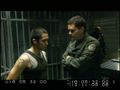
editFelix Gaeta displays a tattoo of a rather large tiger during his interview with D'Anna Biers (TRS: "Final Cut"). Gaeta indicated he was quite inebriated with ambrosia to minimize the pain of the tattoo.
Socinus has a tattoo of an Aries design on his right arm (TRS: "Kobol's Last Gleaming, Part I").[continuity 3]
An unnamed pilot has many tattoos on both upper arms, depicting a tiger and a dragon, among other things.
Vireem, specialist aboard the battlestar Pegasus, has a complex tattoo on his left bicep, featuring a Chinese-style dragon and glyph (TRS: "Pegasus" and "Resurrection Ship, Part II")[continuity 4].
-

-
 Socinus's tattoo (TRS: "Kobol's Last Gleaming, Part I").
 -
 The unnamed tattooed pilot seen throughout the series.
 -
 Vireem's tattoo (TRS: "Resurrection Ship, Part II").


Sculpture
editIn addition to the Arrow of Apollo, the Delphi Museum of the Colonies contains a large collection of ancient pottery. Located in numerous display cases in the exhibit halls spanning the museum's levels, this large collection of vases, jars, pots and stone fragments form a rough outline of the Colonials' artistic history. Many of the artifacts and art pieces are quite elaborate and appear to be in the detailed Corinthian Style.
Music
editDreilide Thrace
editDreilide Thrace was a pianist. His daughter Kara kept recordings of some of his piano arrangements in her Delphi apartment (TRS: "Valley of Darkness").[production 3] At some point in his career, he recorded an album, Dreilide Thrace: Live at the Helice Opera House (TRS: "Someone to Watch Over Me").
Colonial Anthem
editThe Colonial anthem is heard as a short fanfare over the Viper flyby during Galactica's decommissioning ceremony and as a background music at the beginning of Baltar's television interview (TRS: "Miniseries"). Its third, and longer, appearance is as background music for the rousing closing speech of D'anna Biers's documentary on the Colonial military (TRS: "Final Cut").[production 4]
Caprica-Era Musical Traditions
editDuring the pre-Fall period on Caprica, distinct musical traditions developed that reflected the planet's sophisticated urban culture. Composer Bear McCreary noted that Caprican society represented a civilization "at its most decadent and opulent peak," which influenced the musical styles of the era.[production 5]
The musical palette of Caprica was deliberately crafted to contrast with the "urgent, tribal, primitive and mystical elements" that would later characterize the post-Fall period during the Battlestar Galactica era. Instead, Caprican musical culture was characterized by:
- Chamber Orchestra Traditions: The sophisticated urban environment of Caprica City supported intimate, contemporary chamber orchestras that performed at venues like concert halls and private gatherings.[production 6]
- Lyrical Harmonic Language: Caprican compositions featured rich, lyrical harmonies that were "far more lyrical and rich than the simple drones and dissonant clusters" that would emerge during the survival-focused post-Fall period.[production 7]
- Gamelan Influences: Traditional Caprican music incorporated gamelan instruments alongside Western orchestral elements, creating a unique cultural fusion that reflected the planet's cosmopolitan nature.[production 8]
Tauron Folk Music
editMusical traditions from Tauron maintained a distinctly ethnic, modal character that drew inspiration from Russian folk music traditions. These pieces were typically performed on acoustic fiddle or Chinese membrane flute, creating what composer Bear McCreary described as music intended to "capture the mood of Tauron" in the same way that Nino Rota's "Godfather" theme evokes Italy.[production 9]
The Tauron musical style represented the ancestral heritage and cultural identity that Joseph Adama and his family maintained despite their integration into Caprican society. This musical tradition served as a connection to the "old country" and the values of Tauron culture.
Cultural Evolution
editThe musical sophistication of pre-Fall Caprica was part of a broader cultural phenomenon. McCreary noted that the restrained, elegant musical style reflected how "Daniel Graystone and Joseph Adama are restrained characters, even during the most turbulent of family crises," with emotions "kept hidden, out of sight from their peers and visible only to those closest to them."[production 10] This musical restraint represented the controlled, civilized surface of Caprican society that concealed deeper moral and emotional complexities.
The eventual transformation from this sophisticated musical culture to the more primitive, percussion-heavy traditions of the post-Fall period represents one of the many cultural losses suffered during the Fall of the Twelve Colonies.
Popular music
editPopular Colonial music can be heard in Boomer's apartment on Caprica in the episode "Downloaded" and in Joe's bar in "Taking a Break From All Your Worries". Another song is playing as Lee Adama enters the bar on Prometheus (TRS: "Black Market")[production 11].
In addition, a popular sing-a-long song is "99 Bottles of Ambrosia"[continuity 5], which Marcia Case throws out there as a recommendation after Kara "Starbuck" Thrace comments on the humdrum of their up-until-then-uneventful search and rescue mission for a missing Raptor (TRS: "Razor").
Roughly 60 BCH, musical styles emerged on Caprica and Tauron, themselves later repeated more than 150,000 years later on the second Earth; these include alternative hip-hop, of which the only known artists are Tauron (CAP: "Reins of a Waterfall") as well as forms of punk rock and dance music (CAP: "Pilot").[production 12]
Scoring Philosophy and Techniques
editThe episode "33" provided an early showcase for Bear McCreary's approach to combining action and drama through music. McCreary explained his technique for the climactic destruction of the Olympic Carrier: "At a surface level, that sequence looks like an action scene, so I put it against a backdrop of driving frame drums and taikos. But as the scene ultimately boils down to the terrifying decision that the main characters must make, I layered in dark orchestral textures and ambient soloists to play more to the drama and less to the spectacle. The result was one of my favorite cues for the entire series."[production 13]
Aesthetics
editProduction Design and Philosophy
editThe overall aesthetic of Caprica was guided by a philosophy of realism and dramatic focus. Executive producer Ronald D. Moore stated that they wanted to carry over the sense of truth from Battlestar Galactica and avoid distracting sci-fi elements like "silly chairs and silly hair," ensuring the show was a "drama first and foremost."[production 14] This approach influenced several key visual choices:
- Period Piece Feel: The show was designed to feel like a period piece relative to Battlestar Galactica. This is reflected in the fashion, such as the prevalence of hats and suits in Joseph Adama's world, creating a sense of an older, more formal society.[production 15]
- Grounded Technology: The production team deliberately chose to use recognizable, real-world cars rather than futuristic "air cars" to maintain a "touchstone of familiarity." The mandate was to use exotic or vintage models that would look unfamiliar to American audiences.[production 16]
- Formal Cinematography: Director Jeffrey Reiner employed a more staid and formal camera style compared to the visceral, handheld look of Battlestar Galactica. This was intended to visually represent the stability of Caprican society before its eventual fall.[production 17]
- V-Club Inspiration: The visual design of the V-Club was inspired by a photograph from David LaChapelle, which had a "sacred vibe with almost an apocalyptic party feel to it."[production 18]
Musical Aesthetic Philosophy
editThe musical aesthetic of Caprica reflected director Jeffrey Reiner's overall vision for the series' emotional landscape. Reiner emphasized the importance of music that could "drive the story in an unrelenting manner, but evoke the inner emotions of the characters without falling into schmaltz."[production 19]
This aesthetic philosophy resulted in musical choices that were:
- Restrained and Subtle: Rather than making "overt or obvious emotional statements," the music allowed "the drama on screen to unfold naturally," matching the reserved nature of characters like Daniel Graystone and Joseph Adama.[production 20]
- Bittersweet and Elegant: The score captured the moral ambiguity of the characters through harmonic progressions that had a "slippery, seductive quality" where "you can never quite tell where it's going emotionally."[production 21]
- Strategically Emotional: Sweeping, emotional phrases were reserved "for only the most important moments," creating greater impact when they occurred.[production 22]
This musical aesthetic directly supported the series' exploration of characters who were "deeply flawed" with "no 'hero,' in the traditional sense," requiring music that could reach "beneath their muted exteriors and reveal the longing, brooding emotions within."[production 23]
Colonial Heraldry and Symbolism
editFlags of the Twelve Colonies
editThe flags of the Twelve Colonies represent a sophisticated heraldic tradition that reflects both individual colonial identity and shared cultural heritage. Each colony's flag follows a consistent design template featuring a circular emblem at the top containing what appears to be a stylized representation of the Sacred Scrolls' sacred symbols, with each colony's unique identifying symbol displayed prominently on the banner below.[production 24]
The flags were created to represent:
- Virgon - Features a geometric angular design
- Picon - Displays a stylized temple or building structure
- Caprica - Shows what appears to be a phoenix or bird motif
- Tauron - Contains a bull's head or horned design reflecting the colony's name
- Gemenon - Features twin or paired symbols
- Scorpia - Displays a scorpion-like design matching the colony's astrological association
- Aerilon - Features an agricultural or farming motif
- Leonis - Shows a lion-related heraldic design
- Canceron - Contains a crab or crustacean symbol
- Sagittaron - Features an archer or bow design
- Libran - Shows balanced scales representing justice
- Aquarion - Displays water-bearer or aquatic symbolism
These flags first appeared prominently during the service for the dead in the Miniseries and, later, Colonial Day ceremonies held aboard the luxury liner Cloud Nine, marking both a celebration of colonial unity and a forum for political discourse within the Fleet.[production 25]
Octagons
editColonial printouts, photographs, videos, and data discs are rarely rectangular; the corners are trimmed at 45 degree angles, creating snub rectangles, i.e. octagons. This design choice developed out of discussions between production designer Richard Hudolin, Ronald D. Moore, David Eick, and director Michael Rymer, who felt that cutting the corners of most documents was an easy way to make the look "a bit unconventional and unfamiliar" to audiences. The reasoning for this within the Colonial universe is likely based on their cultural aversion to right angles, as rectangles are, particularly for paper, more efficient from a practical standpoint.[production 26]
This design choice is also evident in Colonial computer systems with windows and menus often having clipped corners.
Hexagons
editIn the Re-imagined Series, hexagons feature significantly as dog tags, playing cards, glass bottles and many other objects. This likely reflects both the dislike of right angles and the simplicity of polygons over curved shapes.
Pentagons
editWhile not a part of Colonial society per se, pentagons play a large part in the architecture of the lone Thirteenth Tribe structure encountered by the Colonials thus far, the Temple of Five. Much like the Colonials, it appears at least the ancient members of the Thirteenth Tribe were also wary of right angles.
Architecture
editFederal Period
edit
This style was mix of older and newer trends, utilizing traditional stone facades along with glass and steel. This architecture was found throughout Caprica City, Delphi, and other unnamed cities prior to the Cylon attack.
Several buildings in Caprica City had the form of a pyramid, but the cultural significance of this design choice is unknown[continuity 6].
Ancient Kobol
edit

In "Kobol's Last Gleaming, Part I," Roslin looks at schematics for the City of the Gods on Kobol. Its buildings, such as the Temple, Forum, and the Opera House, were made of stone and range in shape and size, and resemble classical Greco-Roman architecture.
Later, the ruins of the Opera House are seen when Gaius Baltar and others crash-land nearby. The building was made of stone and utilized decorative columns and pillars. While there, Baltar has a vision which may have represented the original appearance of the Opera House before it fell into disrepair.
Polygonal Architecture
editMany places and objects within Galactica reflect early aesthetic choices that eschew right-angular forms. Many corridors, including ship bulkhead doors, are hexagonal. CIC elements, particularly the Command & Control Center table, the tactical station table, and even the alignment of the displays of the DRADIS console, form a hexagonal appearance.
This aesthetic appears to have waned during the construction of more advanced battlestars such as Pegasus, which uses far fewer hexagonal shapes.[production 27]
References
editProduction History
edit- ↑ David Bassom (2005). Battlestar Galactica: The Official Companion. Titan Books, p. 140.
- ↑ Katee Sackhoff. TV Guide Photoshoot Video Interview (backup available on Archive.org) (in English). Retrieved on 6 August 2025.
- ↑ Bear McCreary. Bear McCreary's Blog (backup available on Archive.org) (in English). Retrieved on 6 August 2025.
- ↑ Bear McCreary. Bear McCreary's Blog (backup available on Archive.org) (in English). Retrieved on 6 August 2025.
- ↑ Bear McCreary (22 January 2010). Caprica: Pilot (backup available on Archive.org) (in English). Retrieved on 6 August 2025.
- ↑ Bear McCreary (22 January 2010). Caprica: Pilot (backup available on Archive.org) (in English). Retrieved on 6 August 2025.
- ↑ Bear McCreary (22 January 2010). Caprica: Pilot (backup available on Archive.org) (in English). Retrieved on 6 August 2025.
- ↑ Bear McCreary (22 January 2010). Caprica: Pilot (backup available on Archive.org) (in English). Retrieved on 6 August 2025.
- ↑ Bear McCreary (22 January 2010). Caprica: Pilot (backup available on Archive.org) (in English). Retrieved on 6 August 2025.
- ↑ Bear McCreary. Bear McCreary's Blog (backup available on Archive.org) (in English). Retrieved on 6 August 2025.
- ↑ McCreary, Bear (23 April 2009). The Themes of "Caprica" (backup available on Archive.org) (in English). Retrieved on 26 February 2010.
- ↑ David Bassom (2005). Battlestar Galactica: The Official Companion. Titan Books, p. 47.
- ↑ Podcast for Caprica pilot (content archived on Archive.org) (in English). Syfy. Retrieved on 6 August 2025.
- ↑ Podcast for Caprica pilot (content archived on Archive.org) (in English). Syfy. Retrieved on 6 August 2025.
- ↑ Podcast for Caprica pilot (content archived on Archive.org) (in English). Syfy. Retrieved on 6 August 2025.
- ↑ Podcast for Caprica pilot (content archived on Archive.org) (in English). Syfy. Retrieved on 6 August 2025.
- ↑ Podcast for Caprica pilot (content archived on Archive.org) (in English). Syfy. Retrieved on 6 August 2025.
- ↑ Bear McCreary (22 January 2010). Caprica: Pilot (backup available on Archive.org) (in English). Retrieved on 6 August 2025.
- ↑ Bear McCreary (22 January 2010). Caprica: Pilot (backup available on Archive.org) (in English). Retrieved on 6 August 2025.
- ↑ Bear McCreary (22 January 2010). Caprica: Pilot (backup available on Archive.org) (in English). Retrieved on 6 August 2025.
- ↑ Bear McCreary (22 January 2010). Caprica: Pilot (backup available on Archive.org) (in English). Retrieved on 6 August 2025.
- ↑ Bear McCreary (22 January 2010). Caprica: Pilot (backup available on Archive.org) (in English). Retrieved on 6 August 2025.
- ↑ David Bassom (2005). Battlestar Galactica: The Official Companion. Titan Books, p. 86.
- ↑ David Bassom (2005). Battlestar Galactica: The Official Companion. Titan Books, p. 84.
- ↑ David Bassom (2005). Battlestar Galactica: The Official Companion. Titan Books, p. 140.
- ↑ Pegasus (RDM) (backup available on Archive.org) (in English). Retrieved on 6 August 2025.
Social Media and External Sources
edit- ↑ Serge (2010). Serge's Twitter Account (content archived on Archive.org) (in English). Retrieved on 6 August 2025.
Continuity and Behind-the-Scenes
edit- ↑ Continuity errors (RDM) (backup available on Archive.org) (in English). Retrieved on 6 August 2025.
- ↑ Katee Sackhoff (backup available on Archive.org) (in English). Retrieved on 6 August 2025.
- ↑ Socinus (backup available on Archive.org) (in English). Retrieved on 6 August 2025.
- ↑ Vireem (backup available on Archive.org) (in English). Retrieved on 6 August 2025.
- ↑ 99 Bottles of Beer (backup available on Archive.org) (in English). Retrieved on 6 August 2025.
- ↑ Caprica attack image (backup available on Archive.org) (in English). Retrieved on 6 August 2025.

