
Paradis: Difference between revisions

More actions
April Arcus (talk | contribs) No edit summary |
No edit summary |
||
| (19 intermediate revisions by 6 users not shown) | |||
| Line 1: | Line 1: | ||
{{Book Data| | {{separate continuity|universe=TOS|cont=Richard Hatch continuation|lcont=:Category:Books}} | ||
{{Book Data | |||
| | | image = Paradis.jpg | ||
| | | title= Paradis | ||
| | | series= Richard Hatch | ||
| | | bookno= 5 | ||
| | | episode= | ||
| | | author=[[Richard Hatch]] and [[Brad Linaweaver]] | ||
| | | published= July 1, 2003 | ||
| | | isbn=0743474414 | ||
| | | prev= ''[[Rebellion]]'' | ||
| next= ''[[Destiny (book)|Destiny]]'' | |||
}} | }} | ||
'''''Paradis''''' is the fifth novel in [[Richard Hatch]]'s continuation story based off the [[Battlestar Galactica (TOS)|Original Series]]. | |||
== Summary == | |||
Following their harrowing experiences in the [[Ur cloud]], the [[the Fleet (TOS-RH)|Fleet]] discovers a seemingly perfect planet called Paradis. The planet offers abundant resources, a welcoming native population called the [[Gamon]], and hope for respite from their endless flight. However, what begins as a sanctuary quickly becomes a test of Colonial values when construction projects violate sacred Gamon territory, threatening to ignite a war between the desperate refugees and their generous hosts. As tensions escalate, ancient secrets buried beneath the planet's surface reveal that the [[Thirteenth Tribe]] once visited Paradis—with catastrophic consequences for the natives. Commander {{TOS-RH|Apollo}} must navigate political pressure to colonize permanently, prevent armed conflict with the Gamon, and uncover why the Thirteenth Tribe fled this apparent paradise, all while the planet's red giant sun approaches the final stages of its evolution. | |||
=== Prologue === | |||
The novel opens with a meditation on {{TOS-RH|Starbuck}}'s warrior philosophy, examining the psychological state that allows him to excel in combat. When fully immersed in his warrior's mindset, he can fly any mission and become one with his [[Viper (TOS)|Viper]], putting away those parts of himself that might make him hesitate for that crucial micron separating life from death. This warrior mentality proves impossible for civilians to grasp, as Starbuck possesses the ability to save his life precisely because he becomes willing to sacrifice it.<ref name="PAR1">{{cite book/RH|5|1}}</ref> | |||
The prologue contrasts Starbuck's individualistic warrior spirit with the [[Cylons (TOS)|Cylon]] collective consciousness. While Cylons are part of a true collective where personal survival means nothing, this is as much a weakness as a strength—they have nothing to sacrifice. Starbuck, by contrast, is deeply in love with life, yet remains ready and willing to throw that life away if he can damage the enemy. This paradox enrages [[Imperious Leader]], as mankind produces unpredictable warriors like Starbuck who cannot be calculated or anticipated.<ref name="PAR1" /> | |||
Over twenty-five yahren of exodus have transformed Starbuck into an even more dangerous warrior, strengthened rather than made cautious by his love for his daughter {{TOS-RH|Dalton}}. Now he has more for which to fight, not less. His deepening friendship with Apollo, who has grown into the grueling burden of Fleet command after {{TOS-RH|Adama}}'s death, reflects their shared understanding of warrior dedication that transcends personal survival. Apollo must worry about everyone in ways Starbuck does not, making decisions about who will live and who will die, while Starbuck only has to fight and be willing to die if necessary. Across the great divide of leadership, the two men face each other and accept their different duties, with Apollo always retaining his warrior soul.<ref name="PAR1" /> | |||
The prologue establishes that if [[Imperious Leader]] ever truly saw into the minds of these two men, he would want to exterminate them before all other humans, understanding they are even more dangerous than he first imagined. Not all human beings struggle to the end because of love for their friends and species—only heroes do that, and the hardest kind of love pays any price for freedom. The tragedy, however, is that such heroes are fundamentally unsuited to live in any kind of paradise.<ref name="PAR1" /> | |||
=== Chapter One === | |||
{{TOS-RH|Baltar}} is plagued by nightmares featuring omnipresent eyes following him like a [[skyeye]]. The oppressive sensation of too many eyes watching him constantly proves to be what he hates most about these recurring dreams. His dreams are populated by accusatory Cylon heads and the corpses of [[Caprica]]'s dead, all bearing witness to his betrayal.<ref name="PAR82">{{cite book/RH|5|82}}</ref> | |||
These terrifying visions grow worse with each passing night, and Baltar finds himself delaying sleep despite mounting exhaustion, knowing what awaits him in the darkness. One nightmare features a glowing Cylon head that grows electric spider legs and slices off his head before devouring every tasty morsel. Another night brings corpses of Caprica rising from dusty oblivion to pursue him to the edge of a cliff where a spindly creature awaits, intent on sucking out the marrow of his bones. There are other dreams so terrible he can no longer remember the details, his mind mercifully blocking them from conscious recall.<ref name="PAR82" /> | |||
Paradoxically, the only thing giving spice and savor to Baltar's life is the class he had been so reluctant at first to teach. Some of the students seem to have developed genuine solicitude toward their eccentric professor, observing the deep circles under his eyes and his increasingly pale expression with real concern. He is no longer sarcastic with the blonde girl who had arrested the class's attention with her suggestion of purchasing test answers—instead, he appreciates the concern shown by his students to his great surprise.<ref name="PAR82" /> | |||
Even more remarkable is that five students produce adequate answers to his thought exercise about why the Galacticans don't simply construct an artificial space habitat of any desired size and be done with planet-hopping once and for all. There is no single correct answer to this philosophical question, but several plausible scenarios exist, and a handful of his students have identified them. The primary reasons include that a space habitat would present a more attractive target to the Cylons than a dispersed planetary presence, and the religious impulse driving many to find the holy soil of the home world and fulfill the destiny promised by Adama.<ref name="PAR82" /> | |||
If satisfaction in one's work were sufficient tonic to drive away demons of the night, then Professor Baltar's students would offer him the cure. Alas, happy waking moments do nothing to deaden the pain of his incessant headaches, and the nightmares persist with unrelenting intensity.<ref name="PAR82" /> | |||
=== Chapter Two === | |||
The Colonial leadership convenes to discuss the critical matter of resource allocation on Paradis, with the future of the Fleet hanging in the balance. The pregnancy of {{TOS-RH|Cassiopeia}} is beginning to show, and Apollo catches Starbuck staring at the woman they all know he still loves—their personal lives remain so complicated that perhaps only an entire bureaucracy could sort them out. Despite these personal complications, more pressing matters demand their attention as the exhausted leadership must soldier on, searching for new sources of [[tylium]] and other resources to recharge their depleted reserves.<ref name="PAR21">{{cite book/RH|5|21}}</ref> | |||
A wealthy Council member raises pointed concerns about the lack of objective criteria for determining which ships should be deconstructed for materials, in what order, and when. The assembly has argued extensively about destroying vessels past the point of repair so they can be cannibalized for salvageable craft and their materials utilized for temporary habitats—with some planning more permanent structures as well. His detailed statement inspires mumbling and accusations, exemplifying yet again how the military is so often forced to make decisions that paralyze civilian authority.<ref name="PAR21" /> | |||
Before Apollo can intercede, architect {{TOS-RH|Ryis}} takes the floor with a detailed plan that has already garnered support from several influential Council members. Ryis has no problem with destroying obsolete ships and presents a logical course of action—perhaps this time the Council will follow through without having its collective arm twisted by the warriors. He works cooperatively with civilian authorities and the warriors alike, demonstrating organizational skills and devotion to efficiency that remind Apollo unsettlingly of Adama himself.<ref name="PAR21" /> | |||
Apollo feels oddly detached from the proceedings, perhaps because there is no clear path in front of him—maybe he is only at his best when facing life-and-death crises rather than bureaucratic deliberations. He wonders if Paradis might finally offer a vacation from such urgent responsibilities, though he knows better than to expect respite from the burdens of command, as his inner light never blinds him to reality.<ref name="PAR21" /> | |||
Finally, it is Apollo's turn to speak, and since the warriors have proven themselves as recently as the [[Ur cloud]], civilians are happy to hear from him without the usual resistance or revolution—the external enemy has no inkling where the Colonials have fled. Apollo addresses the assembly with measured optimism, noting that they will be on Paradis for some time as the planet seems to have everything they need, and the native population welcomes them as guests. He emphasizes that communications are proceeding well, as the Colonials are fortunate the Gamon share a similar language to the [[Nomen]].<ref name="PAR21" /> | |||
When someone from the general population shouts a question about tylium availability, [[President Tigh]] takes the floor to elaborate on what truly matters. He emphasizes that preliminary tests are promising and reminds everyone that on Paradis, they won't have to synthesize their basic needs—the planet offers a rich harvest of foodstuffs. {{TOS-RH|Cassiopeia}} whispers to Starbuck about potential new sources of medicine, with Tigh's keen hearing picking up her comment and expanding on it: all sorts of resources from housing to medical supplies will be theirs for the taking on this new world.<ref name="PAR22">{{cite book/RH|5|22}}</ref> | |||
Tigh expresses confidence they will eventually locate enough sources of tylium to feed their engines, adding with attempted levity that they won't have to worry about paying black market prices since the Gamon are unfamiliar with the fuel's value. His joke achieves the opposite of its intended effect—several voices curse Baltar, who built his original fortune dealing in scarce supplies of essential fuel and made countless enemies even before his ultimate betrayal.<ref name="PAR22" /> | |||
Apollo regains the floor with a stirring pledge that they will find the tylium needed and be good neighbors to the Gamon, giving his solemn promise that they will repair the fleet so the Marron drive can once again return them to the stars. His words are intended to inspire, but there is no applause—only Ryis smiles, and there is something deeply unpleasant about his expression that Apollo cannot quite identify but finds deeply troubling.<ref name="PAR22" /> | |||
=== Chapter Three === | |||
The Gamon invite {{TOS-RH|Gar'Tokk}} to run through their forest, an offer he accepts as the profound honor it represents. The meetings between Colonial and native leadership have gone well, and Apollo gives silent approval with a solemn nod to his friend and ally before Gar'Tokk begins his run down a path into the woods—a lush forest that calls to his very blood.<ref name="PAR22" /> | |||
As a [[Borellian Nomen]], Gar'Tokk feels the Gamon understand him right down to the root of his being, as if he has come home among these nature-oriented people. His fellow Nomen recognize the same spiritual connection to Paradis, though they are less concerned about the mysterious barrier that Gar'Tokk senses in understanding the natives fully. Many Nomen have yet to forgive Gar'Tokk for his close friendship with Apollo, a Colonial, making his unique position as bridge between cultures both lonely and essential.<ref name="PAR22" /> | |||
During this historic visit, the Gamon elder {{TOS-RH|Yarto}} approaches Apollo and Gar'Tokk, flanked by two younger males and carrying an object wrapped in black cloth.<ref name="PAR27">{{cite book/RH|5|27}}</ref> A few words exchanged with Gar'Tokk make the ceremonial nature of the moment official—Apollo doesn't need translation to recognize a gift of profound significance when receiving one. He unwraps the object and touches the covers of a very old book, not needing to get past the cover to be amazed.<ref name="PAR27" /> | |||
The symbols and markings are familiar enough, but it is the insignia on the cover that truly stuns both Apollo and Gar'Tokk into awed silence. The ancient tome must have been written by the [[Thirteenth Tribe]]—physical evidence that they visited this world in ages past. This discovery will have profound implications for the Colonials' understanding of their own history and the Gamon's mysterious civilization.<ref name="PAR27" /> | |||
Meanwhile, high above Paradis aboard one of the orbital vessels, architect Ryis shares his vision with his passionate and devoted lover {{TOS-RH|Tillis}}, who virtually worships him and provides a receptive audience for him to unburden his soul. Stroking her cheek, Ryis announces with satisfaction that the Council is finally moving in his desired direction. When she playfully asks while unbuttoning his shirt when they will arrive at his desired destination, he admits it will take time while slipping off her boots. She nibbles his ear and assures him she has plenty of time—that's what she likes about him, she breathes as her fingers begin to undo his belt.<ref name="PAR27" /> | |||
Later, after their passionate encounter, Ryis returns to his grand plans, explaining his strategy to Tillis even as she hopes for an encore. For Ryis, everything exists in neat, airtight compartments—a life made up of discrete events with no bleeding between them.<ref name="PAR27" /> He reveals that they have been discussing destroying ships past repair to cannibalize them for salvageable craft, with remaining materials to be used for temporary habitats and permanent structures on the new planet.<ref name="PAR30">{{cite book/RH|5|30}}</ref> | |||
Ryis's true vision emerges as he outlines his plan to ensure Colonials receive increasingly more supplies and resources while the warriors receive less and less. He declares with almost religious fervor that as an architect torn from his home world and set adrift in space because of the war, he has now found a virgin planet where he can split trees and blow up hills to build an entire world. He explains his ambition to provide housing for an entire population without homes, calling Paradis an architect's dream.<ref name="PAR30" /> | |||
When Tillis questions what the Council will decide, noting that Apollo insists they should only stay as long as required to get back under way, Ryis laughs dismissively. He points out that repairs will take an extraordinarily long time—they were near the end of their resources when the alien monsters found them again, barely surviving. Paradis represents a second chance against all odds, and Ryis intends to make the most of it. He jumps back on the bed and kisses Tillis triumphantly, assuring her the people will love life on the planet so much they'll never want to leave—he'll make sure of it. Lifting her up, he expresses his ultimate ambition that as far as he is concerned, they have found Earth.<ref name="PAR30" /> | |||
=== Chapter Four === | |||
The Colonial migration to Paradis begins in earnest, appearing chaotic when viewed from outside but actually following careful organization beneath the surface confusion. The dismantling of larger ships in orbit commences as a massive engineering project, with heat shields and mini-thrusters used to transport pieces safely to the planet's surface. In some cases, space vessels are combined rather than dismantled, with one engine carrying the remnants of what had once been proud vessels before they were transformed into surrealistic constructions drifting in space.<ref name="PAR30" /> | |||
The Colonials, who originated on many different worlds with diverse cultures, differ in their traditions for disposing of the dead—and many have died during all the yahren of their long exodus. Not all had been given burial in space, as some bequeathed their remains to the medical staff in a melancholy task headed by Dr. {{TOS-RH|Wilker}}, while others had been cremated and the ashes carefully preserved. Now these loved ones are finally given burial in the earth of the new world, just as the body of {{TOS-RH|Cain}} had been laid to rest. This ritual brings closure to many who had carried the weight of their dead through the cold void of space for too long.<ref name="PAR30" /> | |||
The Gamon's telepathic communication network proves to be extraordinarily beneficial for the exhausted space travelers—it is a diplomat's dream come true.<ref name="PAR34">{{cite book/RH|5|34}}</ref> Every Gamon on the planet can communicate with every other through telepathy, meaning the agreement Apollo made is universal. Wherever the Colonials venture on Paradis, the diplomatic accord goes with them, eliminating any requirement for endless separate negotiations with different regional authorities or tribal groups.<ref name="PAR34" /> | |||
So every door is open, and the Colonials go through them all with a sense of joy they can only express through tireless work—and how they work! The scientists are the happiest of all, some applying themselves to extracting minerals from the sea (easier for space-based technology than ground mining), while others pursue the countless resources needed to create decent housing, medical facilities, and infrastructure that could one day help repair and even build new starships.<ref name="PAR34" /> | |||
For the Gamon, there seems to be no end to the human beings arriving on Paradis. Due to the deconstruction of several civilian ships, there are far too many people to return to space even before the population begins to increase—an anticipated and inevitable consequence of settlement that concerns the natives but not the Colonials.<ref name="PAR34" /> | |||
These problems for the future are of no concern to Colonials hungering to touch earth right now, to smell fresh air and stand on solid ground after surviving Cylons, the [[Chitain]], and near-starvation.<ref name="PAR35">{{cite book/RH|5|35}}</ref> All they know is that they have survived against impossible odds, and it is as if the [[Lords of Kobol]] have whispered incantations from the dark past and manufactured Paradis expressly for those who needed it most.<ref name="PAR35" /> | |||
No sooner is a dilapidated ship dismantled than it begins to transform into a temporary shelter, as the new denizens of Paradis hammer and dig and plant and bolt and sweat and pray. They make lights to banish the night and throw up walls to provide shade from the day. Those who listen to the Gamon when advice is offered build better structures and sleep better in them—it is good to be welcome in a new world, even by a seemingly primitive people.<ref name="PAR35" /> | |||
There is more effective communication on large-scale enterprises than on small homesteads, where individual settlers often ignore native wisdom. Ryis proves his exceptional skill as an organizer, working effectively with civilian authorities, coordinating with the warriors, and taking all advice from the native population that is offered. He issues bold statements to the effect that temporary shelters will not be needed for long, as he intends to give everyone a permanent home as soon as possible. His great dream grows brighter every day—[[New Caprica City]], a shining monument to human resilience and architectural vision.<ref name="PAR35" /> | |||
Despite Ryis never giving overt cause for complaint and even tending to take the side of the warriors over other Colonials whenever there is hesitation in the deconstruction of terminally crippled ships, Apollo feels inexplicably uncomfortable in the architect's company. The head architect has a sense of mission and devotion to efficiency that reminds Apollo uncomfortably of Adama—yet something feels wrong, though Apollo cannot articulate precisely what troubles him about this ambitious, effective man.<ref name="PAR35" /> | |||
=== Chapter Five === | |||
The celebration marking the Colonial arrival on Paradis features an elaborate fireworks display using concentrated plasma bursts combined with three-dimensional holographic imagery.<ref name="PAR48">{{cite book/RH|5|48}}</ref> While adults view the spectacle with measured appreciation, having seen such technological displays before, thirteen-year-old {{TOS-RH|Koren}} experiences every moment with youthful wonder and enthusiasm. The display culminates in a vision of a glowing white sphere resembling a new moon in the sky, though the greatest light remains ''[[Galactica (TOS-RH)|Galactica]]'' herself in orbit—the battlestar that will never be dismantled for parts, destined only to be destroyed in battle or cosmic catastrophe rather than die in pieces.<ref name="PAR48" /> | |||
During the celebration, Koren observes Apollo and {{TOS-RH|Cassiopeia}} together, noticing their whispered conversations and how Apollo places his hand on Cassie's slightly rounded stomach, indicating her advancing pregnancy. The boy recognizes the special looks they give him, placing their hands on his head as if he might be the most special thing in their world—a moment of perfection that feels almost too good to be true. However, perfection never lasts, and Koren soon observes the adults arguing about something in hushed tones, preferring to focus on the spectacular lights above rather than hear the words of their disagreement.<ref name="PAR48" /> | |||
=== Chapter Six === | |||
Gar'Tokk convenes with other Borellian Nomen on a hilltop overlooking the scattered debris from dismantled spaceships, which lie in jumbled heaps resembling discarded carapaces of giant insects.<ref name="PAR55">{{cite book/RH|5|55}}</ref> {{TOS-RH|H'Mal}} and {{TOS-RH|Bu'Klin}}, recent additions to Gar'Tokk's inner circle, have developed their relationship through shared hunting experiences on Paradis, finding common ground in their connection to the planet's natural environment. Gar'Tokk warns his companions of approaching trouble—not the familiar threats of Cylons or Chitain, but complications arising from the construction of [[New Caprica City]].<ref name="PAR55" /> | |||
The Nomen leader articulates a fundamental philosophical difference between his people and the Colonials, observing that Colonials fail to understand true freedom because they anchor themselves to single locations and claim permanent ownership, whereas the Nomen find freedom through motion and the ability to roam entire planets.<ref name="PAR55" /> The conversation is interrupted when Yarto materializes seemingly from nowhere, having approached without the Nomen detecting his presence—an impossible feat that amazes them and demonstrates they exist within the Gamon's domain, subject to capabilities they do not fully comprehend.<ref name="PAR56">{{cite book/RH|5|56}}</ref> | |||
Elsewhere on the planet, Ryis conducts a clandestine meeting with select individuals from mining and construction operations, recruiting them to work directly under his authority outside their normal assignments. This secret gathering suggests the architect's ambitions extend beyond his official mandate and hint at plans that require personnel willing to operate outside normal chains of command.<ref name="PAR56" /> | |||
=== Chapter Seven === | |||
Colonial resource extraction operations expand across Paradis, including a coastal station constructed from salvaged spaceship components that performs multiple functions: extracting potable water from ocean brine, separating useful minerals, collecting tidal energy, and deploying robotic probes to search for undersea tylium deposits.<ref name="PAR70">{{cite book/RH|5|70}}</ref> During a survey mission, Apollo, Starbuck, {{TOS-RH|Boomer}}, and Koren pause for a meal on a hilltop offering comprehensive views of New Caprica City's expanding construction.<ref name="PAR68">{{cite book/RH|5|68}}</ref> | |||
While Koren admires the growing city with the same wonder he reserves for battlestars, the senior warriors express concerns about Ryis consistently achieving his objectives without proper Council oversight. Apollo's attention focuses on an unprecedented gathering of Gamon forming a circular perimeter around the city—a concentration of natives far exceeding any previous assembly he has witnessed.<ref name="PAR68" /> Upon reaching the site, Gar'Tokk explains that Ryis proceeded with construction expansion into territory the Gamon consider sacrosanct, particularly the mountain designated for mining operations, without consulting Yarto or any other native leadership.<ref name="PAR69">{{cite book/RH|5|69}}</ref> | |||
Apollo enters the construction zone alone to confront Ryis directly. The architect responds with arrogant dismissal of the Commander's concerns, revealing that energy readings at the site register at extraordinary levels and the tylium ore quality surpasses all previous discoveries. Ryis announces his intention to designate the mountain as Kobol Mound, and when Apollo references their agreement with the Gamon, the architect coldly informs him that appealing to the Council would prove futile since they support his position. Ryis's contemptuous dismissal of the natives as childish and his refusal to acknowledge Apollo's rank by addressing him properly signal the depths of the ideological divide that has emerged within the Colonial leadership.<ref name="PAR70" /> | |||
=== Chapter Eight === | |||
The catastrophe Apollo feared becomes reality in the most brutal and irreversible way possible.<ref name="PAR100">{{cite book/RH|5|100}}</ref> Apollo and Starbuck rush toward the construction site after spotting the Gamon gathering, hearing the sounds of failure even as they run past signs warning of deep holes and falling debris. They are too late—a hazard has been unleashed that no hard hat could protect against.<ref name="PAR100" /> | |||
A dozen Gamon fall to the ground, their bodies smoking with craters where their chests used to be, victims of laser fire from construction workers. The massacre of unarmed protesters marks the start of a new war—not with Cylons who exist to exterminate humanity, not with the Chitain whose motives remain alien and incomprehensible. This time there are no demonic monsters who have declared a campaign of extermination against humanity, no clear external enemy to unite against.<ref name="PAR100" /> | |||
This time the Colonials are starting it. The targets are humanoids who extended their hands in friendship on a safe and welcoming world, offering sanctuary to desperate refugees fleeing across the stars. For the first time in their long exodus, the Colonials are the aggressors, the ones who have broken faith and spilled innocent blood. The war on Paradis has begun, and the moral clarity that sustained the Colonials through yahren of persecution has been irrevocably compromised.<ref name="PAR100" /> | |||
=== Chapter Nine === | |||
Baltar's physical and psychological condition continues its deterioration as his headaches intensify and his nightmares assume increasingly surreal and disturbing forms. Despite mounting exhaustion, he delays sleep as long as possible, knowing that horrific visions await him in unconsciousness. His subconscious produces elaborate torments: a luminous Cylon head sprouting electric spider legs that decapitates and consumes him; the risen dead of Caprica pursuing him to a precipice where a skeletal creature awaits to extract his bone marrow; and other terrors so profound that his waking mind mercifully blocks their recall.<ref name="PAR82" /> | |||
One evening, Baltar attempts to use alcohol as a sedative, hoping intoxication might shield him from his nocturnal demons. The strategy fails—instead of experiencing nightmares about himself, he finds himself trapped in a dark vision concerning Cassiopeia. Having monitored her pregnancy throughout its progression with particular interest since first suggesting to Apollo the unusual nature of her child's parentage, Baltar's dreams now focus on her condition with ominous intensity. The nightmare suggests that his earlier intimations about the child's unique origins may prove more significant than anyone has yet acknowledged.<ref name="PAR82" /> | |||
=== Chapter Ten === | |||
President Tigh seeks solace in his private garden estate on Paradis, where he has adopted a local creature he designates a blooie—a name derived from the animal's distinctive hungry vocalization—which he has named Cyranus after a galaxy.<ref name="PAR123">{{cite book/RH|5|123}}</ref> Originally acquired from a Gamon who demonstrated proper trapping technique while the animal was young, Tigh had hoped the creature's fierce appearance (prominent snout and large teeth) would deter unwanted visitors, despite its fundamentally gentle nature betrayed by oversized floppy ears and an extraordinarily long tongue that expresses affection through enthusiastic licking.<ref name="PAR123" /> | |||
The blooie's startling vocalizations fail to achieve their intended deterrent effect, as visitors continue seeking Tigh to discuss the singular topic dominating all Colonial discourse: the impending conflict with the Gamon. Whether advocating for or against military confrontation, all petitioners focus exclusively on this crisis, leaving Tigh to contemplate the grim irony that he might need to return to his presidential quarters aboard the battlestar to achieve privacy, as spacecraft offer fewer access points than planetary estates. The weight of the Gamon massacre intensifies as Tigh prepares for a critical emergency meeting that will determine the Colonial response to their first act of unprovoked aggression since beginning their exodus.<ref name="PAR123" /> | |||
=== Chapter Eleven === | |||
President Tigh convenes an emergency meeting in the new Council chambers of New Caprica City, built by Ryis with a chandelier and polished wooden table befitting a seat of permanent authority.<ref name="PAR101">{{cite book/RH|5|101}}</ref> The massacre has created a new enemy in the Gamon, and Tigh's role as mediator between warriors and civilians has never been more crucial.<ref name="PAR101" /> At the contentious meeting, Apollo confronts the assembled leadership about the crime committed against the Gamon, noting pointedly that no representative of the natives is present.<ref name="PAR103">{{cite book/RH|5|103}}</ref> When Tigh suggests the Gamon must accept that there's enough room on Paradis for everyone to live together in peace, {{TOS-RH|Athena}} cannot suppress bitter laughter. Apollo draws a grim parallel to the near-genocide of the Borellian Nomen in Colonial history, questioning whether they have truly grown as a people. Starbuck reports bluntly that construction crews fired on unarmed Gamon and killed them in cold blood. When Tigh defends the crews by claiming the Gamon were becoming hostile, Apollo mocks this justification for killing weaponless natives on their own world, where the Colonials are present only by invitation. Gar'Tokk delivers the Gamon's uncompromising position: they will not permit technological structures in their sacred places and will die first before allowing it. Ryis makes a dramatic entrance, clearly enjoying his newfound popularity among those who support permanent colonization.<ref name="PAR103" /> | |||
=== Chapter Twelve === | |||
Apollo confronts the exhausting burden of his command responsibilities, recognizing the near-impossible task ahead: persuading thousands of physically and emotionally depleted Colonials to abandon this seemingly perfect world for the harsh isolation of renewed interstellar flight.<ref name="PAR122">{{cite book/RH|5|122}}</ref> During a private conversation with Baltar, Apollo observes an unexpected transformation in the traitor's demeanor—genuine compassion directed toward Apollo's predicament rather than the self-serving calculation that typically characterizes Baltar's interactions.<ref name="PAR122" /> | |||
This moment of unexpected empathy convinces Apollo that the man responsible for humanity's near-extinction might paradoxically become instrumental in their salvation, representing redemption that extends beyond even Baltar's critical contributions during the Ur cloud crisis. The two men find common ground in their memories of Adama, sharing a moment of silent tribute to the fallen commander that transcends their adversarial history.<ref name="PAR122" /> | |||
The magnitude of Apollo's challenge becomes clear as he contemplates the seemingly impossible requirements ahead: preventing military conflict between Colonials and Gamon, locating sufficient resources to repair and expand the fleet, and convincing the exhausted population to voluntarily surrender comfort and security for an uncertain future among the stars. Each objective alone would tax any leader's capabilities; together, they represent a test of Apollo's command that may determine whether the human species survives or fragments into competing factions on a world that cannot sustain them.<ref name="PAR122" /> | |||
=== Chapter Thirteen === | |||
Baltar's teaching continues to be his one source of satisfaction despite his worsening condition. A blonde student who had earlier joked about purchasing test answers now shows genuine concern for her professor's pale expression and the deep circles under his eyes.<ref name="PAR82" /> During class discussions, students debate the fundamental question of permanent settlement versus continued exodus.<ref name="PAR146">{{cite book/RH|5|146}}</ref> A sandy-haired student provocatively argues that if the ancient book bearing the seal of the original tribes truly comes from the Thirteenth Tribe, then the Colonials may have a claim to Paradis predating the Gamon by ages. He suggests it is their sacred duty to reclaim the planet from these strange natives who couldn't possibly be descendants of human beings. Baltar acknowledges this position represents the belief of those supporting a campaign that will result in bloodshed, commending the student for stating the implications boldly. Another student notes that Ryis never discusses history and destiny, only practical matters of providing permanent homes. Baltar concludes the class with a powerful observation: if they had actually found Earth in this exact situation, Commander Apollo would never advocate doing to Earthmen what they are doing to the Gamon. He dismisses the class with hope they will meet again when the unpleasantness is over.<ref name="PAR146" /> | |||
=== Chapter Fourteen === | |||
Koren reflects on the apparent correlation between physical proximity and cultural friction, observing how closeness between different civilizations seems to generate conflict rather than understanding.<ref name="PAR148">{{cite book/RH|5|148}}</ref> The boy's idealistic hope envisions humanity discovering an extended family among the stars rather than endless battlefields, distinguishing between the Cylons (whose extermination programming makes warfare inevitable) and the Gamon (whose fundamental difference from the mechanical enemy should preclude hostilities).<ref name="PAR148" /> | |||
Koren convinces himself that establishing communication with a Gamon peer might overcome the fear-driven barriers preventing adult dialogue, despite never encountering a native child throughout his time on Paradis despite assurances they exist. His thoughts return to the emotional distance that separated him from his biological father {{TOS-RH|Jinkrat}}, whose attempts at reconciliation proved impossible during the starvation crisis when all other human concerns reduced to insignificance or distraction. The boy's retreat into imaginary companionship—a behavior he had abandoned years earlier—signals the psychological regression triggered by Paradis's deteriorating situation.<ref name="PAR148" /> | |||
Apollo, still processing his contentious meeting with Tigh, reflects bitterly on how the planet's beauty may constitute a cosmic curse, driving rational beings toward acts of folly and despair.<ref name="PAR149">{{cite book/RH|5|149}}</ref> He observes that humans would never wage war over a lifeless cinder, yet this blue-and-green jewel beckons with promises valuable enough to justify both killing and dying—perhaps revealing the fundamental tragedy that too many causes merit lethal defense. Apollo assigns himself partial blame for failing to establish clearer distinctions between temporary refuge and permanent colonization, and for inadequately ensuring the Gamon communicated which territories required absolute protection from Colonial intrusion.<ref name="PAR149" /> | |||
=== Chapter Fifteen === | |||
Apollo encounters Cassiopeia unexpectedly, and the moment crystallizes into one of those frozen instances where time seems suspended.<ref name="PAR150">{{cite book/RH|5|150}}</ref> He finds himself cataloging every detail of her appearance with the intensity of first sight: delicate features suggesting porcelain craftsmanship, flawless proportions from neck to head, perfectly shaped eyebrows, a refined nose, elevated but not severe cheekbones, and a mouth and teeth that complete the aesthetic perfection. Since delivering her child, Cassie has recovered the youthful radiance that once captivated any healthy male, her natural presence affecting Apollo with such intensity that desire manifests as physical dizziness.<ref name="PAR150" /> | |||
The spell fractures when she speaks, her question cutting through his reverie with immediate urgency regarding their shared situation and the child's future.<ref name="PAR150" /> Their conversation shifts abruptly to matters of parental responsibility, with Cassie directly confronting Apollo about whether he intends to abandon her and their child in the pattern established by Starbuck.<ref name="PAR151">{{cite book/RH|5|151}}</ref> Apollo reflexively defends his friend, arguing that Starbuck never established full commitment to Cassie because he lacks that capacity, and she entered their relationship understanding this fundamental limitation.<ref name="PAR151" /> | |||
Cassie demands unambiguous clarification: will Apollo formalize their relationship through sealing and accept acknowledged paternity of his biological child? Her direct confrontation, delivered with resolute strength and unwavering focus, commands a response of equivalent honesty and thoughtfulness. Apollo finds himself caught between competing obligations—his feelings for Cassie, his responsibilities as commander, his friendship with Starbuck, and the complex web of relationships that defines their small community of survivors—leaving him uncertain how to navigate this deeply personal crisis amid the larger catastrophe unfolding on Paradis.<ref name="PAR151" /> | |||
=== Chapter Sixteen === | |||
Apollo meets with the Gamon elder for a final telepathic communication of profound importance, bringing Gar'Tokk as witness to this historic encounter.<ref name="PAR157">{{cite book/RH|5|157}}</ref> The meeting reveals truths that will fundamentally alter the Colonials' understanding of both the Gamon and their own presence on Paradis.<ref name="PAR157" /> | |||
The elder first addresses what appeared to be a massacre of Gamon protesters, explaining that those who seemed to die actually "passed from this dimension" as they chose to make a great journey to a higher plane of existence. This revelation about Gamon metaphysics—their ability to transcend physical death through conscious choice—demonstrates how profoundly the Colonials have misunderstood these seemingly primitive beings.<ref name="PAR157" /> | |||
He then delivers a stern ultimatum that allows no room for negotiation: the Colonials may stay only as long as required to complete necessary repairs to their fleet, then they must leave Paradis. The elder's tone makes clear this is not a request but an absolute requirement. His explanation carries the weight of bitter historical experience regarding the last time a culture such as theirs visited the Gamon world—a mistake of hospitality that resulted in horror that cannot be forgotten and never forgiven.<ref name="PAR157" /> | |||
There is so much to take in that Apollo cannot respond for a long, silent moment, with only the heavy breathing of Gar'Tokk beside him anchoring Apollo to the present. Apollo asks if the elder can reveal what culture came before, suggesting that such knowledge might help reorient his people for the task ahead. The question seems to elicit something that might be a hint of a smile around the corners of the elder's mouth—perhaps approval of Apollo as a diplomatic representative, even if most of his race differs greatly from him.<ref name="PAR157" /> | |||
The elder's telepathic response is uncompromising, explaining that while Apollo is a good representative, most of his race is very different, and the Gamon will not be infected by Colonial vices. The Gamon find the Colonial contempt for the planet unacceptable, and their technology and culture cannot be allowed on Paradis except temporarily, as the discussion has now ended.<ref name="PAR157" /> | |||
When Apollo asks the logical follow-up question about what happens if the Colonials refuse to leave, the answer he receives is deeply unsettling in its implications. The elder responds with three simple words and complete absence of fear: the Colonials will have no choice in the matter. The utter lack of concern in the elder's demeanor is profoundly disconcerting to Apollo—doesn't the Gamon leader realize that the very technology he decries should assure a Colonial victory if diplomacy fails and conflict erupts?<ref name="PAR157" /> | |||
Then the old man does something even more surprising and deeply moving. He walks over to Gar'Tokk and places a withered hand directly over the Noman's heart—this is one of the rare times when Gar'Tokk does not mind being touched by another being. The elder repeats this gesture with Apollo, placing his aged hand over the commander's heart, creating a moment of profound spiritual connection. Without another word, the elder slowly and silently moves back into the village, leaving the two friends to contemplate what has just transpired.<ref name="PAR157" /> | |||
Apollo and Gar'Tokk leave the village, and for a long time they cannot think of anything adequate to say about the encounter. Apollo finally breaks the silence by noting he observed a Gamon child during the meeting—the first he has seen, which will be significant news for young Koren. More silence follows before Gar'Tokk reveals he received a final telepathic message as they departed.<ref name="PAR157" /> | |||
When Apollo offers to respect the privacy of the communication, Gar'Tokk explains it is for Apollo, though the elder asked the Noman to be the bearer. The message is cryptic but profound: when the Colonial race matures, they may find the Gamon again one day. Apollo finds this odd to say when they haven't even left the planet yet, still trying to understand what the elder meant by insisting they will have no choice about leaving Paradis. Gar'Tokk strokes his beard thoughtfully and offers his characteristic wisdom about trusting one's spirit for guidance. Apollo can only respond with ancient faith in the Lords of Kobol.<ref name="PAR157" /> | |||
Deep beneath the surface of Paradis, far from these diplomatic exchanges, a handful of humans and their Gamon guide continue to explore an entirely different mystery.<ref name="PAR158">{{cite book/RH|5|158}}</ref> Natural light from the walls of a gigantic cavern pours down on their weary heads, and for those with curiosity to look upward, gigantic designs are visible on the ceiling of the enormous cavern—designs that no human or native could have possibly placed there. For those ready to study mysteries closer to home, the ruins surrounding the small band of adventurers provide a lifetime's worth of archaeological investigation. The central question haunts them all: what happened to devastate such a great metropolis?<ref name="PAR158" /> | |||
=== Chapter Seventeen === | |||
Starbuck leads a combat air patrol with {{TOS-RH|Bojay}} and Boomer, during which Bojay needles him about his relationship troubles with Athena.<ref name="PAR128">{{cite book/RH|5|128}}</ref> Starbuck complains about Athena's intense personality and demands for tender loving care, while Bojay points out he was receiving exactly that from Cassie before their relationship ended. When Starbuck suggests Cassie deserves better than him, Bojay observes that with such an attitude, no woman will be able to give him what he wants.<ref name="PAR128" /> The conversation turns to their mission: investigating the disappearance of five Vipers and their pilots, including Sheba, {{TOS-RH|Troy}}, and Dalton.<ref name="PAR129">{{cite book/RH|5|129}}</ref> Starbuck dismisses concerns about dangerous native animals, arguing that armed Viper pilots face no significant threat from Paradis's wildlife. When Boomer suggests the Gamon might have hidden high-tech weapons, Starbuck doesn't believe it, and similarly rejects the idea of another advanced race on the planet.<ref name="PAR129" /> Meanwhile, aboard ''Galactica'', Athena confronts Starbuck on the bridge about his pattern of avoiding her for months, finding excuses to be elsewhere whenever they have a chance to be together.<ref name="PAR192">{{cite book/RH|5|192}}</ref> Demanding honesty, she accuses him of running out on another relationship in his characteristic style. Starbuck finally admits he has been avoiding her but doesn't know why—or perhaps he does know but doesn't want to confront it.<ref name="PAR192" /> | |||
=== Chapter Eighteen === | |||
The Borellian Nomen observe a dramatic increase in the Gamon population density near Colonial settlements, with natives apparently converging from across the planet to mass around areas of human activity.<ref name="PAR205">{{cite book/RH|5|205}}</ref> Gar'Tokk, having concluded after Yarto's undetected approach that the Gamon possess capabilities beyond Colonial comprehension, designates them as wielders of abilities indistinguishable from magic. He theorizes they retain numerous undisclosed capacities that have yet to manifest in Colonial observation.<ref name="PAR205" /> | |||
Apollo speculates whether this population surge represents a final warning from the elder regarding the necessity of Colonial departure, while Gar'Tokk articulates his assessment that the Gamon merely appear primitive in the manner of the Nomen but actually represent a civilization far more advanced than human technology. Apollo acknowledges reaching similar conclusions through independent analysis.<ref name="PAR205" /> | |||
Boomer contacts Starbuck with intelligence regarding a crashed starship containing ancient symbols and writings requiring interpretation beyond standard Colonial expertise. Apollo assigns Starbuck to transport Gar'Tokk to the site, unable to abandon his command post with potential crisis imminent within eighteen centons.<ref name="PAR205" /> At the crash location, the team discovers functional equipment including a ship's log that Gar'Tokk translates, revealing the Thirteenth Tribe's complete historical interaction with Paradis.<ref name="PAR212">{{cite book/RH|5|212}}</ref> | |||
The log documents how the Tribe arrived to find a primitive but peaceful race, the Gamon, and elected to establish permanent settlement. Over two millennia, Colonial provision of advanced technology and education produced catastrophic cultural contamination: the Gamon abandoned their peaceful traditions to study warfare, subsequently turning their new knowledge against each other in internecine conflicts. The log-keeper expresses profound regret that exposing the Gamon to machines and information created irreparable culture shock that destroyed their civilization's fundamental character.<ref name="PAR212" /> | |||
Scientific analysis eventually revealed Paradis's sun approaches its final evolutionary phase, destined to contract into a white dwarf within fifty to one hundred thousand yahren, releasing its outer layers in a lethal radiation storm.<ref name="PAR213">{{cite book/RH|5|213}}</ref> Unable to evacuate the Gamon and facing native dependence on Colonial presence, the Tribe chose flight—but the Gamon, now dependent on their technological benefactors, responded by sabotaging several ships. The final entry records that the crew has been poisoned by an undetected agent, and the ship is configured to self-destruct to prevent Gamon access to its most dangerous information systems. Boomer's astronomical calculations, based on stellar positions recorded in the navigation charts, provide Apollo with critical historical context for understanding the Gamon's fierce resistance to permanent Colonial settlement.<ref name="PAR213" /> | |||
=== Chapter Nineteen === | |||
Military police Captain {{TOS-RH|Page}} confronts an assignment that challenges his career motivations, assembling his personnel for transport to the battlestars orbiting Paradis.<ref name="PAR207">{{cite book/RH|5|207}}</ref> Having previously confronted Starbuck at the city gates while operating within his own jurisdiction, Page now faces the prospect of engaging warriors within their native environment—the void of space where their Viper skills and combat experience against Cylons establish their undisputed superiority. The prospect of confronting warriors on their home territory where they demonstrate maximum capability fills him with apprehension about the mission parameters.<ref name="PAR207" /> | |||
Apollo manages to secure brief rest, though his sustained adrenaline production—perhaps his only genuine addiction—makes shutting down his heightened physiological state extremely difficult. Before retiring, he pauses at a large viewport to observe Paradis in its full splendor, reflecting that the planet's beauty evokes comparisons to the exceptional women in his life. He contemplates whether beauty itself constitutes a universal curse that drives rational beings toward acts of folly and despair, observing that humans would never wage war over a desolate wasteland yet find the blue-and-green globe below worth both killing and dying to possess.<ref name="PAR207" /> | |||
During his dreamless sleep, Gar'Tokk's consciousness intrudes in what manifests as telepathic communication—not a threatening vision but a wake-up call with strong suggestion for immediate contact.<ref name="PAR208">{{cite book/RH|5|208}}</ref> Apollo awakens experiencing a powerful physical sensation centered in his solar plexus and attempts to establish comlink contact with Gar'Tokk, receiving no response. Similar attempts to reach Starbuck prove equally unsuccessful. When he finally contacts Athena, sounds of physical struggle emerge from behind her position on the screen, though Apollo cannot observe past her image to identify the disturbance's source.<ref name="PAR208" /> | |||
=== Chapter Twenty === | |||
As ''Galactica'' approaches the ancient space ark discovered within Paradis's subterranean caverns, Starbuck maintains perimeter security while Apollo and the research team board the vessel. Apollo experiences initial amazement at both the ark's scale and sophisticated design before following Gar'Tokk to the remnants of the bridge section, where select equipment continues functioning as evidenced by a slowly pulsing purple indicator light.<ref name="PAR212" /> | |||
Through Gar'Tokk's linguistic expertise translating the ancient recordings, the complete tragic narrative of the Thirteenth Tribe's colonization attempt unfolds, providing the definitive explanation for the Gamon's absolute refusal to permit permanent Colonial settlement regardless of diplomatic overtures or resource sharing proposals. The historical record documents in painful detail how well-intentioned technological and educational assistance destroyed the Gamon's peaceful civilization, transforming them into warriors who turned their newfound knowledge against each other in destructive conflict.<ref name="PAR212" /> | |||
The evidence explains the elder's unwavering firmness about restricting Colonial presence to temporary visits, as the Gamon collective memory retains vivid impressions of how their previous encounter with an advanced spacefaring culture nearly extinguished their distinctive way of life. The discovery provides Apollo with the historical context necessary to understand that the Gamon's resistance stems not from xenophobia or territorial aggression but from hard-won wisdom about the corrosive effects of premature cultural contact with technologically superior civilizations.<ref name="PAR212" /> | |||
=== Chapter Twenty-One === | |||
Apollo proposes formal sealing to Cassie in a secluded glade on Paradis, kneeling to acknowledge the gravity of his request while admitting his substantial flaws and ongoing struggle to learn how to properly love a woman.<ref name="PAR235">{{cite book/RH|5|235}}</ref> Cassie's response subverts his expectations: while his proposal brings her genuine happiness, she declines because she feels no need to formalize their bond beyond its current state.<ref name="PAR236">{{cite book/RH|5|236}}</ref> | |||
She articulates her position with characteristic clarity: she values him as friend and occasional lover, but more crucially, the fleet requires him to function as Apollo, the commander capable of safely leading them from this deceptive paradise toward their authentic destiny. When Apollo seeks clarification about maintaining their current arrangement and deferring the sealing question indefinitely, Cassie agrees but suggests they should not waste the beautiful setting—embracing and kissing him with intensity that confirms the depth of their connection despite her rejection of formal commitment.<ref name="PAR236" /> | |||
At Cain's grave, Sheba and {{TOS-RH|Rhaya}} encounter each other in what may constitute more than mere coincidence, both wondering whether Cain's spirit facilitated their meeting.<ref name="PAR237">{{cite book/RH|5|237}}</ref> Rhaya reveals her fatherless upbringing and how she considered Cain a substitute father despite minimal direct contact. When Sheba inquires whether she knew her biological father, Rhaya explains her mother reported he died before her birth—information that prompts Sheba to place her hand on Rhaya's shoulder while observing they have substantial matters to discuss regarding Commander Cain. The two women share drinks to honor both past and future, with Rhaya's characteristic optimism suggesting they toast to the great future awaiting them.<ref name="PAR237" /> | |||
=== Chapter Twenty-Two === | |||
Starbuck regains consciousness with Cassie at his bedside, immediately remarking that seeing her face as his first conscious sight made him believe he had died and reached paradise. She responds with enthusiastic physical affection, explaining he nearly did expire and caused considerable anxiety among those who care for him.<ref name="PAR237" /> Starbuck describes a dream where he and Cassie had formalized their relationship through sealing and produced three children, experiencing happiness surpassing anything in his conscious life.<ref name="PAR238">{{cite book/RH|5|238}}</ref> | |||
Cassie gently redirects him toward acknowledging reality rather than dwelling on dreams, but Starbuck presses forward, confessing he doesn't want to lose her and acknowledging his history of disappointing her and causing emotional pain. He formulates a proposal he should have offered years earlier, asking Cassie to be sealed to him. Her response—laughter followed by a gentle kiss and clear declination—stuns him completely.<ref name="PAR238" /> | |||
Cassie explains her recent self-reflection has produced contentment with her current identity, finding fulfillment in her child and her medical work, with Starbuck constituting a major component of her satisfying life provided their relationship maintains its current parameters. She reveals that she delivered identical responses to both Starbuck and Apollo when each man proposed to her, leaving Starbuck in a state of confused astonishment as he processes her unexpected refusal.<ref name="PAR238" /> | |||
=== Chapter Twenty-Three === | |||
Over the subsequent weeks, the Colonials execute an accelerated preparation for departure from Paradis and its unstable stellar system.<ref name="PAR239">{{cite book/RH|5|239}}</ref> The engineering teams demonstrate remarkable ingenuity in reconstructing every potentially salvageable vessel, while the revelation regarding the ancient space ark's message from the Thirteenth Tribe circulates throughout the fleet, providing historical context for their necessary evacuation.<ref name="PAR239" /> | |||
Gar'Tokk's unique linguistic capabilities that enabled translation of the ancient message transform him into an unexpected celebrity among the Colonials, though his Borellian Nomen nature makes him profoundly uncomfortable with such attention, prompting increasingly frequent retreats to his private quarters. The leadership tier—Apollo and Tigh, Athena and Starbuck—devotes itself entirely to logistics, calculating how to create sufficient accommodations to evacuate every Colonial without abandoning anyone to Paradis's uncertain fate.<ref name="PAR239" /> | |||
Boomer, {{TOS-RH|Trays}}, Dalton and Troy execute dozens of missions daily, ferrying essential goods and materiel from planetary surface to orbital positions and distributing resources throughout the dispersed fleet. The Council of Twelve formalizes its support structure by reaffirming Tigh's presidential authority while simultaneously issuing an emergency proclamation that consolidates acting command authority with Apollo, eliminating the factional dissent that had complicated earlier decision-making as the entire population focuses on evacuation procedures.<ref name="PAR239" /> | |||
When Dr. {{TOS-RH|Salik}} reports that the red giant sun has begun its contraction phase, with severe ion storms providing empirical confirmation of the theoretical analysis, the timing proves fortunate—''Galactica'', ''[[Daedalus (TOS-RH)|Daedalus]]'' and the remainder of the hastily repaired fleet have achieved departure readiness.<ref name="PAR239" /> | |||
=== Epilogue === | |||
Apollo stands on ''[[Galactica (TOS-RH)|Galactica]]'''s bridge with {{TOS-RH|Boomer}} at his side, coordinating the fleet's departure with {{TOS-RH|Athena}} aboard ''[[Daedalus (TOS-RH)|Daedalus]]'' as all ships prepare for their exodus from Paradis.<ref name="PAR240">{{cite book/RH|5|240}}</ref> All is in readiness for the massive undertaking of moving the entire cobbled-together fleet away from this world that had promised so much. They must use conventional drive to move sufficient distance from Paradis and the dying red star system before they can safely engage their faster-than-light engines—a requirement that will take time and expose them to potential danger if pursuit materializes.<ref name="PAR240" /> | |||
As the fleet begins pulling from orbit, a crowd gathers on the bridge to witness this historic moment of departure from what might have been humanity's permanent home. Apollo gives the order to leave, his voice steady despite the weight of the decision, unable to take his eyes from the visual display as the planet—so seemingly perfect, so deceptively welcoming—slowly grows distant on the giant screen.<ref name="PAR240" /> | |||
In this moment of transition, Apollo realizes that someone has placed a hand on his right shoulder, and someone else on his left. He doesn't need to turn to know it is {{TOS-RH|Cassiopeia}} and {{TOS-RH|Starbuck}}, standing with him in silent solidarity as they watch paradise recede. They exchange glances loaded with shared history and unspoken understanding, but say nothing at first, simply being present for each other as they leave behind yet another world that could not become home.<ref name="PAR240" /> | |||
Finally, Cassie breaks the contemplative silence with the observation that this was an important stop along the path they are traveling. When they give her curious looks, she elaborates on her meaning with characteristic insight, noting that they learned they remain under the guidance of the Lords of Kobol, having arrived through Apollo's vision which their discoveries validated, teaching them once more to trust Apollo's guidance—at least those who ever doubted it, she adds with a knowing smile that acknowledges past conflicts and present unity.<ref name="PAR240" /> | |||
Starbuck, never one to let a moment become too serious, adds with his characteristic humor that the experience gave Apollo a rare chance to play hero and save his life for a change. Apollo responds with perfect deadpan delivery about making mistakes and learning from them. The joke breaks the tension, allowing them all to smile at the absurdity and terror and beauty of what they have just survived together.<ref name="PAR240" /> | |||
Starbuck continues the banter, joking that he learned the moment his back was turned his best friend would try to marry the girl he loves. They all smile at this acknowledgment of their complicated romantic entanglements, the love triangle that somehow never quite destroyed their friendship. But then Apollo's expression shifts to something more serious, more profound, as he articulates what he has truly learned from their time on Paradis: that the love and trust of a true friend is worth more than anything in the universe.<ref name="PAR240" /> | |||
The sincerity of Apollo's words threatens to overwhelm Starbuck's emotional defenses, prompting him to deflect with mock dismay about cracking open chilled ambrosa and having a good cry. Boomer jumps in with solidarity, agreeing except for the crying part, of course. The laughter that follows is genuine, a release of tension and an affirmation of bonds that have been tested but not broken by their experiences on this world.<ref name="PAR240" /> | |||
There is one member of ''Galactica'' who does not go to the bridge to witness their departure from Paradis, whose experience of this moment is very different from the camaraderie and hope on the command deck.<ref name="PAR241">{{cite book/RH|5|241}}</ref> {{TOS-RH|Baltar}} lies in his quarters, in his bed, his body covered in cold sweat after shaking himself awake from yet another nightmare. He had sought his bed for rest only because he had disdained sleep for far too many centons, his exhaustion finally overcoming his fear of what awaits him in dreams. Even the relentless pain in his head could not prevent him from falling into unconsciousness—but consciousness brings no relief.<ref name="PAR241" /> | |||
Now, panting in the darkness of his quarters, Baltar tries to reassure himself that it is only a dream. But he knows better—he has always known better. The nightmare images that have plagued him throughout their time on Paradis have finally coalesced into one great, menacing, undeniable message that he can no longer ignore or rationalize away. The message is simple, direct, and terrifying in its implications for everything the fleet has struggled to achieve: the Cylons are coming.<ref name="PAR241" /> | |||
== Behind the Scenes == | |||
=== Development and Collaboration === | |||
''Paradis'' was the first novel in the collaboration between [[Richard Hatch]] and Brad Linaweaver, marking the beginning of their three-book partnership.<ref group="external" name="linaweaver_mondocult_paradis_beginning">{{cite web|url=http://www.mondocult.com/articles/Linaweaver/Hatch/hatch.html#:~:text=This%20opportunity%20was%20provided%20by%20the%20grandfather%20of%20DRAGON%20CON|title=A Man for All Reasons: A Personal Tribute to Richard Hatch|author=Brad Linaweaver|publisher=Mondo Cult|date=November 2009|accessdate=November 2, 2025}}</ref> The collaboration came about through Edward E. Kramer, who connected Linaweaver with Hatch after buying numerous short stories from Linaweaver for various anthologies and co-editing the libertarian science fiction anthology ''Free Space'' with him for Tor Books.<ref group="external" name="linaweaver_mondocult_paradis_beginning" /> Kramer believed Linaweaver could bring more to Hatch's novels than his previous collaborators.<ref group="external" name="linaweaver_mondocult_paradis_beginning" /> | |||
The initial meeting took place at Hatch's apartment in Studio City in 2003, during which Hatch presented Linaweaver with his extensive master outline for what would become ''Paradis''.<ref group="external" name="linaweaver_mondocult_first_meeting">{{cite web|url=http://www.mondocult.com/articles/Linaweaver/Hatch/hatch.html#:~:text=I%20only%20partly%20understood%20the%20special%20quality%20Richard%20had%20with%20the%20series|title=A Man for All Reasons: A Personal Tribute to Richard Hatch|author=Brad Linaweaver|publisher=Mondo Cult|date=November 2009|accessdate=November 2, 2025}}</ref> Linaweaver recalled that Hatch's outlines were epic in scope, demonstrating how seriously he took the novels.<ref group="external" name="linaweaver_mondocult_outlines">{{cite web|url=http://www.mondocult.com/articles/Linaweaver/Hatch/hatch.html#:~:text=Let%20me%20tell%20you%20about%20Richard%20and%20his%20outlines|title=A Man for All Reasons: A Personal Tribute to Richard Hatch|author=Brad Linaweaver|publisher=Mondo Cult|date=November 2009|accessdate=November 2, 2025}}</ref> | |||
=== Writing Method === | |||
The collaborative method that would define all three novels was established with ''Paradis''. Hatch excelled at constructing elaborate plots through his detailed outlines, while Linaweaver focused on going deeper into the characters, enriching the dialogue, and providing narrative flow.<ref group="external" name="linaweaver_mondocult_method">{{cite web|url=http://www.mondocult.com/articles/Linaweaver/Hatch/hatch.html#:~:text=His%20plots.%20My%20narrative%20flow|title=A Man for All Reasons: A Personal Tribute to Richard Hatch|author=Brad Linaweaver|publisher=Mondo Cult|date=November 2009|accessdate=November 2, 2025}}</ref> Linaweaver promised Hatch never to turn a chunk of his beloved master outline into a quick first draft simply to cash a check, committing to treating the media tie-in novels as actual novels rather than commercial product.<ref group="external" name="linaweaver_mondocult_method" /> | |||
The two writers would meet to review each chapter together, fixing problems and refining content.<ref group="external" name="linaweaver_mondocult_process">{{cite web|url=http://www.mondocult.com/articles/Linaweaver/Hatch/hatch.html#:~:text=We%27d%20meet%20and%20go%20over%20each%20chapter|title=A Man for All Reasons: A Personal Tribute to Richard Hatch|author=Brad Linaweaver|publisher=Mondo Cult|date=November 2009|accessdate=November 2, 2025}}</ref> Hatch could always politely decline to include material if it didn't work, giving Linaweaver freedom to experiment.<ref group="external" name="linaweaver_mondocult_process" /> | |||
=== Content Additions === | |||
For ''Paradis'', which primarily takes place on a planet where the heroes are temporarily marooned, Linaweaver asked if he could add a chapter featuring a giant monster, reasoning that being on another planet without a giant monster missed an opportunity.<ref group="external" name="linaweaver_mondocult_monster">{{cite web|url=http://www.mondocult.com/articles/Linaweaver/Hatch/hatch.html#:~:text=I%20asked%20if%20I%20could%20add%20a%20chapter%20with%20a%20giant%20monster|title=A Man for All Reasons: A Personal Tribute to Richard Hatch|author=Brad Linaweaver|publisher=Mondo Cult|date=November 2009|accessdate=November 2, 2025}}</ref> Hatch agreed to let him try, and ultimately liked the result enough to include it in the final novel.<ref group="external" name="linaweaver_mondocult_monster" /> | |||
The collaboration also addressed the adult approach to sex that had been part of the original movie-quality episodes.<ref group="external" name="linaweaver_mondocult_sex">{{cite web|url=http://www.mondocult.com/articles/Linaweaver/Hatch/hatch.html#:~:text=We%27d%20already%20had%20a%20meeting%20of%20minds%20on%20something%20more%20important|title=A Man for All Reasons: A Personal Tribute to Richard Hatch|author=Brad Linaweaver|publisher=Mondo Cult|date=November 2009|accessdate=November 2, 2025}}</ref> Hatch's novels pushed the envelope, and Linaweaver wanted to develop this aspect further, with the heroes and heroines spending as much time wrestling with passionate emotions as with each other.<ref group="external" name="linaweaver_mondocult_sex" /> | |||
Linaweaver's contribution included transforming brief outline elements into detailed prose. He provided an example from the novel where a brief outline note about the Colonials coming down to the planet became an elaborate passage describing the dismantling of ships in orbit, the creative use of heat shields and mini-thrusters, and the burial of the dead in the earth of the new world, including the body of {{TOS-RH|Cain}}.<ref group="external" name="linaweaver_mondocult_detail">{{cite web|url=http://www.mondocult.com/articles/Linaweaver/Hatch/hatch.html#:~:text=Another%20thing%20that%20came%20out%20of%20the%20first%20of%20our%20novels|title=A Man for All Reasons: A Personal Tribute to Richard Hatch|author=Brad Linaweaver|publisher=Mondo Cult|date=November 2009|accessdate=November 2, 2025}}</ref> | |||
=== Publication and Convention Appearances === | |||
''Paradis'' was published by ibooks and distributed by Simon & Schuster.<ref group="external" name="linaweaver_mondocult_publication">{{cite web|url=http://www.mondocult.com/articles/Linaweaver/Hatch/hatch.html#:~:text=This%20opportunity%20was%20provided%20by%20the%20grandfather%20of%20DRAGON%20CON|title=A Man for All Reasons: A Personal Tribute to Richard Hatch|author=Brad Linaweaver|publisher=Mondo Cult|date=November 2009|accessdate=November 2, 2025}}</ref> Like the subsequent novels in the series, it suffered from production issues, as the publisher never allowed Hatch to review galleys before publication, resulting in copy editing and proofreading errors.<ref group="external" name="linaweaver_mondocult_galleys">{{cite web|url=http://www.mondocult.com/articles/Linaweaver/Hatch/hatch.html#:~:text=ibooks%20never%20let%20Richard%20see%20the%20galleys|title=A Man for All Reasons: A Personal Tribute to Richard Hatch|author=Brad Linaweaver|publisher=Mondo Cult|date=November 2009|accessdate=November 2, 2025}}</ref> Hatch openly shared this information with fans at conventions rather than keeping it secret.<ref group="external" name="linaweaver_mondocult_galleys" /> | |||
The novel was celebrated at GALACTICON, held October 24-26, 2003 at the Sheraton Universal in Los Angeles, which coincided with California wildfires.<ref group="external" name="linaweaver_mondocult_galacticon">{{cite web|url=http://www.mondocult.com/articles/Linaweaver/Hatch/hatch.html#:~:text=Along%20with%20appearances%20at%20DRAGON%20CON|title=A Man for All Reasons: A Personal Tribute to Richard Hatch|author=Brad Linaweaver|publisher=Mondo Cult|date=November 2009|accessdate=November 2, 2025}}</ref> The 25th anniversary event featured many celebrities from the early, expensive days of ''Battlestar Galactica'', and the wildfires kept some notables from leaving prematurely.<ref group="external" name="linaweaver_mondocult_galacticon" /> Linaweaver had the recently published ''Paradis'' in hand and collected as many autographs as possible.<ref group="external" name="linaweaver_mondocult_galacticon" /> | |||
During a panel at GALACTICON, Hatch and Linaweaver gave each other credit for their respective contributions to ''Paradis'', which the fans appreciated.<ref group="external" name="linaweaver_mondocult_galacticon_panel">{{cite web|url=http://www.mondocult.com/articles/Linaweaver/Hatch/hatch.html#:~:text=Doing%20a%20panel%20with%20him%20at%20the%20event|title=A Man for All Reasons: A Personal Tribute to Richard Hatch|author=Brad Linaweaver|publisher=Mondo Cult|date=November 2009|accessdate=November 2, 2025}}</ref> One fan pointed out that the copy editing and proofreading on ''Paradis'' was terrible, and Linaweaver noted that none of the fans assumed it was the authors' fault—they correctly blamed ibooks.<ref group="external" name="linaweaver_mondocult_galacticon_panel" /> Linaweaver took the opportunity to express hope that ibooks would do better on future books.<ref group="external" name="linaweaver_mondocult_galacticon_panel" /> | |||
The success of ''Paradis'' led directly to the subsequent collaborations on ''[[Destiny (TOS-RH)|Destiny]]'' and ''[[Redemption (TOS-RH)|Redemption]]'', establishing a working relationship and friendship between Hatch and Linaweaver that would continue until Hatch's death in 2017.<ref group="external" name="linaweaver_mondocult_friendship">{{cite web|url=http://www.mondocult.com/articles/Linaweaver/Hatch/hatch.html#:~:text=The%20way%20we%20worked%20led%20to%20a%20friendship|title=A Man for All Reasons: A Personal Tribute to Richard Hatch|author=Brad Linaweaver|publisher=Mondo Cult|date=November 2009|accessdate=November 2, 2025}}</ref> | |||
== Alternate covers == | |||
<gallery mode="slideshow"> | |||
Image:Paradis.jpg|Cover with {{TOS-RH|Starbuck}} and {{TOS-RH|Apollo}}. | |||
Image:Paradis - 2nd cover.jpg|Variant cover with [[Cassiopeia (TOS-RH)|Cassiopeia]], {{TOS-RH|Athena}}, Starbuck and Apollo. | |||
</gallery> | |||
== Notes == | |||
* The novel explores themes of colonialism, cultural imperialism, and the moral complexities of desperate refugees versus indigenous rights, drawing explicit parallels to the Colonial treatment of the Borellian Nomen. | |||
* The discovery of the Thirteenth Tribe's catastrophic impact on Gamon civilization provides crucial backstory explaining the natives' absolute refusal to allow permanent settlement, despite their initial hospitality. | |||
* Cassie's pregnancy and the mystery surrounding her child's parentage (with Baltar's suggestions about its unique nature) creates ongoing tension throughout the narrative. | |||
* The romantic quadrangle involving Apollo, Cassie, Starbuck, and Athena reaches a temporary resolution with Cassie declining marriage proposals from both Apollo and Starbuck, choosing instead to maintain her independence. | |||
* Sheba's meeting with Rhaya at Cain's grave hints strongly at a family connection, with Rhaya's birthmark and fatherless background suggesting she may be Cain's daughter. | |||
* The novel's title "Paradis" (paradise) proves deeply ironic—what appears as salvation becomes another test of Colonial values and another place they cannot stay. | |||
* Baltar's role shifts from traitor to reluctant teacher and even advisor, with his nightmares serving as prophetic warnings about Cylon pursuit. | |||
* The Gamon's mysterious abilities (telepathy, appearing to die while actually ascending to a "higher dimension," population manifestation) suggest they are far more advanced than their seemingly primitive lifestyle indicates. | |||
* The subplot involving Koren's search for Gamon children and his adopted family dynamics with Apollo and Cassie adds emotional depth to the larger political and military conflicts. | |||
* The novel establishes that Paradis's red giant sun will eventually become a white dwarf within fifty to one hundred thousand yahren, making it ultimately uninhabitable regardless of Colonial intentions. | |||
== References == | |||
=== External Sources === | |||
{{reflist|group=external}} | |||
=== Novel Citations === | |||
<references /> | |||
{{Richard Hatch novels}} | |||
[[Category:A to Z]] | |||
[[Category:Books]] | |||
[[Category:Merchandise]] | |||
{{indicator|TOS}}[[Category:TOS]] | |||
[[Category:Richard Hatch Novelizations]] | |||
Latest revision as of 16:22, 3 November 2025
| |||||


| ||
| Paradis A book of the Richard Hatch line | ||
|---|---|---|
| Book No. | 5 | |
| Author(s) | Richard Hatch and Brad Linaweaver | |
| Adaptation of | ||
| No. of Pages | {{{pages}}} | |
| Published | July 1, 2003 | |
| ISBN | 0743474414 | |
| Chronology | ||
| Previous | Next | |
| Rebellion | Paradis | Destiny |
| Paperback Version | ||
| Available at Amazon.com – Purchase | ||
| Available at Amazon.co.uk – Purchase | ||
| Audiobook Version | ||
| Available at iTunes – [{{{itunes}}} Purchase] | ||
Paradis is the fifth novel in Richard Hatch's continuation story based off the Original Series.
Summary
edit sourceFollowing their harrowing experiences in the Ur cloud, the Fleet discovers a seemingly perfect planet called Paradis. The planet offers abundant resources, a welcoming native population called the Gamon, and hope for respite from their endless flight. However, what begins as a sanctuary quickly becomes a test of Colonial values when construction projects violate sacred Gamon territory, threatening to ignite a war between the desperate refugees and their generous hosts. As tensions escalate, ancient secrets buried beneath the planet's surface reveal that the Thirteenth Tribe once visited Paradis—with catastrophic consequences for the natives. Commander Apollo must navigate political pressure to colonize permanently, prevent armed conflict with the Gamon, and uncover why the Thirteenth Tribe fled this apparent paradise, all while the planet's red giant sun approaches the final stages of its evolution.
Prologue
edit sourceThe novel opens with a meditation on Starbuck's warrior philosophy, examining the psychological state that allows him to excel in combat. When fully immersed in his warrior's mindset, he can fly any mission and become one with his Viper, putting away those parts of himself that might make him hesitate for that crucial micron separating life from death. This warrior mentality proves impossible for civilians to grasp, as Starbuck possesses the ability to save his life precisely because he becomes willing to sacrifice it.[1]
The prologue contrasts Starbuck's individualistic warrior spirit with the Cylon collective consciousness. While Cylons are part of a true collective where personal survival means nothing, this is as much a weakness as a strength—they have nothing to sacrifice. Starbuck, by contrast, is deeply in love with life, yet remains ready and willing to throw that life away if he can damage the enemy. This paradox enrages Imperious Leader, as mankind produces unpredictable warriors like Starbuck who cannot be calculated or anticipated.[1]
Over twenty-five yahren of exodus have transformed Starbuck into an even more dangerous warrior, strengthened rather than made cautious by his love for his daughter Dalton. Now he has more for which to fight, not less. His deepening friendship with Apollo, who has grown into the grueling burden of Fleet command after Adama's death, reflects their shared understanding of warrior dedication that transcends personal survival. Apollo must worry about everyone in ways Starbuck does not, making decisions about who will live and who will die, while Starbuck only has to fight and be willing to die if necessary. Across the great divide of leadership, the two men face each other and accept their different duties, with Apollo always retaining his warrior soul.[1]
The prologue establishes that if Imperious Leader ever truly saw into the minds of these two men, he would want to exterminate them before all other humans, understanding they are even more dangerous than he first imagined. Not all human beings struggle to the end because of love for their friends and species—only heroes do that, and the hardest kind of love pays any price for freedom. The tragedy, however, is that such heroes are fundamentally unsuited to live in any kind of paradise.[1]
Chapter One
edit sourceBaltar is plagued by nightmares featuring omnipresent eyes following him like a skyeye. The oppressive sensation of too many eyes watching him constantly proves to be what he hates most about these recurring dreams. His dreams are populated by accusatory Cylon heads and the corpses of Caprica's dead, all bearing witness to his betrayal.[2]
These terrifying visions grow worse with each passing night, and Baltar finds himself delaying sleep despite mounting exhaustion, knowing what awaits him in the darkness. One nightmare features a glowing Cylon head that grows electric spider legs and slices off his head before devouring every tasty morsel. Another night brings corpses of Caprica rising from dusty oblivion to pursue him to the edge of a cliff where a spindly creature awaits, intent on sucking out the marrow of his bones. There are other dreams so terrible he can no longer remember the details, his mind mercifully blocking them from conscious recall.[2]
Paradoxically, the only thing giving spice and savor to Baltar's life is the class he had been so reluctant at first to teach. Some of the students seem to have developed genuine solicitude toward their eccentric professor, observing the deep circles under his eyes and his increasingly pale expression with real concern. He is no longer sarcastic with the blonde girl who had arrested the class's attention with her suggestion of purchasing test answers—instead, he appreciates the concern shown by his students to his great surprise.[2]
Even more remarkable is that five students produce adequate answers to his thought exercise about why the Galacticans don't simply construct an artificial space habitat of any desired size and be done with planet-hopping once and for all. There is no single correct answer to this philosophical question, but several plausible scenarios exist, and a handful of his students have identified them. The primary reasons include that a space habitat would present a more attractive target to the Cylons than a dispersed planetary presence, and the religious impulse driving many to find the holy soil of the home world and fulfill the destiny promised by Adama.[2]
If satisfaction in one's work were sufficient tonic to drive away demons of the night, then Professor Baltar's students would offer him the cure. Alas, happy waking moments do nothing to deaden the pain of his incessant headaches, and the nightmares persist with unrelenting intensity.[2]
Chapter Two
edit sourceThe Colonial leadership convenes to discuss the critical matter of resource allocation on Paradis, with the future of the Fleet hanging in the balance. The pregnancy of Cassiopeia is beginning to show, and Apollo catches Starbuck staring at the woman they all know he still loves—their personal lives remain so complicated that perhaps only an entire bureaucracy could sort them out. Despite these personal complications, more pressing matters demand their attention as the exhausted leadership must soldier on, searching for new sources of tylium and other resources to recharge their depleted reserves.[3]
A wealthy Council member raises pointed concerns about the lack of objective criteria for determining which ships should be deconstructed for materials, in what order, and when. The assembly has argued extensively about destroying vessels past the point of repair so they can be cannibalized for salvageable craft and their materials utilized for temporary habitats—with some planning more permanent structures as well. His detailed statement inspires mumbling and accusations, exemplifying yet again how the military is so often forced to make decisions that paralyze civilian authority.[3]
Before Apollo can intercede, architect Ryis takes the floor with a detailed plan that has already garnered support from several influential Council members. Ryis has no problem with destroying obsolete ships and presents a logical course of action—perhaps this time the Council will follow through without having its collective arm twisted by the warriors. He works cooperatively with civilian authorities and the warriors alike, demonstrating organizational skills and devotion to efficiency that remind Apollo unsettlingly of Adama himself.[3]
Apollo feels oddly detached from the proceedings, perhaps because there is no clear path in front of him—maybe he is only at his best when facing life-and-death crises rather than bureaucratic deliberations. He wonders if Paradis might finally offer a vacation from such urgent responsibilities, though he knows better than to expect respite from the burdens of command, as his inner light never blinds him to reality.[3]
Finally, it is Apollo's turn to speak, and since the warriors have proven themselves as recently as the Ur cloud, civilians are happy to hear from him without the usual resistance or revolution—the external enemy has no inkling where the Colonials have fled. Apollo addresses the assembly with measured optimism, noting that they will be on Paradis for some time as the planet seems to have everything they need, and the native population welcomes them as guests. He emphasizes that communications are proceeding well, as the Colonials are fortunate the Gamon share a similar language to the Nomen.[3]
When someone from the general population shouts a question about tylium availability, President Tigh takes the floor to elaborate on what truly matters. He emphasizes that preliminary tests are promising and reminds everyone that on Paradis, they won't have to synthesize their basic needs—the planet offers a rich harvest of foodstuffs. Cassiopeia whispers to Starbuck about potential new sources of medicine, with Tigh's keen hearing picking up her comment and expanding on it: all sorts of resources from housing to medical supplies will be theirs for the taking on this new world.[4]
Tigh expresses confidence they will eventually locate enough sources of tylium to feed their engines, adding with attempted levity that they won't have to worry about paying black market prices since the Gamon are unfamiliar with the fuel's value. His joke achieves the opposite of its intended effect—several voices curse Baltar, who built his original fortune dealing in scarce supplies of essential fuel and made countless enemies even before his ultimate betrayal.[4]
Apollo regains the floor with a stirring pledge that they will find the tylium needed and be good neighbors to the Gamon, giving his solemn promise that they will repair the fleet so the Marron drive can once again return them to the stars. His words are intended to inspire, but there is no applause—only Ryis smiles, and there is something deeply unpleasant about his expression that Apollo cannot quite identify but finds deeply troubling.[4]
Chapter Three
edit sourceThe Gamon invite Gar'Tokk to run through their forest, an offer he accepts as the profound honor it represents. The meetings between Colonial and native leadership have gone well, and Apollo gives silent approval with a solemn nod to his friend and ally before Gar'Tokk begins his run down a path into the woods—a lush forest that calls to his very blood.[4]
As a Borellian Nomen, Gar'Tokk feels the Gamon understand him right down to the root of his being, as if he has come home among these nature-oriented people. His fellow Nomen recognize the same spiritual connection to Paradis, though they are less concerned about the mysterious barrier that Gar'Tokk senses in understanding the natives fully. Many Nomen have yet to forgive Gar'Tokk for his close friendship with Apollo, a Colonial, making his unique position as bridge between cultures both lonely and essential.[4]
During this historic visit, the Gamon elder Yarto approaches Apollo and Gar'Tokk, flanked by two younger males and carrying an object wrapped in black cloth.[5] A few words exchanged with Gar'Tokk make the ceremonial nature of the moment official—Apollo doesn't need translation to recognize a gift of profound significance when receiving one. He unwraps the object and touches the covers of a very old book, not needing to get past the cover to be amazed.[5]
The symbols and markings are familiar enough, but it is the insignia on the cover that truly stuns both Apollo and Gar'Tokk into awed silence. The ancient tome must have been written by the Thirteenth Tribe—physical evidence that they visited this world in ages past. This discovery will have profound implications for the Colonials' understanding of their own history and the Gamon's mysterious civilization.[5]
Meanwhile, high above Paradis aboard one of the orbital vessels, architect Ryis shares his vision with his passionate and devoted lover Tillis, who virtually worships him and provides a receptive audience for him to unburden his soul. Stroking her cheek, Ryis announces with satisfaction that the Council is finally moving in his desired direction. When she playfully asks while unbuttoning his shirt when they will arrive at his desired destination, he admits it will take time while slipping off her boots. She nibbles his ear and assures him she has plenty of time—that's what she likes about him, she breathes as her fingers begin to undo his belt.[5]
Later, after their passionate encounter, Ryis returns to his grand plans, explaining his strategy to Tillis even as she hopes for an encore. For Ryis, everything exists in neat, airtight compartments—a life made up of discrete events with no bleeding between them.[5] He reveals that they have been discussing destroying ships past repair to cannibalize them for salvageable craft, with remaining materials to be used for temporary habitats and permanent structures on the new planet.[6]
Ryis's true vision emerges as he outlines his plan to ensure Colonials receive increasingly more supplies and resources while the warriors receive less and less. He declares with almost religious fervor that as an architect torn from his home world and set adrift in space because of the war, he has now found a virgin planet where he can split trees and blow up hills to build an entire world. He explains his ambition to provide housing for an entire population without homes, calling Paradis an architect's dream.[6]
When Tillis questions what the Council will decide, noting that Apollo insists they should only stay as long as required to get back under way, Ryis laughs dismissively. He points out that repairs will take an extraordinarily long time—they were near the end of their resources when the alien monsters found them again, barely surviving. Paradis represents a second chance against all odds, and Ryis intends to make the most of it. He jumps back on the bed and kisses Tillis triumphantly, assuring her the people will love life on the planet so much they'll never want to leave—he'll make sure of it. Lifting her up, he expresses his ultimate ambition that as far as he is concerned, they have found Earth.[6]
Chapter Four
edit sourceThe Colonial migration to Paradis begins in earnest, appearing chaotic when viewed from outside but actually following careful organization beneath the surface confusion. The dismantling of larger ships in orbit commences as a massive engineering project, with heat shields and mini-thrusters used to transport pieces safely to the planet's surface. In some cases, space vessels are combined rather than dismantled, with one engine carrying the remnants of what had once been proud vessels before they were transformed into surrealistic constructions drifting in space.[6]
The Colonials, who originated on many different worlds with diverse cultures, differ in their traditions for disposing of the dead—and many have died during all the yahren of their long exodus. Not all had been given burial in space, as some bequeathed their remains to the medical staff in a melancholy task headed by Dr. Wilker, while others had been cremated and the ashes carefully preserved. Now these loved ones are finally given burial in the earth of the new world, just as the body of Cain had been laid to rest. This ritual brings closure to many who had carried the weight of their dead through the cold void of space for too long.[6]
The Gamon's telepathic communication network proves to be extraordinarily beneficial for the exhausted space travelers—it is a diplomat's dream come true.[7] Every Gamon on the planet can communicate with every other through telepathy, meaning the agreement Apollo made is universal. Wherever the Colonials venture on Paradis, the diplomatic accord goes with them, eliminating any requirement for endless separate negotiations with different regional authorities or tribal groups.[7]
So every door is open, and the Colonials go through them all with a sense of joy they can only express through tireless work—and how they work! The scientists are the happiest of all, some applying themselves to extracting minerals from the sea (easier for space-based technology than ground mining), while others pursue the countless resources needed to create decent housing, medical facilities, and infrastructure that could one day help repair and even build new starships.[7]
For the Gamon, there seems to be no end to the human beings arriving on Paradis. Due to the deconstruction of several civilian ships, there are far too many people to return to space even before the population begins to increase—an anticipated and inevitable consequence of settlement that concerns the natives but not the Colonials.[7]
These problems for the future are of no concern to Colonials hungering to touch earth right now, to smell fresh air and stand on solid ground after surviving Cylons, the Chitain, and near-starvation.[8] All they know is that they have survived against impossible odds, and it is as if the Lords of Kobol have whispered incantations from the dark past and manufactured Paradis expressly for those who needed it most.[8]
No sooner is a dilapidated ship dismantled than it begins to transform into a temporary shelter, as the new denizens of Paradis hammer and dig and plant and bolt and sweat and pray. They make lights to banish the night and throw up walls to provide shade from the day. Those who listen to the Gamon when advice is offered build better structures and sleep better in them—it is good to be welcome in a new world, even by a seemingly primitive people.[8]
There is more effective communication on large-scale enterprises than on small homesteads, where individual settlers often ignore native wisdom. Ryis proves his exceptional skill as an organizer, working effectively with civilian authorities, coordinating with the warriors, and taking all advice from the native population that is offered. He issues bold statements to the effect that temporary shelters will not be needed for long, as he intends to give everyone a permanent home as soon as possible. His great dream grows brighter every day—New Caprica City, a shining monument to human resilience and architectural vision.[8]
Despite Ryis never giving overt cause for complaint and even tending to take the side of the warriors over other Colonials whenever there is hesitation in the deconstruction of terminally crippled ships, Apollo feels inexplicably uncomfortable in the architect's company. The head architect has a sense of mission and devotion to efficiency that reminds Apollo uncomfortably of Adama—yet something feels wrong, though Apollo cannot articulate precisely what troubles him about this ambitious, effective man.[8]
Chapter Five
edit sourceThe celebration marking the Colonial arrival on Paradis features an elaborate fireworks display using concentrated plasma bursts combined with three-dimensional holographic imagery.[9] While adults view the spectacle with measured appreciation, having seen such technological displays before, thirteen-year-old Koren experiences every moment with youthful wonder and enthusiasm. The display culminates in a vision of a glowing white sphere resembling a new moon in the sky, though the greatest light remains Galactica herself in orbit—the battlestar that will never be dismantled for parts, destined only to be destroyed in battle or cosmic catastrophe rather than die in pieces.[9]
During the celebration, Koren observes Apollo and Cassiopeia together, noticing their whispered conversations and how Apollo places his hand on Cassie's slightly rounded stomach, indicating her advancing pregnancy. The boy recognizes the special looks they give him, placing their hands on his head as if he might be the most special thing in their world—a moment of perfection that feels almost too good to be true. However, perfection never lasts, and Koren soon observes the adults arguing about something in hushed tones, preferring to focus on the spectacular lights above rather than hear the words of their disagreement.[9]
Chapter Six
edit sourceGar'Tokk convenes with other Borellian Nomen on a hilltop overlooking the scattered debris from dismantled spaceships, which lie in jumbled heaps resembling discarded carapaces of giant insects.[10] H'Mal and Bu'Klin, recent additions to Gar'Tokk's inner circle, have developed their relationship through shared hunting experiences on Paradis, finding common ground in their connection to the planet's natural environment. Gar'Tokk warns his companions of approaching trouble—not the familiar threats of Cylons or Chitain, but complications arising from the construction of New Caprica City.[10]
The Nomen leader articulates a fundamental philosophical difference between his people and the Colonials, observing that Colonials fail to understand true freedom because they anchor themselves to single locations and claim permanent ownership, whereas the Nomen find freedom through motion and the ability to roam entire planets.[10] The conversation is interrupted when Yarto materializes seemingly from nowhere, having approached without the Nomen detecting his presence—an impossible feat that amazes them and demonstrates they exist within the Gamon's domain, subject to capabilities they do not fully comprehend.[11]
Elsewhere on the planet, Ryis conducts a clandestine meeting with select individuals from mining and construction operations, recruiting them to work directly under his authority outside their normal assignments. This secret gathering suggests the architect's ambitions extend beyond his official mandate and hint at plans that require personnel willing to operate outside normal chains of command.[11]
Chapter Seven
edit sourceColonial resource extraction operations expand across Paradis, including a coastal station constructed from salvaged spaceship components that performs multiple functions: extracting potable water from ocean brine, separating useful minerals, collecting tidal energy, and deploying robotic probes to search for undersea tylium deposits.[12] During a survey mission, Apollo, Starbuck, Boomer, and Koren pause for a meal on a hilltop offering comprehensive views of New Caprica City's expanding construction.[13]
While Koren admires the growing city with the same wonder he reserves for battlestars, the senior warriors express concerns about Ryis consistently achieving his objectives without proper Council oversight. Apollo's attention focuses on an unprecedented gathering of Gamon forming a circular perimeter around the city—a concentration of natives far exceeding any previous assembly he has witnessed.[13] Upon reaching the site, Gar'Tokk explains that Ryis proceeded with construction expansion into territory the Gamon consider sacrosanct, particularly the mountain designated for mining operations, without consulting Yarto or any other native leadership.[14]
Apollo enters the construction zone alone to confront Ryis directly. The architect responds with arrogant dismissal of the Commander's concerns, revealing that energy readings at the site register at extraordinary levels and the tylium ore quality surpasses all previous discoveries. Ryis announces his intention to designate the mountain as Kobol Mound, and when Apollo references their agreement with the Gamon, the architect coldly informs him that appealing to the Council would prove futile since they support his position. Ryis's contemptuous dismissal of the natives as childish and his refusal to acknowledge Apollo's rank by addressing him properly signal the depths of the ideological divide that has emerged within the Colonial leadership.[12]
Chapter Eight
edit sourceThe catastrophe Apollo feared becomes reality in the most brutal and irreversible way possible.[15] Apollo and Starbuck rush toward the construction site after spotting the Gamon gathering, hearing the sounds of failure even as they run past signs warning of deep holes and falling debris. They are too late—a hazard has been unleashed that no hard hat could protect against.[15]
A dozen Gamon fall to the ground, their bodies smoking with craters where their chests used to be, victims of laser fire from construction workers. The massacre of unarmed protesters marks the start of a new war—not with Cylons who exist to exterminate humanity, not with the Chitain whose motives remain alien and incomprehensible. This time there are no demonic monsters who have declared a campaign of extermination against humanity, no clear external enemy to unite against.[15]
This time the Colonials are starting it. The targets are humanoids who extended their hands in friendship on a safe and welcoming world, offering sanctuary to desperate refugees fleeing across the stars. For the first time in their long exodus, the Colonials are the aggressors, the ones who have broken faith and spilled innocent blood. The war on Paradis has begun, and the moral clarity that sustained the Colonials through yahren of persecution has been irrevocably compromised.[15]
Chapter Nine
edit sourceBaltar's physical and psychological condition continues its deterioration as his headaches intensify and his nightmares assume increasingly surreal and disturbing forms. Despite mounting exhaustion, he delays sleep as long as possible, knowing that horrific visions await him in unconsciousness. His subconscious produces elaborate torments: a luminous Cylon head sprouting electric spider legs that decapitates and consumes him; the risen dead of Caprica pursuing him to a precipice where a skeletal creature awaits to extract his bone marrow; and other terrors so profound that his waking mind mercifully blocks their recall.[2]
One evening, Baltar attempts to use alcohol as a sedative, hoping intoxication might shield him from his nocturnal demons. The strategy fails—instead of experiencing nightmares about himself, he finds himself trapped in a dark vision concerning Cassiopeia. Having monitored her pregnancy throughout its progression with particular interest since first suggesting to Apollo the unusual nature of her child's parentage, Baltar's dreams now focus on her condition with ominous intensity. The nightmare suggests that his earlier intimations about the child's unique origins may prove more significant than anyone has yet acknowledged.[2]
Chapter Ten
edit sourcePresident Tigh seeks solace in his private garden estate on Paradis, where he has adopted a local creature he designates a blooie—a name derived from the animal's distinctive hungry vocalization—which he has named Cyranus after a galaxy.[16] Originally acquired from a Gamon who demonstrated proper trapping technique while the animal was young, Tigh had hoped the creature's fierce appearance (prominent snout and large teeth) would deter unwanted visitors, despite its fundamentally gentle nature betrayed by oversized floppy ears and an extraordinarily long tongue that expresses affection through enthusiastic licking.[16]
The blooie's startling vocalizations fail to achieve their intended deterrent effect, as visitors continue seeking Tigh to discuss the singular topic dominating all Colonial discourse: the impending conflict with the Gamon. Whether advocating for or against military confrontation, all petitioners focus exclusively on this crisis, leaving Tigh to contemplate the grim irony that he might need to return to his presidential quarters aboard the battlestar to achieve privacy, as spacecraft offer fewer access points than planetary estates. The weight of the Gamon massacre intensifies as Tigh prepares for a critical emergency meeting that will determine the Colonial response to their first act of unprovoked aggression since beginning their exodus.[16]
Chapter Eleven
edit sourcePresident Tigh convenes an emergency meeting in the new Council chambers of New Caprica City, built by Ryis with a chandelier and polished wooden table befitting a seat of permanent authority.[17] The massacre has created a new enemy in the Gamon, and Tigh's role as mediator between warriors and civilians has never been more crucial.[17] At the contentious meeting, Apollo confronts the assembled leadership about the crime committed against the Gamon, noting pointedly that no representative of the natives is present.[18] When Tigh suggests the Gamon must accept that there's enough room on Paradis for everyone to live together in peace, Athena cannot suppress bitter laughter. Apollo draws a grim parallel to the near-genocide of the Borellian Nomen in Colonial history, questioning whether they have truly grown as a people. Starbuck reports bluntly that construction crews fired on unarmed Gamon and killed them in cold blood. When Tigh defends the crews by claiming the Gamon were becoming hostile, Apollo mocks this justification for killing weaponless natives on their own world, where the Colonials are present only by invitation. Gar'Tokk delivers the Gamon's uncompromising position: they will not permit technological structures in their sacred places and will die first before allowing it. Ryis makes a dramatic entrance, clearly enjoying his newfound popularity among those who support permanent colonization.[18]
Chapter Twelve
edit sourceApollo confronts the exhausting burden of his command responsibilities, recognizing the near-impossible task ahead: persuading thousands of physically and emotionally depleted Colonials to abandon this seemingly perfect world for the harsh isolation of renewed interstellar flight.[19] During a private conversation with Baltar, Apollo observes an unexpected transformation in the traitor's demeanor—genuine compassion directed toward Apollo's predicament rather than the self-serving calculation that typically characterizes Baltar's interactions.[19]
This moment of unexpected empathy convinces Apollo that the man responsible for humanity's near-extinction might paradoxically become instrumental in their salvation, representing redemption that extends beyond even Baltar's critical contributions during the Ur cloud crisis. The two men find common ground in their memories of Adama, sharing a moment of silent tribute to the fallen commander that transcends their adversarial history.[19]
The magnitude of Apollo's challenge becomes clear as he contemplates the seemingly impossible requirements ahead: preventing military conflict between Colonials and Gamon, locating sufficient resources to repair and expand the fleet, and convincing the exhausted population to voluntarily surrender comfort and security for an uncertain future among the stars. Each objective alone would tax any leader's capabilities; together, they represent a test of Apollo's command that may determine whether the human species survives or fragments into competing factions on a world that cannot sustain them.[19]
Chapter Thirteen
edit sourceBaltar's teaching continues to be his one source of satisfaction despite his worsening condition. A blonde student who had earlier joked about purchasing test answers now shows genuine concern for her professor's pale expression and the deep circles under his eyes.[2] During class discussions, students debate the fundamental question of permanent settlement versus continued exodus.[20] A sandy-haired student provocatively argues that if the ancient book bearing the seal of the original tribes truly comes from the Thirteenth Tribe, then the Colonials may have a claim to Paradis predating the Gamon by ages. He suggests it is their sacred duty to reclaim the planet from these strange natives who couldn't possibly be descendants of human beings. Baltar acknowledges this position represents the belief of those supporting a campaign that will result in bloodshed, commending the student for stating the implications boldly. Another student notes that Ryis never discusses history and destiny, only practical matters of providing permanent homes. Baltar concludes the class with a powerful observation: if they had actually found Earth in this exact situation, Commander Apollo would never advocate doing to Earthmen what they are doing to the Gamon. He dismisses the class with hope they will meet again when the unpleasantness is over.[20]
Chapter Fourteen
edit sourceKoren reflects on the apparent correlation between physical proximity and cultural friction, observing how closeness between different civilizations seems to generate conflict rather than understanding.[21] The boy's idealistic hope envisions humanity discovering an extended family among the stars rather than endless battlefields, distinguishing between the Cylons (whose extermination programming makes warfare inevitable) and the Gamon (whose fundamental difference from the mechanical enemy should preclude hostilities).[21]
Koren convinces himself that establishing communication with a Gamon peer might overcome the fear-driven barriers preventing adult dialogue, despite never encountering a native child throughout his time on Paradis despite assurances they exist. His thoughts return to the emotional distance that separated him from his biological father Jinkrat, whose attempts at reconciliation proved impossible during the starvation crisis when all other human concerns reduced to insignificance or distraction. The boy's retreat into imaginary companionship—a behavior he had abandoned years earlier—signals the psychological regression triggered by Paradis's deteriorating situation.[21]
Apollo, still processing his contentious meeting with Tigh, reflects bitterly on how the planet's beauty may constitute a cosmic curse, driving rational beings toward acts of folly and despair.[22] He observes that humans would never wage war over a lifeless cinder, yet this blue-and-green jewel beckons with promises valuable enough to justify both killing and dying—perhaps revealing the fundamental tragedy that too many causes merit lethal defense. Apollo assigns himself partial blame for failing to establish clearer distinctions between temporary refuge and permanent colonization, and for inadequately ensuring the Gamon communicated which territories required absolute protection from Colonial intrusion.[22]
Chapter Fifteen
edit sourceApollo encounters Cassiopeia unexpectedly, and the moment crystallizes into one of those frozen instances where time seems suspended.[23] He finds himself cataloging every detail of her appearance with the intensity of first sight: delicate features suggesting porcelain craftsmanship, flawless proportions from neck to head, perfectly shaped eyebrows, a refined nose, elevated but not severe cheekbones, and a mouth and teeth that complete the aesthetic perfection. Since delivering her child, Cassie has recovered the youthful radiance that once captivated any healthy male, her natural presence affecting Apollo with such intensity that desire manifests as physical dizziness.[23]
The spell fractures when she speaks, her question cutting through his reverie with immediate urgency regarding their shared situation and the child's future.[23] Their conversation shifts abruptly to matters of parental responsibility, with Cassie directly confronting Apollo about whether he intends to abandon her and their child in the pattern established by Starbuck.[24] Apollo reflexively defends his friend, arguing that Starbuck never established full commitment to Cassie because he lacks that capacity, and she entered their relationship understanding this fundamental limitation.[24]
Cassie demands unambiguous clarification: will Apollo formalize their relationship through sealing and accept acknowledged paternity of his biological child? Her direct confrontation, delivered with resolute strength and unwavering focus, commands a response of equivalent honesty and thoughtfulness. Apollo finds himself caught between competing obligations—his feelings for Cassie, his responsibilities as commander, his friendship with Starbuck, and the complex web of relationships that defines their small community of survivors—leaving him uncertain how to navigate this deeply personal crisis amid the larger catastrophe unfolding on Paradis.[24]
Chapter Sixteen
edit sourceApollo meets with the Gamon elder for a final telepathic communication of profound importance, bringing Gar'Tokk as witness to this historic encounter.[25] The meeting reveals truths that will fundamentally alter the Colonials' understanding of both the Gamon and their own presence on Paradis.[25]
The elder first addresses what appeared to be a massacre of Gamon protesters, explaining that those who seemed to die actually "passed from this dimension" as they chose to make a great journey to a higher plane of existence. This revelation about Gamon metaphysics—their ability to transcend physical death through conscious choice—demonstrates how profoundly the Colonials have misunderstood these seemingly primitive beings.[25]
He then delivers a stern ultimatum that allows no room for negotiation: the Colonials may stay only as long as required to complete necessary repairs to their fleet, then they must leave Paradis. The elder's tone makes clear this is not a request but an absolute requirement. His explanation carries the weight of bitter historical experience regarding the last time a culture such as theirs visited the Gamon world—a mistake of hospitality that resulted in horror that cannot be forgotten and never forgiven.[25]
There is so much to take in that Apollo cannot respond for a long, silent moment, with only the heavy breathing of Gar'Tokk beside him anchoring Apollo to the present. Apollo asks if the elder can reveal what culture came before, suggesting that such knowledge might help reorient his people for the task ahead. The question seems to elicit something that might be a hint of a smile around the corners of the elder's mouth—perhaps approval of Apollo as a diplomatic representative, even if most of his race differs greatly from him.[25]
The elder's telepathic response is uncompromising, explaining that while Apollo is a good representative, most of his race is very different, and the Gamon will not be infected by Colonial vices. The Gamon find the Colonial contempt for the planet unacceptable, and their technology and culture cannot be allowed on Paradis except temporarily, as the discussion has now ended.[25]
When Apollo asks the logical follow-up question about what happens if the Colonials refuse to leave, the answer he receives is deeply unsettling in its implications. The elder responds with three simple words and complete absence of fear: the Colonials will have no choice in the matter. The utter lack of concern in the elder's demeanor is profoundly disconcerting to Apollo—doesn't the Gamon leader realize that the very technology he decries should assure a Colonial victory if diplomacy fails and conflict erupts?[25]
Then the old man does something even more surprising and deeply moving. He walks over to Gar'Tokk and places a withered hand directly over the Noman's heart—this is one of the rare times when Gar'Tokk does not mind being touched by another being. The elder repeats this gesture with Apollo, placing his aged hand over the commander's heart, creating a moment of profound spiritual connection. Without another word, the elder slowly and silently moves back into the village, leaving the two friends to contemplate what has just transpired.[25]
Apollo and Gar'Tokk leave the village, and for a long time they cannot think of anything adequate to say about the encounter. Apollo finally breaks the silence by noting he observed a Gamon child during the meeting—the first he has seen, which will be significant news for young Koren. More silence follows before Gar'Tokk reveals he received a final telepathic message as they departed.[25]
When Apollo offers to respect the privacy of the communication, Gar'Tokk explains it is for Apollo, though the elder asked the Noman to be the bearer. The message is cryptic but profound: when the Colonial race matures, they may find the Gamon again one day. Apollo finds this odd to say when they haven't even left the planet yet, still trying to understand what the elder meant by insisting they will have no choice about leaving Paradis. Gar'Tokk strokes his beard thoughtfully and offers his characteristic wisdom about trusting one's spirit for guidance. Apollo can only respond with ancient faith in the Lords of Kobol.[25]
Deep beneath the surface of Paradis, far from these diplomatic exchanges, a handful of humans and their Gamon guide continue to explore an entirely different mystery.[26] Natural light from the walls of a gigantic cavern pours down on their weary heads, and for those with curiosity to look upward, gigantic designs are visible on the ceiling of the enormous cavern—designs that no human or native could have possibly placed there. For those ready to study mysteries closer to home, the ruins surrounding the small band of adventurers provide a lifetime's worth of archaeological investigation. The central question haunts them all: what happened to devastate such a great metropolis?[26]
Chapter Seventeen
edit sourceStarbuck leads a combat air patrol with Bojay and Boomer, during which Bojay needles him about his relationship troubles with Athena.[27] Starbuck complains about Athena's intense personality and demands for tender loving care, while Bojay points out he was receiving exactly that from Cassie before their relationship ended. When Starbuck suggests Cassie deserves better than him, Bojay observes that with such an attitude, no woman will be able to give him what he wants.[27] The conversation turns to their mission: investigating the disappearance of five Vipers and their pilots, including Sheba, Troy, and Dalton.[28] Starbuck dismisses concerns about dangerous native animals, arguing that armed Viper pilots face no significant threat from Paradis's wildlife. When Boomer suggests the Gamon might have hidden high-tech weapons, Starbuck doesn't believe it, and similarly rejects the idea of another advanced race on the planet.[28] Meanwhile, aboard Galactica, Athena confronts Starbuck on the bridge about his pattern of avoiding her for months, finding excuses to be elsewhere whenever they have a chance to be together.[29] Demanding honesty, she accuses him of running out on another relationship in his characteristic style. Starbuck finally admits he has been avoiding her but doesn't know why—or perhaps he does know but doesn't want to confront it.[29]
Chapter Eighteen
edit sourceThe Borellian Nomen observe a dramatic increase in the Gamon population density near Colonial settlements, with natives apparently converging from across the planet to mass around areas of human activity.[30] Gar'Tokk, having concluded after Yarto's undetected approach that the Gamon possess capabilities beyond Colonial comprehension, designates them as wielders of abilities indistinguishable from magic. He theorizes they retain numerous undisclosed capacities that have yet to manifest in Colonial observation.[30]
Apollo speculates whether this population surge represents a final warning from the elder regarding the necessity of Colonial departure, while Gar'Tokk articulates his assessment that the Gamon merely appear primitive in the manner of the Nomen but actually represent a civilization far more advanced than human technology. Apollo acknowledges reaching similar conclusions through independent analysis.[30]
Boomer contacts Starbuck with intelligence regarding a crashed starship containing ancient symbols and writings requiring interpretation beyond standard Colonial expertise. Apollo assigns Starbuck to transport Gar'Tokk to the site, unable to abandon his command post with potential crisis imminent within eighteen centons.[30] At the crash location, the team discovers functional equipment including a ship's log that Gar'Tokk translates, revealing the Thirteenth Tribe's complete historical interaction with Paradis.[31]
The log documents how the Tribe arrived to find a primitive but peaceful race, the Gamon, and elected to establish permanent settlement. Over two millennia, Colonial provision of advanced technology and education produced catastrophic cultural contamination: the Gamon abandoned their peaceful traditions to study warfare, subsequently turning their new knowledge against each other in internecine conflicts. The log-keeper expresses profound regret that exposing the Gamon to machines and information created irreparable culture shock that destroyed their civilization's fundamental character.[31]
Scientific analysis eventually revealed Paradis's sun approaches its final evolutionary phase, destined to contract into a white dwarf within fifty to one hundred thousand yahren, releasing its outer layers in a lethal radiation storm.[32] Unable to evacuate the Gamon and facing native dependence on Colonial presence, the Tribe chose flight—but the Gamon, now dependent on their technological benefactors, responded by sabotaging several ships. The final entry records that the crew has been poisoned by an undetected agent, and the ship is configured to self-destruct to prevent Gamon access to its most dangerous information systems. Boomer's astronomical calculations, based on stellar positions recorded in the navigation charts, provide Apollo with critical historical context for understanding the Gamon's fierce resistance to permanent Colonial settlement.[32]
Chapter Nineteen
edit sourceMilitary police Captain Page confronts an assignment that challenges his career motivations, assembling his personnel for transport to the battlestars orbiting Paradis.[33] Having previously confronted Starbuck at the city gates while operating within his own jurisdiction, Page now faces the prospect of engaging warriors within their native environment—the void of space where their Viper skills and combat experience against Cylons establish their undisputed superiority. The prospect of confronting warriors on their home territory where they demonstrate maximum capability fills him with apprehension about the mission parameters.[33]
Apollo manages to secure brief rest, though his sustained adrenaline production—perhaps his only genuine addiction—makes shutting down his heightened physiological state extremely difficult. Before retiring, he pauses at a large viewport to observe Paradis in its full splendor, reflecting that the planet's beauty evokes comparisons to the exceptional women in his life. He contemplates whether beauty itself constitutes a universal curse that drives rational beings toward acts of folly and despair, observing that humans would never wage war over a desolate wasteland yet find the blue-and-green globe below worth both killing and dying to possess.[33]
During his dreamless sleep, Gar'Tokk's consciousness intrudes in what manifests as telepathic communication—not a threatening vision but a wake-up call with strong suggestion for immediate contact.[34] Apollo awakens experiencing a powerful physical sensation centered in his solar plexus and attempts to establish comlink contact with Gar'Tokk, receiving no response. Similar attempts to reach Starbuck prove equally unsuccessful. When he finally contacts Athena, sounds of physical struggle emerge from behind her position on the screen, though Apollo cannot observe past her image to identify the disturbance's source.[34]
Chapter Twenty
edit sourceAs Galactica approaches the ancient space ark discovered within Paradis's subterranean caverns, Starbuck maintains perimeter security while Apollo and the research team board the vessel. Apollo experiences initial amazement at both the ark's scale and sophisticated design before following Gar'Tokk to the remnants of the bridge section, where select equipment continues functioning as evidenced by a slowly pulsing purple indicator light.[31]
Through Gar'Tokk's linguistic expertise translating the ancient recordings, the complete tragic narrative of the Thirteenth Tribe's colonization attempt unfolds, providing the definitive explanation for the Gamon's absolute refusal to permit permanent Colonial settlement regardless of diplomatic overtures or resource sharing proposals. The historical record documents in painful detail how well-intentioned technological and educational assistance destroyed the Gamon's peaceful civilization, transforming them into warriors who turned their newfound knowledge against each other in destructive conflict.[31]
The evidence explains the elder's unwavering firmness about restricting Colonial presence to temporary visits, as the Gamon collective memory retains vivid impressions of how their previous encounter with an advanced spacefaring culture nearly extinguished their distinctive way of life. The discovery provides Apollo with the historical context necessary to understand that the Gamon's resistance stems not from xenophobia or territorial aggression but from hard-won wisdom about the corrosive effects of premature cultural contact with technologically superior civilizations.[31]
Chapter Twenty-One
edit sourceApollo proposes formal sealing to Cassie in a secluded glade on Paradis, kneeling to acknowledge the gravity of his request while admitting his substantial flaws and ongoing struggle to learn how to properly love a woman.[35] Cassie's response subverts his expectations: while his proposal brings her genuine happiness, she declines because she feels no need to formalize their bond beyond its current state.[36]
She articulates her position with characteristic clarity: she values him as friend and occasional lover, but more crucially, the fleet requires him to function as Apollo, the commander capable of safely leading them from this deceptive paradise toward their authentic destiny. When Apollo seeks clarification about maintaining their current arrangement and deferring the sealing question indefinitely, Cassie agrees but suggests they should not waste the beautiful setting—embracing and kissing him with intensity that confirms the depth of their connection despite her rejection of formal commitment.[36]
At Cain's grave, Sheba and Rhaya encounter each other in what may constitute more than mere coincidence, both wondering whether Cain's spirit facilitated their meeting.[37] Rhaya reveals her fatherless upbringing and how she considered Cain a substitute father despite minimal direct contact. When Sheba inquires whether she knew her biological father, Rhaya explains her mother reported he died before her birth—information that prompts Sheba to place her hand on Rhaya's shoulder while observing they have substantial matters to discuss regarding Commander Cain. The two women share drinks to honor both past and future, with Rhaya's characteristic optimism suggesting they toast to the great future awaiting them.[37]
Chapter Twenty-Two
edit sourceStarbuck regains consciousness with Cassie at his bedside, immediately remarking that seeing her face as his first conscious sight made him believe he had died and reached paradise. She responds with enthusiastic physical affection, explaining he nearly did expire and caused considerable anxiety among those who care for him.[37] Starbuck describes a dream where he and Cassie had formalized their relationship through sealing and produced three children, experiencing happiness surpassing anything in his conscious life.[38]
Cassie gently redirects him toward acknowledging reality rather than dwelling on dreams, but Starbuck presses forward, confessing he doesn't want to lose her and acknowledging his history of disappointing her and causing emotional pain. He formulates a proposal he should have offered years earlier, asking Cassie to be sealed to him. Her response—laughter followed by a gentle kiss and clear declination—stuns him completely.[38]
Cassie explains her recent self-reflection has produced contentment with her current identity, finding fulfillment in her child and her medical work, with Starbuck constituting a major component of her satisfying life provided their relationship maintains its current parameters. She reveals that she delivered identical responses to both Starbuck and Apollo when each man proposed to her, leaving Starbuck in a state of confused astonishment as he processes her unexpected refusal.[38]
Chapter Twenty-Three
edit sourceOver the subsequent weeks, the Colonials execute an accelerated preparation for departure from Paradis and its unstable stellar system.[39] The engineering teams demonstrate remarkable ingenuity in reconstructing every potentially salvageable vessel, while the revelation regarding the ancient space ark's message from the Thirteenth Tribe circulates throughout the fleet, providing historical context for their necessary evacuation.[39]
Gar'Tokk's unique linguistic capabilities that enabled translation of the ancient message transform him into an unexpected celebrity among the Colonials, though his Borellian Nomen nature makes him profoundly uncomfortable with such attention, prompting increasingly frequent retreats to his private quarters. The leadership tier—Apollo and Tigh, Athena and Starbuck—devotes itself entirely to logistics, calculating how to create sufficient accommodations to evacuate every Colonial without abandoning anyone to Paradis's uncertain fate.[39]
Boomer, Trays, Dalton and Troy execute dozens of missions daily, ferrying essential goods and materiel from planetary surface to orbital positions and distributing resources throughout the dispersed fleet. The Council of Twelve formalizes its support structure by reaffirming Tigh's presidential authority while simultaneously issuing an emergency proclamation that consolidates acting command authority with Apollo, eliminating the factional dissent that had complicated earlier decision-making as the entire population focuses on evacuation procedures.[39]
When Dr. Salik reports that the red giant sun has begun its contraction phase, with severe ion storms providing empirical confirmation of the theoretical analysis, the timing proves fortunate—Galactica, Daedalus and the remainder of the hastily repaired fleet have achieved departure readiness.[39]
Epilogue
edit sourceApollo stands on Galactica's bridge with Boomer at his side, coordinating the fleet's departure with Athena aboard Daedalus as all ships prepare for their exodus from Paradis.[40] All is in readiness for the massive undertaking of moving the entire cobbled-together fleet away from this world that had promised so much. They must use conventional drive to move sufficient distance from Paradis and the dying red star system before they can safely engage their faster-than-light engines—a requirement that will take time and expose them to potential danger if pursuit materializes.[40]
As the fleet begins pulling from orbit, a crowd gathers on the bridge to witness this historic moment of departure from what might have been humanity's permanent home. Apollo gives the order to leave, his voice steady despite the weight of the decision, unable to take his eyes from the visual display as the planet—so seemingly perfect, so deceptively welcoming—slowly grows distant on the giant screen.[40]
In this moment of transition, Apollo realizes that someone has placed a hand on his right shoulder, and someone else on his left. He doesn't need to turn to know it is Cassiopeia and Starbuck, standing with him in silent solidarity as they watch paradise recede. They exchange glances loaded with shared history and unspoken understanding, but say nothing at first, simply being present for each other as they leave behind yet another world that could not become home.[40]
Finally, Cassie breaks the contemplative silence with the observation that this was an important stop along the path they are traveling. When they give her curious looks, she elaborates on her meaning with characteristic insight, noting that they learned they remain under the guidance of the Lords of Kobol, having arrived through Apollo's vision which their discoveries validated, teaching them once more to trust Apollo's guidance—at least those who ever doubted it, she adds with a knowing smile that acknowledges past conflicts and present unity.[40]
Starbuck, never one to let a moment become too serious, adds with his characteristic humor that the experience gave Apollo a rare chance to play hero and save his life for a change. Apollo responds with perfect deadpan delivery about making mistakes and learning from them. The joke breaks the tension, allowing them all to smile at the absurdity and terror and beauty of what they have just survived together.[40]
Starbuck continues the banter, joking that he learned the moment his back was turned his best friend would try to marry the girl he loves. They all smile at this acknowledgment of their complicated romantic entanglements, the love triangle that somehow never quite destroyed their friendship. But then Apollo's expression shifts to something more serious, more profound, as he articulates what he has truly learned from their time on Paradis: that the love and trust of a true friend is worth more than anything in the universe.[40]
The sincerity of Apollo's words threatens to overwhelm Starbuck's emotional defenses, prompting him to deflect with mock dismay about cracking open chilled ambrosa and having a good cry. Boomer jumps in with solidarity, agreeing except for the crying part, of course. The laughter that follows is genuine, a release of tension and an affirmation of bonds that have been tested but not broken by their experiences on this world.[40]
There is one member of Galactica who does not go to the bridge to witness their departure from Paradis, whose experience of this moment is very different from the camaraderie and hope on the command deck.[41] Baltar lies in his quarters, in his bed, his body covered in cold sweat after shaking himself awake from yet another nightmare. He had sought his bed for rest only because he had disdained sleep for far too many centons, his exhaustion finally overcoming his fear of what awaits him in dreams. Even the relentless pain in his head could not prevent him from falling into unconsciousness—but consciousness brings no relief.[41]
Now, panting in the darkness of his quarters, Baltar tries to reassure himself that it is only a dream. But he knows better—he has always known better. The nightmare images that have plagued him throughout their time on Paradis have finally coalesced into one great, menacing, undeniable message that he can no longer ignore or rationalize away. The message is simple, direct, and terrifying in its implications for everything the fleet has struggled to achieve: the Cylons are coming.[41]
Behind the Scenes
edit sourceDevelopment and Collaboration
edit sourceParadis was the first novel in the collaboration between Richard Hatch and Brad Linaweaver, marking the beginning of their three-book partnership.[external 1] The collaboration came about through Edward E. Kramer, who connected Linaweaver with Hatch after buying numerous short stories from Linaweaver for various anthologies and co-editing the libertarian science fiction anthology Free Space with him for Tor Books.[external 1] Kramer believed Linaweaver could bring more to Hatch's novels than his previous collaborators.[external 1]
The initial meeting took place at Hatch's apartment in Studio City in 2003, during which Hatch presented Linaweaver with his extensive master outline for what would become Paradis.[external 2] Linaweaver recalled that Hatch's outlines were epic in scope, demonstrating how seriously he took the novels.[external 3]
Writing Method
edit sourceThe collaborative method that would define all three novels was established with Paradis. Hatch excelled at constructing elaborate plots through his detailed outlines, while Linaweaver focused on going deeper into the characters, enriching the dialogue, and providing narrative flow.[external 4] Linaweaver promised Hatch never to turn a chunk of his beloved master outline into a quick first draft simply to cash a check, committing to treating the media tie-in novels as actual novels rather than commercial product.[external 4]
The two writers would meet to review each chapter together, fixing problems and refining content.[external 5] Hatch could always politely decline to include material if it didn't work, giving Linaweaver freedom to experiment.[external 5]
Content Additions
edit sourceFor Paradis, which primarily takes place on a planet where the heroes are temporarily marooned, Linaweaver asked if he could add a chapter featuring a giant monster, reasoning that being on another planet without a giant monster missed an opportunity.[external 6] Hatch agreed to let him try, and ultimately liked the result enough to include it in the final novel.[external 6]
The collaboration also addressed the adult approach to sex that had been part of the original movie-quality episodes.[external 7] Hatch's novels pushed the envelope, and Linaweaver wanted to develop this aspect further, with the heroes and heroines spending as much time wrestling with passionate emotions as with each other.[external 7]
Linaweaver's contribution included transforming brief outline elements into detailed prose. He provided an example from the novel where a brief outline note about the Colonials coming down to the planet became an elaborate passage describing the dismantling of ships in orbit, the creative use of heat shields and mini-thrusters, and the burial of the dead in the earth of the new world, including the body of Cain.[external 8]
Publication and Convention Appearances
edit sourceParadis was published by ibooks and distributed by Simon & Schuster.[external 9] Like the subsequent novels in the series, it suffered from production issues, as the publisher never allowed Hatch to review galleys before publication, resulting in copy editing and proofreading errors.[external 10] Hatch openly shared this information with fans at conventions rather than keeping it secret.[external 10]
The novel was celebrated at GALACTICON, held October 24-26, 2003 at the Sheraton Universal in Los Angeles, which coincided with California wildfires.[external 11] The 25th anniversary event featured many celebrities from the early, expensive days of Battlestar Galactica, and the wildfires kept some notables from leaving prematurely.[external 11] Linaweaver had the recently published Paradis in hand and collected as many autographs as possible.[external 11]
During a panel at GALACTICON, Hatch and Linaweaver gave each other credit for their respective contributions to Paradis, which the fans appreciated.[external 12] One fan pointed out that the copy editing and proofreading on Paradis was terrible, and Linaweaver noted that none of the fans assumed it was the authors' fault—they correctly blamed ibooks.[external 12] Linaweaver took the opportunity to express hope that ibooks would do better on future books.[external 12]
The success of Paradis led directly to the subsequent collaborations on Destiny and Redemption, establishing a working relationship and friendship between Hatch and Linaweaver that would continue until Hatch's death in 2017.[external 13]
Alternate covers
edit source-
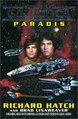
-
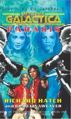 Variant cover with Cassiopeia, Athena, Starbuck and Apollo.

Notes
edit source- The novel explores themes of colonialism, cultural imperialism, and the moral complexities of desperate refugees versus indigenous rights, drawing explicit parallels to the Colonial treatment of the Borellian Nomen.
- The discovery of the Thirteenth Tribe's catastrophic impact on Gamon civilization provides crucial backstory explaining the natives' absolute refusal to allow permanent settlement, despite their initial hospitality.
- Cassie's pregnancy and the mystery surrounding her child's parentage (with Baltar's suggestions about its unique nature) creates ongoing tension throughout the narrative.
- The romantic quadrangle involving Apollo, Cassie, Starbuck, and Athena reaches a temporary resolution with Cassie declining marriage proposals from both Apollo and Starbuck, choosing instead to maintain her independence.
- Sheba's meeting with Rhaya at Cain's grave hints strongly at a family connection, with Rhaya's birthmark and fatherless background suggesting she may be Cain's daughter.
- The novel's title "Paradis" (paradise) proves deeply ironic—what appears as salvation becomes another test of Colonial values and another place they cannot stay.
- Baltar's role shifts from traitor to reluctant teacher and even advisor, with his nightmares serving as prophetic warnings about Cylon pursuit.
- The Gamon's mysterious abilities (telepathy, appearing to die while actually ascending to a "higher dimension," population manifestation) suggest they are far more advanced than their seemingly primitive lifestyle indicates.
- The subplot involving Koren's search for Gamon children and his adopted family dynamics with Apollo and Cassie adds emotional depth to the larger political and military conflicts.
- The novel establishes that Paradis's red giant sun will eventually become a white dwarf within fifty to one hundred thousand yahren, making it ultimately uninhabitable regardless of Colonial intentions.
References
edit sourceExternal Sources
edit source- ↑ 1.0 1.1 1.2 Brad Linaweaver (November 2009). A Man for All Reasons: A Personal Tribute to Richard Hatch (backup available on Archive.org) (in English). Mondo Cult. Retrieved on November 2, 2025.
- ↑ Brad Linaweaver (November 2009). A Man for All Reasons: A Personal Tribute to Richard Hatch (backup available on Archive.org) (in English). Mondo Cult. Retrieved on November 2, 2025.
- ↑ Brad Linaweaver (November 2009). A Man for All Reasons: A Personal Tribute to Richard Hatch (backup available on Archive.org) (in English). Mondo Cult. Retrieved on November 2, 2025.
- ↑ 4.0 4.1 Brad Linaweaver (November 2009). A Man for All Reasons: A Personal Tribute to Richard Hatch (backup available on Archive.org) (in English). Mondo Cult. Retrieved on November 2, 2025.
- ↑ 5.0 5.1 Brad Linaweaver (November 2009). A Man for All Reasons: A Personal Tribute to Richard Hatch (backup available on Archive.org) (in English). Mondo Cult. Retrieved on November 2, 2025.
- ↑ 6.0 6.1 Brad Linaweaver (November 2009). A Man for All Reasons: A Personal Tribute to Richard Hatch (backup available on Archive.org) (in English). Mondo Cult. Retrieved on November 2, 2025.
- ↑ 7.0 7.1 Brad Linaweaver (November 2009). A Man for All Reasons: A Personal Tribute to Richard Hatch (backup available on Archive.org) (in English). Mondo Cult. Retrieved on November 2, 2025.
- ↑ Brad Linaweaver (November 2009). A Man for All Reasons: A Personal Tribute to Richard Hatch (backup available on Archive.org) (in English). Mondo Cult. Retrieved on November 2, 2025.
- ↑ Brad Linaweaver (November 2009). A Man for All Reasons: A Personal Tribute to Richard Hatch (backup available on Archive.org) (in English). Mondo Cult. Retrieved on November 2, 2025.
- ↑ 10.0 10.1 Brad Linaweaver (November 2009). A Man for All Reasons: A Personal Tribute to Richard Hatch (backup available on Archive.org) (in English). Mondo Cult. Retrieved on November 2, 2025.
- ↑ 11.0 11.1 11.2 Brad Linaweaver (November 2009). A Man for All Reasons: A Personal Tribute to Richard Hatch (backup available on Archive.org) (in English). Mondo Cult. Retrieved on November 2, 2025.
- ↑ 12.0 12.1 12.2 Brad Linaweaver (November 2009). A Man for All Reasons: A Personal Tribute to Richard Hatch (backup available on Archive.org) (in English). Mondo Cult. Retrieved on November 2, 2025.
- ↑ Brad Linaweaver (November 2009). A Man for All Reasons: A Personal Tribute to Richard Hatch (backup available on Archive.org) (in English). Mondo Cult. Retrieved on November 2, 2025.
Novel Citations
edit source- ↑ 1.0 1.1 1.2 1.3 Hatch, Richard; Linaweaver, Brad (2004). Paradis. Tor Books, p. 1.
- ↑ 2.0 2.1 2.2 2.3 2.4 2.5 2.6 2.7 Hatch, Richard; Linaweaver, Brad (2004). Paradis. Tor Books, p. 82.
- ↑ 3.0 3.1 3.2 3.3 3.4 Hatch, Richard; Linaweaver, Brad (2004). Paradis. Tor Books, p. 21.
- ↑ 4.0 4.1 4.2 4.3 4.4 Hatch, Richard; Linaweaver, Brad (2004). Paradis. Tor Books, p. 22.
- ↑ 5.0 5.1 5.2 5.3 5.4 Hatch, Richard; Linaweaver, Brad (2004). Paradis. Tor Books, p. 27.
- ↑ 6.0 6.1 6.2 6.3 6.4 Hatch, Richard; Linaweaver, Brad (2004). Paradis. Tor Books, p. 30.
- ↑ 7.0 7.1 7.2 7.3 Hatch, Richard; Linaweaver, Brad (2004). Paradis. Tor Books, p. 34.
- ↑ 8.0 8.1 8.2 8.3 8.4 Hatch, Richard; Linaweaver, Brad (2004). Paradis. Tor Books, p. 35.
- ↑ 9.0 9.1 9.2 Hatch, Richard; Linaweaver, Brad (2004). Paradis. Tor Books, p. 48.
- ↑ 10.0 10.1 10.2 Hatch, Richard; Linaweaver, Brad (2004). Paradis. Tor Books, p. 55.
- ↑ 11.0 11.1 Hatch, Richard; Linaweaver, Brad (2004). Paradis. Tor Books, p. 56.
- ↑ 12.0 12.1 Hatch, Richard; Linaweaver, Brad (2004). Paradis. Tor Books, p. 70.
- ↑ 13.0 13.1 Hatch, Richard; Linaweaver, Brad (2004). Paradis. Tor Books, p. 68.
- ↑ Hatch, Richard; Linaweaver, Brad (2004). Paradis. Tor Books, p. 69.
- ↑ 15.0 15.1 15.2 15.3 Hatch, Richard; Linaweaver, Brad (2004). Paradis. Tor Books, p. 100.
- ↑ 16.0 16.1 16.2 Hatch, Richard; Linaweaver, Brad (2004). Paradis. Tor Books, p. 123.
- ↑ 17.0 17.1 Hatch, Richard; Linaweaver, Brad (2004). Paradis. Tor Books, p. 101.
- ↑ 18.0 18.1 Hatch, Richard; Linaweaver, Brad (2004). Paradis. Tor Books, p. 103.
- ↑ 19.0 19.1 19.2 19.3 Hatch, Richard; Linaweaver, Brad (2004). Paradis. Tor Books, p. 122.
- ↑ 20.0 20.1 Hatch, Richard; Linaweaver, Brad (2004). Paradis. Tor Books, p. 146.
- ↑ 21.0 21.1 21.2 Hatch, Richard; Linaweaver, Brad (2004). Paradis. Tor Books, p. 148.
- ↑ 22.0 22.1 Hatch, Richard; Linaweaver, Brad (2004). Paradis. Tor Books, p. 149.
- ↑ 23.0 23.1 23.2 Hatch, Richard; Linaweaver, Brad (2004). Paradis. Tor Books, p. 150.
- ↑ 24.0 24.1 24.2 Hatch, Richard; Linaweaver, Brad (2004). Paradis. Tor Books, p. 151.
- ↑ 25.00 25.01 25.02 25.03 25.04 25.05 25.06 25.07 25.08 25.09 Hatch, Richard; Linaweaver, Brad (2004). Paradis. Tor Books, p. 157.
- ↑ 26.0 26.1 Hatch, Richard; Linaweaver, Brad (2004). Paradis. Tor Books, p. 158.
- ↑ 27.0 27.1 Hatch, Richard; Linaweaver, Brad (2004). Paradis. Tor Books, p. 128.
- ↑ 28.0 28.1 Hatch, Richard; Linaweaver, Brad (2004). Paradis. Tor Books, p. 129.
- ↑ 29.0 29.1 Hatch, Richard; Linaweaver, Brad (2004). Paradis. Tor Books, p. 192.
- ↑ 30.0 30.1 30.2 30.3 Hatch, Richard; Linaweaver, Brad (2004). Paradis. Tor Books, p. 205.
- ↑ 31.0 31.1 31.2 31.3 31.4 Hatch, Richard; Linaweaver, Brad (2004). Paradis. Tor Books, p. 212.
- ↑ 32.0 32.1 Hatch, Richard; Linaweaver, Brad (2004). Paradis. Tor Books, p. 213.
- ↑ 33.0 33.1 33.2 Hatch, Richard; Linaweaver, Brad (2004). Paradis. Tor Books, p. 207.
- ↑ 34.0 34.1 Hatch, Richard; Linaweaver, Brad (2004). Paradis. Tor Books, p. 208.
- ↑ Hatch, Richard; Linaweaver, Brad (2004). Paradis. Tor Books, p. 235.
- ↑ 36.0 36.1 Hatch, Richard; Linaweaver, Brad (2004). Paradis. Tor Books, p. 236.
- ↑ 37.0 37.1 37.2 Hatch, Richard; Linaweaver, Brad (2004). Paradis. Tor Books, p. 237.
- ↑ 38.0 38.1 38.2 Hatch, Richard; Linaweaver, Brad (2004). Paradis. Tor Books, p. 238.
- ↑ 39.0 39.1 39.2 39.3 39.4 Hatch, Richard; Linaweaver, Brad (2004). Paradis. Tor Books, p. 239.
- ↑ 40.0 40.1 40.2 40.3 40.4 40.5 40.6 40.7 Hatch, Richard; Linaweaver, Brad (2004). Paradis. Tor Books, p. 240.
- ↑ 41.0 41.1 41.2 Hatch, Richard; Linaweaver, Brad (2004). Paradis. Tor Books, p. 241.