


Ancient Kobolian: Galleon
Raptor
From the only original and legitimate Battlestar Wiki: the free-as-in-beer, non-corporate, open-content encyclopedia, analytical reference, and episode guide on all things Battlestar Galactica. Accept neither subpar substitutes nor subpar clones.
More languages
More actions
The Raptor is a vehicle utilized by both the Colonial military and government emergency service operators. A versatile craft, it is designed to perform multiple roles, but the Raptor most commonly takes part in reconnaissance and scouting operations. Three variants of this design are in use by the Colonials since the outbreak of hostilities with the Cylons.
First Cylon War-era Variant
editOverview
edit| Cylon War-era Variant | |||
|---|---|---|---|

| |||
| [show/hide spoilers] Spoilers hidden in infobox by default only. | |||
| Race: | Colonial | ||
| Type: | Military | ||
| FTL: | Unknown | ||
| Propulsion: | * 2x movable sublight engine pods * RCS thrusters | ||
| Crew: | 2 (Pilot and ECO) | ||
| Capacity: | Approximately 5-10 passengers | ||
| CO: | {{{co}}} | ||
| XO: | {{{xo}}} | ||
| Role: | * Reconnaissance and surveillance * Battlefield logistics * Search and Rescue * Transport | ||
| Weapons: | {{{weapons}}} | ||
| Armaments: | * Ship to ship missiles * Rear "Toaster Slayer" automatic cannon | ||
| Defenses: | * Electronic countermeasures | ||
| Aircraft: | {{{aircraft}}} | ||
| Aviation facilities: | {{{facilities}}} | ||
| Emblem: | [[File:{{{patch}}}|175px|Ship's patch]] | ||
| Other Images: | Gallery | ||
| Length: | {{{length}}} | ||
| Width: | {{{width}}} | ||
| Height: | {{{height}}} | ||
| Weight: | {{{weight}}} | ||
| Wingspan: | {{{wingspan}}} | ||
| Other: | {{{otherdi}}} | ||
| Cost: | {{{construction}}} | ||
| Construction Time: | {{{construction}}} | ||
| Hull Size: | {{{hull size}}} | ||
| Hull: | {{{hull}}} | ||
| FTL Cooldown: | {{{ftl cooldown}}} turns | ||
| Speed: | {{{speed}}} m/s | ||
| Turn Rate: | {{{turn rate}}}°/turn | ||
| Armor Total: | {{{armor total}}} | ||
| Armor Left: | {{{armor left}}} | ||
| Armor Right: | {{{armor right}}} | ||
| Armor Front: | {{{armor front}}} | ||
| Armor Rear: | {{{armor rear}}} | ||
| Armor Top: | {{{armor top}}} | ||
| Armor Bottom: | {{{armor bottom}}} | ||
| DRADIS Range: | {{{dradis range}}} m | ||
| Processing Power: | {{{processing power}}} | ||
| Munition Slots: | {{{munitions}}} | ||
| Munition Cooldown Period: | {{{munition cooldown}}} turns | ||
| Squadron Slots: | {{{squadrons}}} | ||
| Squadron Size: | {{{squadron size}}} | ||
| Special Abilities: | {{{special abilities}}} | ||
| Additional Information | |||
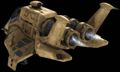
The First Cylon War-era Raptor (nicknamed "flying pillboxes" or "buses") is little changed from its later counterpart, but features a longer cabin with an aft-facing gun emplacement. This design also relies on the main sublight engines for maneuvering.
This design was considered by the Colonials to generally be slow, and an easy target for Cylon forces to attack and destroy. However, it was not impossible to eliminate enemy targets while flying one.
The Raptors of this type are eventually replaced by their modern counterparts (TRS: "Razor Flashbacks").
FTL Operations
editIt is not known if this design commonly carries FTL drives, like their later counterparts do. Ten years into the War, circa 42 BCH (58YR), Raptor 909 does not carry one, however, a statement by Galactica CO Silas Nash suggests that the Colonials do utilize smaller FTL capable ships. It is possible that the FTL drive and related components were removed in order to enlarge the cabin, and to accommodate the "Toaster Slayer" aft-mounted cannon.
Life Support
editThe main flight deck / cabin of a Raptor is fully pressurized. However, crews operate in flight suits and helmets to help protect them against any hull breach. The cabin can also be depressurized and used in space rescue operations.
Propulsion
edit- 2x rotating sublight engine pods mounted aft.
- RCS points
Armament
editRaptors of this era are more commonly armed that the later design. This design can be outfitted with mission specific ship to ship missiles, incorporates a rear cannon, and is equipped with electronic countermeasures for defense (TRS: "Blood and Chrome").
Gallery
edit-
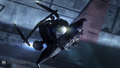 Cylon war era generation Raptor. Its sublight drives are configured differently.
 -
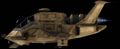
 Engine pods and rear view bubble.
 -
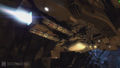 "Toaster Slayer".
Modern Raptor
editOverview
edit| Modern Raptor | |||
|---|---|---|---|

| |||
| [show/hide spoilers] Spoilers hidden in infobox by default only. | |||
| Race: | Colonial | ||
| Type: | Military | ||
| FTL: | Yes (short range) | ||
| Propulsion: | * 2x fixed sublight engines | ||
| Crew: | 2 (Pilot and ECO) | ||
| Capacity: | Approximately 5-10 passengers | ||
| CO: | {{{co}}} | ||
| XO: | {{{xo}}} | ||
| Role: | * Reconnaissance and surveillance * Battlefield logistics * Search and Rescue * Transport | ||
| Weapons: | {{{weapons}}} | ||
| Armaments: | * 2x automatic cannons * 8x Ship to ship missiles * 2x rocket pods * 2x missile based CIWS pods * Communication drones | ||
| Defenses: | * Electronic countermeasures * Decoy drones | ||
| Aircraft: | {{{aircraft}}} | ||
| Aviation facilities: | {{{facilities}}} | ||
| Emblem: | [[File:{{{patch}}}|175px|Ship's patch]] | ||
| Other Images: | Gallery | ||
| Length: | 28 feet (8.6m) | ||
| Width: | {{{width}}} | ||
| Height: | 9.5 feet (2.9m) | ||
| Weight: | 50 tons [1] | ||
| Wingspan: | 18.34 feet (5.6m) | ||
| Other: | {{{otherdi}}} | ||
| Cost: | {{{construction}}} | ||
| Construction Time: | {{{construction}}} | ||
| Hull Size: | {{{hull size}}} | ||
| Hull: | {{{hull}}} | ||
| FTL Cooldown: | {{{ftl cooldown}}} turns | ||
| Speed: | {{{speed}}} m/s | ||
| Turn Rate: | {{{turn rate}}}°/turn | ||
| Armor Total: | {{{armor total}}} | ||
| Armor Left: | {{{armor left}}} | ||
| Armor Right: | {{{armor right}}} | ||
| Armor Front: | {{{armor front}}} | ||
| Armor Rear: | {{{armor rear}}} | ||
| Armor Top: | {{{armor top}}} | ||
| Armor Bottom: | {{{armor bottom}}} | ||
| DRADIS Range: | {{{dradis range}}} m | ||
| Processing Power: | {{{processing power}}} | ||
| Munition Slots: | {{{munitions}}} | ||
| Munition Cooldown Period: | {{{munition cooldown}}} turns | ||
| Squadron Slots: | {{{squadrons}}} | ||
| Squadron Size: | {{{squadron size}}} | ||
| Special Abilities: | {{{special abilities}}} | ||
| Additional Information | |||
The Raptor is usually operated by a crew of two (one pilot and one ECO), has synthetic gravity on board, and is controlled by means of a fly-by-wire system (TRS: "Rapture"). It is capable of atmospheric flight and is also equipped with a short-range FTL engine, allowing it to make short faster-than-light hops. The vehicle has been a mainstay of the Colonial fleet for over 40 years, having entered service sometime prior to the twelfth year, 40 BCH (60YR), of the first Cylon War (TRS: "Razor Flashbacks," Episode 3). Its versatility and reliability in various roles has likely prevented it from being phased out by newer Colonial craft.
As a scout, Raptors can:
- Undertake short and medium-range scans to detect electromagnetic, heat or other signatures from other vessels.
- Scan planetary surfaces for signs of life, energy output, or to locate and assess mineral deposits (TRS: "Water" and "The Hand of God").
- Scout ahead of its parent warship in other planetary or celestial systems for any signs of hostile intent or stellar conditions prior to the parent ship's arrival (TRS: "Miniseries").
- Undertake search & rescue operations after an engagement with Cylon forces.
When scouting, Raptors can operate independently, or in concert with other Raptors and Vipers (TRS: "The Hand of God").
As an ECM platform, the Raptor contains a full suite of electronic countermeasure and monitoring tools, enabling it to:
- Jam wireless or relay transmissions (by wireless or optically) from other spacecraft (TRS: "Miniseries" and "33").
- Scramble control signals used by guided weapons (TRS: "Miniseries").
- Undertake IFF operations for Viper squadrons (TRS: "Miniseries").
In addition to reconnaissance and scouting, the Raptor can also undertake the following roles:
- Airborne warning & control and electronic countermeasures platform supporting Viper operations (TRS: "Miniseries" and "33")
- Marine assault craft (TRS: "Bastille Day", "Kobol's Last Gleaming, Part II", "Pegasus", "Lay Down Your Burdens, Part I" and "Daybreak, Part II")
- Ambulance / evac vehicle (TRS: "Miniseries" and "The Plan")(
- General purpose transport (TRS: "Flesh and Bone", "Tigh Me Up, Tigh Me Down" and "Home, Part II")
- Combat Search and Rescue (TRS: "Fragged" and "Resurrection Ship, Part II")
- Secure communication with other vessels (TRS: "33")
- Launching decoy drones (TRS: "Exodus, Part II")
- Combat assault vehicle (TRS: "A Measure of Salvation" and "Crossroads, Part II")
In the transport role, a Raptor is capable of carrying around eight to ten adults in addition to the two-person crew. In the assault role, it can carry a squad of some eight equipped Marines (TRS: "Bastille Day").
Atmospheric Operations
editThe Raptor is designed for atmospheric as well as space-based operations. However, a critical element for atmospheric operations is that to remain airborne requires fuel: once in an atmosphere, the engines must be run constantly to maintain lift and to hover. Depending on the composition of the atmosphere itself, this can place severe strain on the Raptor's engines (TRS: "You Can't Go Home Again").
Due to their overall configuration and bulk, Raptors may also suffer from poor handling at low speeds, and rely heavily on directed thrust to remain airborne.
FTL Operations
editRaptors are fitted with small, general purpose FTL drives, but unlike larger drives on capital ships, they seem to be limited to ten to twenty FTL jumps, depending in part on the amount of tylium fuel being carried. A Raptor can also be outfitted with a Heavy Raider's navigational computer that, when operated by a Cylon, can be used to calculate and safely make longer jumps than normal (TRS: "Lay Down Your Burdens, Part I").
After allying with the Cylon rebels, Galactica's Raptors were updated with Cylon FTL drives to enhance their jump range (TRS: "Daybreak, Part I")
Life Support
editThe main flight deck / cabin of a Raptor is fully pressurized. However, crews operate in flight suits and helmets to help protect them against any hull breach (TRS: "Miniseries"). The cabin can also be depressurized and used in space rescue operations. Re-pressurization takes 10 seconds (TRS: "You Can't Go Home Again" and "A Day in the Life"). The forward pilot and co-pilot seats can eject in an emergency as the forward canopy is blown away prior to the ejection (TRS: "Dirty Hands").
Propulsion
editArmament
edit
Offensive
editRaptors are normally unarmed as they make for a poor general-purpose fighter. The craft have an internal weapons bay capable of holding both offensive and defensive weapons. They are also capable of carrying heavy external armaments on four wing hardpoints, two wingtip hardpoints, and two fuselage hardpoints on the sides of the Raptor's body. Known weapons carried include:
- nuclear missiles
- bombs/munitions pods
- quad racks of missiles
- multiple-tube rocket batteries mounted on the fuselage points
- dual Kinetic Energy Weapons
Defensive
edit
The Raptor's contours reduce its DRADIS signature to avoid detection. In addition, the craft carries an assortment of pods to aid in communications or defense as well as electronic countermeasures such as a jigger.[2]
- Up to 6 decoy drones
- Up to 4 communication drones
- Up to 4 sets of flares
- Up to 4 chaff pods
Layout
edit
The Raptor is an angular vehicle built for function, not aesthetics. The forward section consists of a flight cabin with side-by-side ejection seats for the pilot and ECO, with a large bubble canopy providing wide fields of view both forward and side. The flight cabin opens into the main compartment where a workstation containing early warning, electronic countermeasures, and other equipment is manned by the ECO when not co-piloting the craft. The main compartment features a few fold-out jump seats attached to the bulkhead, and stowage for repair kits, medical supplies, and emergency pressure seals to deal with small hull breaches from the interior (TRS: "Miniseries").

Access to the Raptor's main compartment is primarily through a large port-side hydraulic door, and a floor-mounted hatchway provides access through the deck. A pressurized docking skirt can also be extended from the underside, enabling the Raptor to dock to the hulls of other vessels. In assault missions, marines can use this skirt to breech a hull and board a hostile vessel (TRS: "Bastille Day" and "Daybreak, Part II").
Aft of the pressurized area are the FTL drive and main sublight engines. Port and starboard stub wings provide additional lift during atmospheric flight, and winglets reduce drag and provide step access to the wings and hull. RCS thrusters are placed throughout the craft for landing, maneuvering and stabilization (TRS: "Miniseries").
Gallery
editInternal Compartments
edit-

-
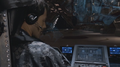 Lee "Apollo" Adama at the pilot's station (TRS: "Home, Part II").
External Views
edit-
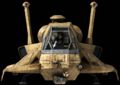
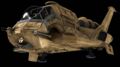 Zoic CGI model.
 -
 Zoic CGI model.
 -
 Zoic CGI model.
 -
 Zoic CGI model.
Civilian Variant
editSearch and Rescue Raptor
edit| EVAC Raptor | |||
|---|---|---|---|

| |||
| [show/hide spoilers] Spoilers hidden in infobox by default only. | |||
| Race: | Colonial | ||
| Type: | Civilian | ||
| FTL: | Unknown | ||
| Propulsion: | |||
| Crew: | 2 | ||
| Capacity: | Approximately 5-10 passengers | ||
| CO: | {{{co}}} | ||
| XO: | {{{xo}}} | ||
| Role: | VTO/L Transport | ||
| Weapons: | {{{weapons}}} | ||
| Armaments: | {{{arm}}} | ||
| Defenses: | {{{def}}} | ||
| Aircraft: | {{{aircraft}}} | ||
| Aviation facilities: | {{{facilities}}} | ||
| Emblem: | [[File:{{{patch}}}|175px|Ship's patch]] | ||
| Other Images: | Gallery | ||
| Length: | {{{length}}} | ||
| Width: | {{{width}}} | ||
| Height: | {{{height}}} | ||
| Weight: | {{{weight}}} | ||
| Wingspan: | {{{wingspan}}} | ||
| Other: | {{{otherdi}}} | ||
| Cost: | {{{construction}}} | ||
| Construction Time: | {{{construction}}} | ||
| Hull Size: | {{{hull size}}} | ||
| Hull: | {{{hull}}} | ||
| FTL Cooldown: | {{{ftl cooldown}}} turns | ||
| Speed: | {{{speed}}} m/s | ||
| Turn Rate: | {{{turn rate}}}°/turn | ||
| Armor Total: | {{{armor total}}} | ||
| Armor Left: | {{{armor left}}} | ||
| Armor Right: | {{{armor right}}} | ||
| Armor Front: | {{{armor front}}} | ||
| Armor Rear: | {{{armor rear}}} | ||
| Armor Top: | {{{armor top}}} | ||
| Armor Bottom: | {{{armor bottom}}} | ||
| DRADIS Range: | {{{dradis range}}} m | ||
| Processing Power: | {{{processing power}}} | ||
| Munition Slots: | {{{munitions}}} | ||
| Munition Cooldown Period: | {{{munition cooldown}}} turns | ||
| Squadron Slots: | {{{squadrons}}} | ||
| Squadron Size: | {{{squadron size}}} | ||
| Special Abilities: | {{{special abilities}}} | ||
| Additional Information | |||
A civilian "Search and Rescue" Raptor is utilized by medical facilities to airlift patients to nearby hospitals. These craft were used after the renewed Cylon attacks to evacuate injured persons from the rubble of targeted cities. After the attacks on Picon, John Cavil took an injured Ellen Tigh to one of these Raptors, which made its way to Rising Star before escaping with Galactica at Ragnar. These craft have a red/white paint scheme which differentiates them with their military counterparts.
It is presumed that the remaining fleet is destroyed or captured by Cylon forces during their occupation of the Colonies (TRS: "The Plan").
Alternate Variants
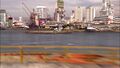
editAlternate Raptors with different color schemes are in use up to the Fall of the Twelve Colonies. One such Raptor can be found in a floating dock off the coast of Picon, near the Club Pink Moon that Ellen Tigh frequents before the Fall, with a two-tone green and white paint scheme (TRS: "The Plan").
-
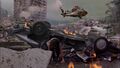 On Caprica, a bloodied Tory Foster leaves the wreck of her car as an evacuation Raptor makes its landing nearby (TRS: "The Plan").
 -
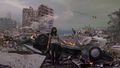 Tory Foster leaves her wrecked car as civilian search and rescue Raptors recover survivors during the Fall of the Twelve Colonies (TRS: "The Plan").
 -
 After Picon is bombarded during the Fall of the Twelve Colonies, John Cavil watches as an injured Ellen Tigh is brought aboard an evacuation Raptor (TRS: "The Plan").
 -
Notes
edit- "Raptor" is a Latin word meaning bird of prey.
- The design of the Raptor originally began as this sketch. "Sketches like this are great for selling a concept," explains production designer Richard Hudolin. "The Raptor is derived from an Apache helicopter and we wanted to give it a retro feel, a nuts-and-bolts look, to give the impression that in its time it was the best of the best, but now its time is almost over."
- The design of the Raptor was based on the US Army's Apache helicopter. Ronald D. Moore thinks of it "as analogous to the Navy's EA-6 Prowler (a variant of the A-6 Intruder popularized in Flight of the Intruder)."[3]
- The joystick seen inside of the Raptor appears to be a Logitech Attack 3.
- The usage of Raptors in both military and civilian applications suggests that the Raptor, which has seen service for over 50 years dating back to the First Cylon War, has entered civilian life in the aftermath of the Armistice.
Making the Raptor fly
edit
Richard Hudolin explains: "The Raptor is made out of foam on a steel frame. We built it so that we could have people safely in there as a 100ft crane picks it up and swings it around. The actors were a little bit surprised: 'Oh, my God, it goes up that high!'"
It's custom-built and then it's painted. We have painters who are literally standing by on the day to add to it before the camera rolls [the wires are removed digitally later in post production]."
"The actors are rehearsing and we have people aging [the Raptor], adding the gunshot hits. One day we had to paint it up as if it had crashed and been on fire - the next day it had to be made pristine again." [4]
See Also
editReferences
edit- ↑ In the Miniseries, Sharon Valerii tells Chief Tyrol "You're not the one out there trying to bring 50 tons of Raptor onto a moving hangar deck". However, given the relatively small size of the craft, this figure seems unrealistically high. In comparison, large military helicopters like the Mi-24 Hind or the CH-53 Sea Stallion weigh approximately 10-15 metric tons.
- ↑ A close-up of a Raptor display in the Miniseries (timestamp 57 m 41 sec) shows the name and number of these items.
- ↑ RDM Battlestar Blog (backup available on Archive.org) (in English). Retrieved on 18 April 2006.
- ↑ (October 2004) "Making the Raptor fly". Radio Times.