
Redemption: Difference between revisions

More actions
mNo edit summary |
No edit summary |
||
| (One intermediate revision by the same user not shown) | |||
| Line 9: | Line 9: | ||
| published= October 10, 2005 | | published= October 10, 2005 | ||
| isbn=1596871199 | | isbn=1596871199 | ||
| prev= ''[[Destiny]]'' | | prev= ''[[Destiny (book)|Destiny]]'' | ||
| next= ''[[Discovery]]'' | | next= ''[[Discovery]]'' | ||
}} | }} | ||
| Line 179: | Line 179: | ||
Image:Redemption UK cover.jpg|United Kingdom cover art | Image:Redemption UK cover.jpg|United Kingdom cover art | ||
</gallery> | </gallery> | ||
== Behind the Scenes == | |||
=== Development and Writing Process === | |||
''Redemption'' represented the most personal exploration of Apollo's character across the three novels co-written by [[Richard Hatch]] and Brad Linaweaver.<ref name="linaweaver_mondocult_hatch_writing" group="external">{{cite web|url=http://www.mondocult.com/articles/Linaweaver/Hatch/hatch.html#:~:text=Redemption%20did%20the%20trick|title=A Man for All Reasons: A Personal Tribute to Richard Hatch|author=Brad Linaweaver|publisher=Mondo Cult|date=November 2009|accessdate=November 2, 2025}}</ref> The novel raised questions about leadership, sacrifice, and mortality that were never fully answered due to the series' premature conclusion. Hatch and Linaweaver had planned these themes to carry forward into the unfinished Magellan project, which would have explored similar concerns about command responsibility and personal cost.<ref name="linaweaver_mondocult_hatch_writing" group="external" /> | |||
The collaborative method established across ''[[Paradis (TOS-RH)|Paradis]]'', ''[[Destiny (book)|Destiny]]'', and ''Redemption'' involved Hatch providing extensive master outlines while Linaweaver contributed deeper character development, enriched dialogue, and narrative flow.<ref name="linaweaver_mondocult_hatch_writing" group="external" /> According to Linaweaver, the partnership worked because Hatch excelled at constructing elaborate plots while Linaweaver focused on bringing emotional depth and thematic complexity to the characters.<ref name="linaweaver_mondocult_hatch_writing" group="external" /> | |||
=== Publication and Reception === | |||
Published by ibooks and distributed by Simon & Schuster, ''Redemption'' faced the same production issues that plagued the earlier novels in the series. The publisher never allowed Hatch to review galleys before publication, resulting in copy editing and proofreading errors that fans correctly attributed to the publisher rather than the authors.<ref group="external" name="linaweaver_mondocult_hatch_galacticon">{{cite web|url=http://www.mondocult.com/articles/Linaweaver/Hatch/hatch.html#:~:text=ibooks%20never%20let%20Richard%20see%20the%20galleys|title=A Man for All Reasons: A Personal Tribute to Richard Hatch|author=Brad Linaweaver|publisher=Mondo Cult|date=November 2009|accessdate=November 2, 2025}}</ref> Hatch openly shared this information with fans at conventions, demonstrating his commitment to transparency about the publishing process.<ref group="external" name="linaweaver_mondocult_hatch_galacticon" /> | |||
Despite these production challenges, Linaweaver believed ''Redemption'' may have been among the most popular novels in the entire Hatch series, alongside ''Destiny''.<ref group="external" name="linaweaver_mondocult_hatch_destiny_popular">{{cite web|url=http://www.mondocult.com/articles/Linaweaver/Hatch/hatch.html#:~:text=Had%20the%20impression%20that%20this%20novel%20was%20not%20only%20the%20most%20popular|title=A Man for All Reasons: A Personal Tribute to Richard Hatch|author=Brad Linaweaver|publisher=Mondo Cult|date=November 2009|accessdate=November 2, 2025}}</ref> The novel's exploration of Apollo's vulnerability and willingness to sacrifice himself resonated strongly with readers familiar with Hatch's portrayal of the character across both the original series and his continuation novels. | |||
=== Intended Two-Part Structure === | |||
Hatch wrote books seven and eight as a unified two-part story, with ''Redemption'' deliberately ending on a cliffhanger.<ref group="external" name="linaweaver_mondocult_hatch_unpublished">{{cite web|url=http://www.mondocult.com/articles/Linaweaver/Hatch/hatch.html#:~:text=We%20had%20planned%20a%20fourth%20novel|title=A Man for All Reasons: A Personal Tribute to Richard Hatch|author=Brad Linaweaver|publisher=Mondo Cult|date=November 2009|accessdate=November 2, 2025}}</ref> Legal disputes over publishing rights resulted in the rights being lost before the eighth book could be published. According to Linaweaver, Hatch completed the manuscript for the eighth novel, and the two authors had hoped Universal would eventually allow continuation of the series after the Re-imagined Series concluded.<ref group="external" name="linaweaver_mondocult_hatch_unpublished" /> However, when the [[Re-imagined Series]] came to fruition with Hatch cast as [[Tom Zarek]], Universal pulled the plug on the novel series entirely.<ref group="external" name="linaweaver_mondocult_hatch_zarek">{{cite web|url=http://www.mondocult.com/articles/Linaweaver/Hatch/hatch.html#:~:text=Richard%20returned%20to%20the%20series%20as%20a%20new%20character%2C%20Tom%20Zarek|title=A Man for All Reasons: A Personal Tribute to Richard Hatch|author=Brad Linaweaver|publisher=Mondo Cult|date=November 2009|accessdate=November 2, 2025}}</ref> | |||
=== Connection to Larger Projects === | |||
The questions raised in ''Redemption'' about leadership, sacrifice, and the psychological cost of command were themes Hatch intended to explore further in ''The Great War of Magellan'', his ambitious multimedia project.<ref group="external" name="linaweaver_mondocult_hatch_magellan">{{cite web|url=http://www.mondocult.com/articles/Linaweaver/Hatch/hatch.html#:~:text=He%20was%20developing%20a%20multi%2Dmedia%20DVD%20comic|title=A Man for All Reasons: A Personal Tribute to Richard Hatch|author=Brad Linaweaver|publisher=Mondo Cult|date=November 2009|accessdate=November 2, 2025}}</ref> Hatch asked Linaweaver to co-write the ''Magellan'' novels using the same collaborative method they had developed for the ''Battlestar Galactica'' series.<ref group="external" name="linaweaver_mondocult_hatch_magellan" /> The authors completed one-third of the first Magellan novel before Hatch's death from pancreatic cancer on February 7, 2017, left the project unfinished and its rights in legal limbo.<ref group="external" name="linaweaver_mondocult_hatch_death">{{cite web|url=http://www.mondocult.com/articles/Linaweaver/Hatch/hatch.html#:~:text=Richard%20Lawrence%20Hatch%20was%20born%20during%20World%20War%20II|title=A Man for All Reasons: A Personal Tribute to Richard Hatch|author=Brad Linaweaver|publisher=Mondo Cult|date=November 2009|accessdate=November 2, 2025}}</ref> | |||
== Notes == | == Notes == | ||
* According to [[Richard Hatch]], ''Redemption'' was not intended as the final book in the series. Hatch wrote books seven and eight as a two-part story, with ''Redemption'' ending on a deliberate cliffhanger. Legal disputes over publishing rights resulted in the rights being lost before book eight could be published. | * According to [[Richard Hatch]], ''Redemption'' was not intended as the final book in the series. Hatch wrote books seven and eight as a two-part story, with ''Redemption'' ending on a deliberate cliffhanger.<ref group="external" name="linaweaver_mondocult_hatch_unpublished" /> Legal disputes over publishing rights resulted in the rights being lost before book eight could be published. Hatch completed the manuscript for the eighth novel, but whether it will ever see publication remains unknown.<ref group="external" name="linaweaver_mondocult_hatch_unpublished" /> | ||
* The novel's title operates on multiple levels: Baltar's redemption through posthumous service, humanity's redemption from the plague through sacrifice and cooperation, and the potential redemption (or damnation) represented by Cassiopeia's son and his ambiguous destiny. | * The novel's title operates on multiple levels: Baltar's redemption through posthumous service, humanity's redemption from the plague through sacrifice and cooperation, and the potential redemption (or damnation) represented by Cassiopeia's son and his ambiguous destiny. | ||
* Baltar's spectral appearances represent a significant evolution of his character arc across the series. Having achieved genuine remorse and sacrificial death in ''[[Destiny ( | * Baltar's spectral appearances represent a significant evolution of his character arc across the series. Having achieved genuine remorse and sacrificial death in ''[[Destiny (book)|Destiny]]'', he continues his journey of atonement from beyond the grave, actively working to save the colonials he once betrayed. According to co-author Brad Linaweaver, [[Richard Hatch]] informed him that no one had written Baltar as effectively as Linaweaver, including every writer on the original television series.<ref group="external" name="linaweaver_mondocult_hatch_baltar">{{cite web|url=http://www.mondocult.com/articles/Linaweaver/Hatch/hatch.html#:~:text=Richard%20happily%20informed%20me%20that%20no%20one%20did%20Baltar|title=A Man for All Reasons: A Personal Tribute to Richard Hatch|author=Brad Linaweaver|publisher=Mondo Cult|date=November 2009|accessdate=November 2, 2025}}</ref> Linaweaver's approach focused on getting inside the head of the series' human villain, portraying Baltar as individualistic evil in contrast to the Cylons' collectivistic evil.<ref group="external" name="linaweaver_mondocult_hatch_baltar_individualistic">{{cite web|url=http://www.mondocult.com/articles/Linaweaver/Hatch/hatch.html#:~:text=Baltar%20is%20individualistic%20evil|title=A Man for All Reasons: A Personal Tribute to Richard Hatch|author=Brad Linaweaver|publisher=Mondo Cult|date=November 2009|accessdate=November 2, 2025}}</ref> | ||
* The plague storyline creates deliberate parallels to the | * The plague storyline creates deliberate parallels to the [[The Living Legend, Part I|original discovery of Commander Cain]]—both instances where hope of salvation brings instead a more complex and dangerous reality requiring difficult choices and sacrifices. | ||
* Gar'Tokk's death and resurrection through Borellian Noman spiritual practices expands the series' exploration of diverse human evolutionary paths and religious traditions within the colonial survivor community. | * Gar'Tokk's death and resurrection through Borellian Noman spiritual practices expands the series' exploration of diverse human evolutionary paths and religious traditions within the colonial survivor community. | ||
| Line 196: | Line 217: | ||
* The epilogue's reference to Baltar and Iblis nearly colliding on the astral plane suggests ongoing cosmic conflicts beyond the physical realm, with implications for the unpublished eighth novel's planned storyline. | * The epilogue's reference to Baltar and Iblis nearly colliding on the astral plane suggests ongoing cosmic conflicts beyond the physical realm, with implications for the unpublished eighth novel's planned storyline. | ||
* Apollo's willingness to be the first to receive the untested cure mirrors his father Adama's leadership style—leading through personal example and shared sacrifice rather than commanding from safety. | * Apollo's willingness to be the first to receive the untested cure mirrors his father Adama's leadership style—leading through personal example and shared sacrifice rather than commanding from safety. This exploration of Apollo's character represented the most personal of the three Hatch-Linaweaver collaborations, raising questions about leadership and sacrifice that would have continued into subsequent novels.<ref group="external" name="linaweaver_mondocult_hatch_writing" /> | ||
* The cure's location aboard a Cylon basestar in Iblis's experimental archives creates a thematic connection between the series' three major antagonistic forces: the Cylons as military threat, Iblis as spiritual/existential threat, and disease as an impersonal but equally deadly threat. | * The cure's location aboard a Cylon basestar in Iblis's experimental archives creates a thematic connection between the series' three major antagonistic forces: the Cylons as military threat, Iblis as spiritual/existential threat, and disease as an impersonal but equally deadly threat. | ||
| Line 202: | Line 223: | ||
== References == | == References == | ||
=== External Sources === | |||
{{reflist|group=external}} | |||
=== Novel Citations === | |||
<references /> | <references /> | ||
Latest revision as of 05:04, 3 November 2025
| |||||


| ||
| Redemption A book of the Richard Hatch line | ||
|---|---|---|
| Book No. | 7 | |
| Author(s) | Richard Hatch and Brad Linaweaver | |
| Adaptation of | ||
| No. of Pages | {{{pages}}} | |
| Published | October 10, 2005 | |
| ISBN | 1596871199 | |
| Chronology | ||
| Previous | Next | |
| Destiny | Redemption | Discovery |
| Paperback Version | ||
| Available at Amazon.com – Purchase | ||
| Available at Amazon.co.uk – Purchase | ||
| Audiobook Version | ||
| Available at iTunes – [{{{itunes}}} Purchase] | ||
Redemption is the seventh and final published novel in Richard Hatch's continuation of the Original Series. The novel confronts Apollo's leadership with an existential crisis when survivors of the Thirteenth Tribe bring not salvation but a deadly plague that threatens to annihilate the Fleet. As death spreads through the colonial ships, the narrative examines themes of sacrifice, the price of knowledge, and redemption through the parallel journeys of Apollo facing mortality and Baltar achieving transcendence beyond death. The novel concludes with a cliffhanger ending, originally intended as the first half of a two-part story that remains unpublished.
Plot
edit sourcePrologue
edit sourceThe novel opens with Cassiopeia holding her five-year-old son, whose dark eyes fill her with inexplicable dread. The boy exhibits unnerving precision in his movements and speaks with an oddly formal voice that lacks the spontaneity of childhood. He does not smile when he hugs her, performing the gesture with mechanical perfection.[1]
Cassie's fears stem from her suspicion that the child may be the son of Count Iblis rather than Apollo. Her maternal instincts war against premonitions of catastrophe as she contemplates what threat her own flesh and blood might pose to the Fleet. The prologue establishes Cassie's emotional isolation and the burden of terrible knowledge she carries alone, setting the stage for the novel's exploration of parenthood, destiny, and impossible choices.[1]
Chapter 1
edit sourceApollo asks Sheba how it feels to breathe again following their near-death experience in the Paradis system. She responds that she was ready to die with him, but it's more fun to live with him. The two share an intimate moment, with Sheba pressing her hand against Apollo's cheek and feeling the warmth always there for her.[2]
The Fleet has discovered an ancient space ark drifting in deep space, representing their greatest find since leaving the Twelve Colonies. The vessel offers potential answers to questions that have driven their journey for three decades, particularly regarding the Thirteenth Tribe's journey to Earth.[2]
Chapter 2
edit sourceStarbuck is furious. He had finally made peace with his gods and accepted that the colonials couldn't cheat death forever, yet Apollo's implacable hope keeps defying the inevitable. Starbuck resents being ordered to leave with the main Fleet while Apollo stayed behind in the Paradis system for what should have been a final stand.[3]
During the hyperspace journey, Starbuck broods over being separated from the fighting and the grim certainty that Apollo and other close friends must be dead by now. He contemplates his unresolved personal problems, particularly concerning Cassie and her strange child. Hyperspace offers nothing for a Viper pilot's skills, leaving Starbuck too depressed even to get properly drunk.[4]
Chapter 3
edit sourceTroy asks Gar'Tokk how he can become a warrior like the Borellian Noman. Gar'Tokk, standing with Troy and his girlfriend Caran, recognizes that the young man's maturity doesn't necessarily provide fertile ground for the transformation he seeks. The Noman questions whether being a warrior in the tradition of Troy's forefathers isn't sufficient.[5]
Chapter 4
edit sourceSheba reflects that she's glad she stayed behind in the Paradis system with Apollo's gallant few. She imagines her father, Commander Cain, would have approved her choice to take a final stand against the seemingly invincible Cylon armada. A last gesture of defiance against the enemy was an admirable way to exit the universe—a trait her father demonstrated repeatedly until his luck finally ran out.[6]
Despite facing odds of a thousand to one and running out of air, Apollo's genius for survival—a trait he shared with his father Adama—kept them alive. Sheba normally doesn't allow herself to believe in miracles, but Apollo has a way of making them happen.[7]
Chapter 5
edit sourceImperious Leader retains his title despite recent setbacks, insisting his handful of followers address him appropriately. So long as he commands even a small force, there remains the possibility of one more campaign. The Cylon leader understands that the new reptilian Cylon leader must consider himself master of all he surveys after victory in the Cylon civil war.[8]
Imperious Leader experiences something close to satisfaction when learning that the new Cylon expeditionary force met defeat in the Paradis system through an explosion caused by none other than Baltar. The old Cylon discovers he shares an unexpected quality with Apollo: they both miss Baltar, who possessed a unique flair for sizing up problems and sharing insights with anyone willing to listen.[9]
Chapter 6
edit sourceWaiting remains the hard part in any battle, whether in outer space behind the controls of a Viper or crouched in a long corridor holding one's breath. Apollo knows all about waiting, having fought so many battles and killed so many enemies that part of him is numb forever. Meditation provides a lifeline to sanity, bringing meaning to both life and death.[10]
Chapter 7
edit sourceBoomer reports to Apollo that they've found a Cylon weapons cache with the guards dead and some weapons still functional. The bad news: approximately ten Cylons have mustered in front of the lab they need to access. Apollo questions why the Cylons would leave weapons unguarded, and Boomer explains that accessing Cylon order files revealed they believed the weapons room had been compromised and its contents sucked into space.[11]
Chapter 8
edit sourceKoren finds Caran in her favorite observation deck after an argument. She always chooses the same location, with a splendid view of the cloud of debris that once was Paradis. Although larger planetary fragments occupy the same orbit as asteroids, the dust cloud provides a large and constant reminder of the once-living planet.[12]
Koren apologizes, and Caran responds that she's never known a boy who can make her angry so fast but then apologize so sweetly. The increasing frequency of their fights stems from the greater dangers they face aboard the ark.[12]
Chapter 9
edit sourceAthena struggles with a report from Tigh informing her that the Fleet might run out of food before reaching the new star system. Every time she makes a promise to herself, the universe conspires to force her to break it. Back when they reached Paradis, she vowed that her people would never go hungry again.[13]
Chapter 10
edit sourceRhaya observes that she won't be the youngest warrior any longer. Bojay agrees, expressing disbelief at how young the new recruits are—total innocents who know nothing. Dalton joins the conversation, noting that they have no choice about recruiting such young warriors.[14]
The three reflect on how much they've changed since Paradis, where Rhaya and Dalton started off on the wrong foot. They've been through too much together not to have been changed for the better.[15]
Chapter 11
edit sourceBoomer and Sheba discover what appear to be bodies in hidden containers aboard the ark. Sheba suggests letting Apollo sleep for a few more centons before informing him, noting the bodies have been there for what could be thousands of yahren. They decide it's a job for the medical staff, and Sheba promises they'll report the discovery to Apollo together, since they never would have found the hidden compartment without Boomer's diligence.[16]
Walking through the neat, antiseptic rows, Sheba observes that some bodies display vibrant flesh tones while others show gray pallor offering little hope of regeneration. At the end of the rows stands a solitary cryonic chamber containing a single body in perfect condition.[17]
Chapter 12
edit sourceAthena misses Apollo intensely. She could share things with him in ways impossible with anyone else, even Tigh. At long last, she's beginning to understand the burden both Apollo and their father carried for such a long time. Life had been easier when she only worried about Daedulus. Taking the captain's chair aboard Galactica means responsibility for the entire Fleet.[18]
Chapter 13
edit sourceApollo and Sheba discuss plans for reviving the suspended animation subjects. Sheba asks which ones they'll bring back, and Apollo responds: "The ones we can." They must try to revive everyone with vital life signs once they determine how the system works. Successfully reviving even one subject would be a miracle, offering the opportunity to speak directly with a member of the legendary Thirteenth Tribe.[19]
Gar'Tokk joins them, announcing he's fortunate they've found more ancient writing to translate. When Sheba asks if he enjoys the translation work, he confirms that he does when he can.[20]
Chapter 14
edit sourceRhaya holds a finger to her lips, gesturing for silence as she examines Hass's injuries. She presses on the purplish bruise disfiguring his lower lip, asking if it hurts. When he confirms it does, she presses harder, eliciting a loud cry of pain. Troy reprimands her for playing with Hass's bruise.[21]
Chapter 15
edit sourceApollo orders Dr. Du'bah's immediate arrest without hesitation. When Sheba asks what happens if the resuscitation procedure worked, Apollo responds that it doesn't matter—he gave explicit orders. He won't hold the other medical personnel responsible, but Du'bah is lucky he doesn't clamp her in irons.[22]
As they stride quickly down a wide hallway in the ark, Apollo blames himself for not placing more guards around the hibernation pods. Du'bah and her cronies simply waited for a changeover between single guards to slip into the hibernation chamber and resume the restorative processes. Sheba confirms that Dr. Bell wasn't among them, and Apollo immediately places Bell in charge. When Apollo stops walking so abruptly that Sheba almost trips, she braces for an attack of righteous wrath—but instead Apollo tells her he doesn't know what he would do without her.[23]
Chapter 16
edit sourceApollo awakens from restless sleep to find Baltar at the foot of his bed. Unlike previous occasions, he can now hear Baltar's voice, though it sounds weak and distant, as though broadcast over a great distance and not quite lip-synching with the image. When Apollo reaches out to touch the apparition, his hand passes straight through the seemingly solid body.[24]
Baltar's figure attempts to speak: "Soon...danger...redemption." Apollo asks if there's any way to make the speech more coherent. Baltar smiles and communicates through gestures, establishing a simple system: every time Apollo hears a word clearly, he writes it down. When a word comes through garbled, Apollo raises his hand and Baltar repeats it until every syllable is audible.[25]
Through this laborious process, Baltar asks what Apollo knows about the survivors of the Thirteenth Tribe. When Apollo answers that three have been recovered and are resting, Baltar's next word comes through with perfect clarity: "Danger!" Baltar's cryptic references to Gar'Tokk's translation work create mounting tension. When the spectral image finally conveys "Go to Gar'Tokk!" Apollo realizes something has gone terribly wrong with the Thirteenth Tribe discovery.[26]
Chapter 17
edit sourceTroy and Rhaya lie in each other's arms, enjoying the silence following lovemaking. They both know one of them must broach the heavy subject on their minds. Rhaya asks about Bojay, and Troy reports seeing him last shift. Neither has seen much of him lately, and they share the same troubling thoughts about how to live with a close friend who sacrifices so much—who goes that extra metron beyond sense or sanity and puts everything on the line.[27]
Chapter 18
edit sourceCaran asks Koren if they're going to die. When he responds that everyone does, she clarifies that she's not kidding around—she's worried about the spreading plague. Koren tries to reassure her by pointing out they have scientists, doctors, and all the advanced technology from both the ark and the Cylon basestar.[28]
Gar'Tokk completes his translation of the pod inscriptions, discovering that the message primarily concerns one specific survivor: an elderly man who carried a plague that devastated the ancient Kobollians.[29] The inscription explicitly warns that he is a carrier who should not be resuscitated until a cure is found. This revelation transforms the chamber of hibernation pods from a site of hope into a haunted place of potential doom.
The timing proves catastrophic—Dr. Du'bah and her medical team have already been exposed to the survivors, as have Apollo, Gar'Tokk, Sheba, and Boomer. The plague represents the worst disease ever to afflict the Kobollians, and its introduction into the Fleet threatens to accomplish what three decades of Cylon pursuit could not: the complete extinction of the surviving colonials.[29]
Chapter 19
edit sourceGar'Tokk isn't hiding from the humans aboard the ark, though if he knew they were looking for him, he would make himself available. After realizing his link with the young Kobollian couple, he simply wants to be alone to meditate. Before embracing solitude, he visits Koren and Caran's special meeting place—a harmless secret they share only with him.[30]
The teenagers aren't yet showing gray splotches on their faces, but they possess a listless quality the Noman recognizes as the first warning sign. He doesn't mention it to them. As the plague continues its devastating spread, Gar'Tokk succumbs to the disease. A horrible vision comes to him: the possibility that Apollo might survive but every other human might die, leaving Apollo alone to wander the black spaces as Gar'Tokk himself has done, cut off from his own species.[31]
The Borellian Noman walks purposefully back toward the hibernation chamber, the source of the plague. Surrounded by the dead and dying, Gar'Tokk retraces his steps through corridors littered with corpses. The ark that brought life to the colonials has transformed the salvation into a floating cemetery.[31]
Chapter 20
edit sourceBaltar is annoyed. Twice now he's almost accomplished his goal, making himself seen and heard, however briefly and sporadically. The results are incomplete, but he's broken through with sight and sound. The trouble is sustaining contact long enough to communicate effectively. A more powerful force sometimes blocks his attempts at breaking through the veil, though he can never identify exactly who or what that force might be.[32]
In a stunning reversal, Gar'Tokk's voice crackles over the comm-link: "I'm back." The Borellian Noman reveals that his people's religious rituals can induce a near-death state that allows the body optimal conditions for repair and regeneration. Dr. Bell confirms that in this condition, Gar'Tokk's unique physiology successfully fought off the plague.[33]
Baltar appears to Apollo once more, this time in a dreamlike underwater realm where Apollo struggles to breathe in what seems like liquid air. Baltar's spectral form has achieved greater coherence and control, allowing for more direct communication about the cure's location. He reveals that Count Iblis, in his malevolent experiments, was responsible for engineering the plague as a biological weapon.[34]
As Apollo begins to "drown" in the dreamscape, Baltar urges him to wake and retrieve the cure immediately. The spectral traitor promises that Apollo's time to remain in such a place has not yet come.[35]
Chapter 21
edit sourceDalton tells Trays that Rhaya went after Bojay—it wasn't the other way around. When Trays asks if she's talked to either of them about it, Dalton questions the point. Rhaya isn't naturally monogamous, and if she wants something, she goes after it. Trays expresses disbelief at Rhaya's insensitivity.[36]
The cure exists aboard a derelict Cylon basestar in Section Four, Category Ten of the human DNA experiments—a repository of Iblis's twisted research. Baltar explains that he has spent his existence beyond death piecing together this information, learning to navigate the astral plane and uncover Iblis's secrets scattered across the cosmos.
Without hesitation, Apollo orders immediate preparation for a mission to the Cylon basestar. He contacts Dr. Bell's team and assembles a strike force to retrieve the experimental cure. Apollo's team successfully locates and retrieves the experimental materials. Dr. Bell and his medical staff work frantically to synthesize the cure from the Cylon research, racing against the plague's accelerating spread through the ark's population.
Apollo volunteers to receive the first injection, demonstrating the leadership and courage that defined his father Adama's legacy.[37] The cure proves effective, halting the plague's progression in those who receive treatment. However, the synthesis process is time-consuming, and for some—including Sheba—it appears the cure may arrive too late. Dr. Bell fears Sheba has deteriorated beyond recovery, but the treatment produces what he describes as a miracle: Sheba returns to full health and to Apollo's arms.[37] Four hundred lives are saved through the coordinated efforts of the living and the dead, human and Noman, colonial and former traitor.
While the plague crisis unfolds, Cassiopeia reaches a breaking point with her son. The boy runs plausible scenarios in his mind, sifting through them for the most probable outcomes. He projects that the next argument between his mother and Starbuck will happen when Starbuck learns how many "accidents" are blamed on the boy. Too many accidents aren't accidents.[38]
The boy decides to extend his horizons beyond tormenting his peer group to include a more representative sample of the colonials. His next project must be grandiose—something affecting all the grownups that won't be dismissed as mere accidents.[39]
Cassie observes that her son takes equal pleasure in manifesting power through both positive and negative acts—transforming a poison into a cure for the common cold with casual indifference to human suffering or salvation.[40] The boy experiences something new: an emotion he's never encountered before. Fascinated by this raw feeling, he studies himself in the mirror, examining his coal black eyes, bone structure, and cranial development. Turning from external surfaces, he journeys within to discover the answer waiting deep inside like a dark seed. The emotion he has discovered, for the first time in his existence, is fear.[40]
Driven to desperation by her son's unnatural behavior and the threat she believes he poses, Cassie takes the boy to a remote section of the ship, carrying a knife. Before she can act, Count Iblis manifests in a blinding display of light, revealing himself as the boy's true father.[41]
Count Iblis confronts Cassiopeia with overwhelming presence, his form growing larger and more terrible as his rage builds. He denounces her intention to murder "our son," revealing that the boy is indeed his offspring rather than Apollo's. The dark entity proclaims the child sacred and blessed, destined to become the savior of the colonial people and lead them to a new golden age of civilization.[42]
Iblis explains that external forces—enemies of the Fleet that Cassie cannot comprehend—have been causing the disasters she attributed to her son. The boy's belief that he caused these events serves Iblis's purposes by building the child's sense of power and invincibility. These are mere "childish fantasies" that will be understood as immaturity once the boy reaches adulthood.[43]
The dark count warns Cassie that any harm to his child will result in terrible vengeance upon her and Starbuck. Before departing, Iblis plants a final seed of paranoia: he warns that Starbuck himself may become an unwilling pawn of the dark forces seeking to destroy their son.[28] Cassie picks up her sleeping son, finding him strangely light, and begins the long trek back to their quarters, leaving the knife behind.
Epilogue
edit sourceThe novel concludes on the astral plane, where two figures pass dangerously close to one another without collision—a fortunate circumstance given the consequences such an encounter might produce. One entity is Count Iblis, obsessed with monitoring his son and increasingly concerned that the boy's tendency toward helping people threatens his dark plans. The transformation of a "perfectly good minor poison" into a cure for the common cold represents the kind of positive manifestation that does not serve Iblis's agenda.[37]
The second figure is Baltar, who has maintained his humanity despite existing beyond death. Unlike Iblis, who confused transcendence with degradation, Baltar retained his essential nature while achieving redemption through service. He remains near the Paradis system long enough to ensure the cure's successful implementation, witnessing Apollo's courage and Bell's expertise produce the miracle of four hundred saved lives.
As Baltar speeds to his next rendezvous, he relishes the thought of four hundred lives saved—perhaps a drop in the bucket against the millions of lives that haunt him down the corridors of eternity, but a start nonetheless. He moves with grace and dignity toward his own personal redemption, each step on this path helping him better appreciate the redemption of others.
Baltar arrives at his destination to discover Imperious Leader with a fourth brain surgically attached, causing the Cylon dictator considerable pain. The novel ends with a cliffhanger as Imperious Leader, without looking up from his headache, welcomes Baltar back and announces: "Thanks to your invaluable contribution, we can finish what we started."[44]
Alternate covers
edit source-
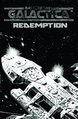 United States' cover art
 -
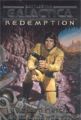 United Kingdom cover art

Behind the Scenes
edit sourceDevelopment and Writing Process
edit sourceRedemption represented the most personal exploration of Apollo's character across the three novels co-written by Richard Hatch and Brad Linaweaver.[external 1] The novel raised questions about leadership, sacrifice, and mortality that were never fully answered due to the series' premature conclusion. Hatch and Linaweaver had planned these themes to carry forward into the unfinished Magellan project, which would have explored similar concerns about command responsibility and personal cost.[external 1]
The collaborative method established across Paradis, Destiny, and Redemption involved Hatch providing extensive master outlines while Linaweaver contributed deeper character development, enriched dialogue, and narrative flow.[external 1] According to Linaweaver, the partnership worked because Hatch excelled at constructing elaborate plots while Linaweaver focused on bringing emotional depth and thematic complexity to the characters.[external 1]
Publication and Reception
edit sourcePublished by ibooks and distributed by Simon & Schuster, Redemption faced the same production issues that plagued the earlier novels in the series. The publisher never allowed Hatch to review galleys before publication, resulting in copy editing and proofreading errors that fans correctly attributed to the publisher rather than the authors.[external 2] Hatch openly shared this information with fans at conventions, demonstrating his commitment to transparency about the publishing process.[external 2]
Despite these production challenges, Linaweaver believed Redemption may have been among the most popular novels in the entire Hatch series, alongside Destiny.[external 3] The novel's exploration of Apollo's vulnerability and willingness to sacrifice himself resonated strongly with readers familiar with Hatch's portrayal of the character across both the original series and his continuation novels.
Intended Two-Part Structure
edit sourceHatch wrote books seven and eight as a unified two-part story, with Redemption deliberately ending on a cliffhanger.[external 4] Legal disputes over publishing rights resulted in the rights being lost before the eighth book could be published. According to Linaweaver, Hatch completed the manuscript for the eighth novel, and the two authors had hoped Universal would eventually allow continuation of the series after the Re-imagined Series concluded.[external 4] However, when the Re-imagined Series came to fruition with Hatch cast as Tom Zarek, Universal pulled the plug on the novel series entirely.[external 5]
Connection to Larger Projects
edit sourceThe questions raised in Redemption about leadership, sacrifice, and the psychological cost of command were themes Hatch intended to explore further in The Great War of Magellan, his ambitious multimedia project.[external 6] Hatch asked Linaweaver to co-write the Magellan novels using the same collaborative method they had developed for the Battlestar Galactica series.[external 6] The authors completed one-third of the first Magellan novel before Hatch's death from pancreatic cancer on February 7, 2017, left the project unfinished and its rights in legal limbo.[external 7]
Notes
edit source- According to Richard Hatch, Redemption was not intended as the final book in the series. Hatch wrote books seven and eight as a two-part story, with Redemption ending on a deliberate cliffhanger.[external 4] Legal disputes over publishing rights resulted in the rights being lost before book eight could be published. Hatch completed the manuscript for the eighth novel, but whether it will ever see publication remains unknown.[external 4]
- The novel's title operates on multiple levels: Baltar's redemption through posthumous service, humanity's redemption from the plague through sacrifice and cooperation, and the potential redemption (or damnation) represented by Cassiopeia's son and his ambiguous destiny.
- Baltar's spectral appearances represent a significant evolution of his character arc across the series. Having achieved genuine remorse and sacrificial death in Destiny, he continues his journey of atonement from beyond the grave, actively working to save the colonials he once betrayed. According to co-author Brad Linaweaver, Richard Hatch informed him that no one had written Baltar as effectively as Linaweaver, including every writer on the original television series.[external 8] Linaweaver's approach focused on getting inside the head of the series' human villain, portraying Baltar as individualistic evil in contrast to the Cylons' collectivistic evil.[external 9]
- The plague storyline creates deliberate parallels to the original discovery of Commander Cain—both instances where hope of salvation brings instead a more complex and dangerous reality requiring difficult choices and sacrifices.
- Gar'Tokk's death and resurrection through Borellian Noman spiritual practices expands the series' exploration of diverse human evolutionary paths and religious traditions within the colonial survivor community.
- Count Iblis's revelation as the father of Cassiopeia's son provides a dark twist on the series' ongoing exploration of Kobollian bloodlines, destiny, and the corruption of the House of Kobol that drives much of Iblis's motivation throughout the novels.
- The epilogue's reference to Baltar and Iblis nearly colliding on the astral plane suggests ongoing cosmic conflicts beyond the physical realm, with implications for the unpublished eighth novel's planned storyline.
- Apollo's willingness to be the first to receive the untested cure mirrors his father Adama's leadership style—leading through personal example and shared sacrifice rather than commanding from safety. This exploration of Apollo's character represented the most personal of the three Hatch-Linaweaver collaborations, raising questions about leadership and sacrifice that would have continued into subsequent novels.[external 1]
- The cure's location aboard a Cylon basestar in Iblis's experimental archives creates a thematic connection between the series' three major antagonistic forces: the Cylons as military threat, Iblis as spiritual/existential threat, and disease as an impersonal but equally deadly threat.
References
edit sourceExternal Sources
edit source- ↑ 1.0 1.1 1.2 1.3 1.4 Brad Linaweaver (November 2009). A Man for All Reasons: A Personal Tribute to Richard Hatch (backup available on Archive.org) (in English). Mondo Cult. Retrieved on November 2, 2025.
- ↑ 2.0 2.1 Brad Linaweaver (November 2009). A Man for All Reasons: A Personal Tribute to Richard Hatch (backup available on Archive.org) (in English). Mondo Cult. Retrieved on November 2, 2025.
- ↑ Brad Linaweaver (November 2009). A Man for All Reasons: A Personal Tribute to Richard Hatch (backup available on Archive.org) (in English). Mondo Cult. Retrieved on November 2, 2025.
- ↑ 4.0 4.1 4.2 4.3 Brad Linaweaver (November 2009). A Man for All Reasons: A Personal Tribute to Richard Hatch (backup available on Archive.org) (in English). Mondo Cult. Retrieved on November 2, 2025.
- ↑ Brad Linaweaver (November 2009). A Man for All Reasons: A Personal Tribute to Richard Hatch (backup available on Archive.org) (in English). Mondo Cult. Retrieved on November 2, 2025.
- ↑ 6.0 6.1 Brad Linaweaver (November 2009). A Man for All Reasons: A Personal Tribute to Richard Hatch (backup available on Archive.org) (in English). Mondo Cult. Retrieved on November 2, 2025.
- ↑ Brad Linaweaver (November 2009). A Man for All Reasons: A Personal Tribute to Richard Hatch (backup available on Archive.org) (in English). Mondo Cult. Retrieved on November 2, 2025.
- ↑ Brad Linaweaver (November 2009). A Man for All Reasons: A Personal Tribute to Richard Hatch (backup available on Archive.org) (in English). Mondo Cult. Retrieved on November 2, 2025.
- ↑ Brad Linaweaver (November 2009). A Man for All Reasons: A Personal Tribute to Richard Hatch (backup available on Archive.org) (in English). Mondo Cult. Retrieved on November 2, 2025.
Novel Citations
edit source- ↑ 1.0 1.1 Hatch, Richard; Linaweaver, Brad (2005). Redemption. iBooks, Inc., p. 3.
- ↑ 2.0 2.1 Hatch, Richard; Linaweaver, Brad (2005). Redemption. iBooks, Inc., p. 5.
- ↑ Hatch, Richard; Linaweaver, Brad (2005). Redemption. iBooks, Inc., p. 12.
- ↑ Hatch, Richard; Linaweaver, Brad (2005). Redemption. iBooks, Inc., p. 13-14.
- ↑ Hatch, Richard; Linaweaver, Brad (2005). Redemption. iBooks, Inc., p. 18.
- ↑ Hatch, Richard; Linaweaver, Brad (2005). Redemption. iBooks, Inc., p. 26.
- ↑ Hatch, Richard; Linaweaver, Brad (2005). Redemption. iBooks, Inc., p. 27.
- ↑ Hatch, Richard; Linaweaver, Brad (2005). Redemption. iBooks, Inc., p. 36.
- ↑ Hatch, Richard; Linaweaver, Brad (2005). Redemption. iBooks, Inc., p. 37.
- ↑ Hatch, Richard; Linaweaver, Brad (2005). Redemption. iBooks, Inc., p. 44.
- ↑ Hatch, Richard; Linaweaver, Brad (2005). Redemption. iBooks, Inc., p. 53.
- ↑ 12.0 12.1 Hatch, Richard; Linaweaver, Brad (2005). Redemption. iBooks, Inc., p. 62.
- ↑ Hatch, Richard; Linaweaver, Brad (2005). Redemption. iBooks, Inc., p. 73.
- ↑ Hatch, Richard; Linaweaver, Brad (2005). Redemption. iBooks, Inc., p. 81.
- ↑ Hatch, Richard; Linaweaver, Brad (2005). Redemption. iBooks, Inc., p. 82.
- ↑ Hatch, Richard; Linaweaver, Brad (2005). Redemption. iBooks, Inc., p. 90-91.
- ↑ Hatch, Richard; Linaweaver, Brad (2005). Redemption. iBooks, Inc., p. 92.
- ↑ Hatch, Richard; Linaweaver, Brad (2005). Redemption. iBooks, Inc., p. 98.
- ↑ Hatch, Richard; Linaweaver, Brad (2005). Redemption. iBooks, Inc., p. 108-109.
- ↑ Hatch, Richard; Linaweaver, Brad (2005). Redemption. iBooks, Inc., p. 109.
- ↑ Hatch, Richard; Linaweaver, Brad (2005). Redemption. iBooks, Inc., p. 118.
- ↑ Hatch, Richard; Linaweaver, Brad (2005). Redemption. iBooks, Inc., p. 126.
- ↑ Hatch, Richard; Linaweaver, Brad (2005). Redemption. iBooks, Inc., p. 127.
- ↑ Hatch, Richard; Linaweaver, Brad (2005). Redemption. iBooks, Inc., p. 135-136.
- ↑ Hatch, Richard; Linaweaver, Brad (2005). Redemption. iBooks, Inc., p. 136.
- ↑ Hatch, Richard; Linaweaver, Brad (2005). Redemption. iBooks, Inc., p. 137.
- ↑ Hatch, Richard; Linaweaver, Brad (2005). Redemption. iBooks, Inc., p. 146.
- ↑ 28.0 28.1 Hatch, Richard; Linaweaver, Brad (2005). Redemption. iBooks, Inc., p. 156.
- ↑ 29.0 29.1 Hatch, Richard; Linaweaver, Brad (2005). Redemption. iBooks, Inc., p. 139.
- ↑ Hatch, Richard; Linaweaver, Brad (2005). Redemption. iBooks, Inc., p. 167.
- ↑ 31.0 31.1 Hatch, Richard; Linaweaver, Brad (2005). Redemption. iBooks, Inc., p. 170.
- ↑ Hatch, Richard; Linaweaver, Brad (2005). Redemption. iBooks, Inc., p. 176.
- ↑ Hatch, Richard; Linaweaver, Brad (2005). Redemption. iBooks, Inc., p. 184.
- ↑ Hatch, Richard; Linaweaver, Brad (2005). Redemption. iBooks, Inc., p. 196.
- ↑ Hatch, Richard; Linaweaver, Brad (2005). Redemption. iBooks, Inc., p. 197.
- ↑ Hatch, Richard; Linaweaver, Brad (2005). Redemption. iBooks, Inc., p. 185.
- ↑ 37.0 37.1 37.2 Hatch, Richard; Linaweaver, Brad (2005). Redemption. iBooks, Inc., p. 198.
- ↑ Hatch, Richard; Linaweaver, Brad (2005). Redemption. iBooks, Inc., p. 129-130.
- ↑ Hatch, Richard; Linaweaver, Brad (2005). Redemption. iBooks, Inc., p. 130.
- ↑ 40.0 40.1 Hatch, Richard; Linaweaver, Brad (2005). Redemption. iBooks, Inc., p. 131.
- ↑ Hatch, Richard; Linaweaver, Brad (2005). Redemption. iBooks, Inc., p. 152.
- ↑ Hatch, Richard; Linaweaver, Brad (2005). Redemption. iBooks, Inc., p. 154.
- ↑ Hatch, Richard; Linaweaver, Brad (2005). Redemption. iBooks, Inc., p. 155.
- ↑ Hatch, Richard; Linaweaver, Brad (2005). Redemption. iBooks, Inc., p. 199.