
Redemption: Difference between revisions

More actions
m Text replacement - "[[Category:TOS" to "{{indicator|TOS}}[[Category:TOS" |
No edit summary |
||
| Line 13: | Line 13: | ||
}} | }} | ||
'''''Redemption''''' is the seventh | '''''Redemption''''' is the seventh and final published novel in [[Richard Hatch]]'s continuation of the [[Battlestar Galactica (TOS)|Original Series]]. The novel confronts {{TOS-RH|Apollo|Apollo's}} leadership with an existential crisis when survivors of the [[Thirteenth Tribe (TOS-RH)|Thirteenth Tribe]] bring not salvation but a deadly plague that threatens to annihilate [[the Fleet (TOS-RH)|the Fleet]]. As death spreads through the colonial ships, the narrative examines themes of sacrifice, the price of knowledge, and redemption through the parallel journeys of Apollo facing mortality and {{TOS-RH|Baltar}} achieving transcendence beyond death. The novel concludes with a cliffhanger ending, originally intended as the first half of a two-part story that remains unpublished. | ||
== Plot == | |||
=== Prologue === | |||
The novel opens with {{TOS-RH|Cassiopeia}} holding her five-year-old son, whose dark eyes fill her with inexplicable dread. The boy exhibits unnerving precision in his movements and speaks with an oddly formal voice that lacks the spontaneity of childhood. He does not smile when he hugs her, performing the gesture with mechanical perfection.<ref name="RED3">{{cite book/RH|7|3}}</ref> | |||
Cassie's fears stem from her suspicion that the child may be the son of [[Count Iblis (TOS-RH)|Count Iblis]] rather than Apollo. Her maternal instincts war against premonitions of catastrophe as she contemplates what threat her own flesh and blood might pose to the Fleet. The prologue establishes Cassie's emotional isolation and the burden of terrible knowledge she carries alone, setting the stage for the novel's exploration of parenthood, destiny, and impossible choices.<ref name="RED3" /> | |||
=== Chapters 1-15 === | |||
Following their departure from [[Paradis (TOS-RH)|Paradis]], the Fleet discovers an ancient space ark containing survivors of the Thirteenth Tribe in [[hybernation|hibernation]].<ref name="RED6">{{cite book/RH|7|6}}</ref> Apollo, joined by {{TOS-RH|Sheba}}, approaches the discovery with both excitement and caution, viewing it as potentially the Fleet's greatest find since leaving the [[Twelve Colonies of Kobol (TOS-RH)|Twelve Colonies]].<ref name="RED6" /> | |||
{{TOS-RH|Gar'Tokk}} successfully translates inscriptions on the hibernation pods, written in an ancient Kobollian dialect. {{TOS-RH|Boomer}} discovers a hidden chamber containing bodies in preservation, including both deteriorated remains and some that appear fresh and viable for resuscitation.<ref name="RED92">{{cite book/RH|7|92}}</ref> The team identifies three survivors who appear suitable for revival, hoping to gain invaluable knowledge about the Thirteenth Tribe's journey and the location of [[Earth (TOS-RH)|Earth]]. | |||
Despite Apollo's explicit orders to proceed with extreme caution, Dr. Du'bah and her medical team disobey and begin unauthorized resuscitation procedures. When discovered, Apollo places Du'bah under arrest and assigns Dr. Bell to take charge of all future medical operations regarding the survivors.<ref name="RED127">{{cite book/RH|7|127}}</ref> The unauthorized revival proves catastrophic when Gar'Tokk's later translation reveals critical warnings about one survivor: an elderly man who carried a plague that devastated the ancient Kobollians.<ref name="RED139">{{cite book/RH|7|139}}</ref> | |||
The inscription explicitly warns that this carrier should not be resuscitated until a cure is found. By the time this translation is complete, Dr. Du'bah and her medical team have already been exposed to the survivors, as have Apollo, Gar'Tokk, Sheba, and Boomer. The plague represents the worst disease ever to afflict the Kobollians, and its introduction into the Fleet threatens to accomplish what three decades of Cylon pursuit could not: the complete extinction of the surviving colonials. Apollo immediately orders total isolation protocols and comprehensive medical examinations for everyone who has had contact with the pods or the resuscitated survivors.<ref name="RED139" /> | |||
=== Chapter 16 === | |||
As the resuscitation procedures begin, Baltar makes contact with Apollo from beyond death, his spectral form appearing with increasing coherence. Through laborious communication—Apollo writing down garbled words until complete sentences emerge—Baltar delivers an urgent warning about danger threatening Sheba and others.<ref name="RED136">{{cite book/RH|7|136}}</ref> | |||
Apollo and Baltar develop a painstaking system: every time Apollo hears a word clearly, he writes it down. When a word comes through garbled, he raises his hand and Baltar repeats it until every syllable is audible. Through this process, Baltar's first coherent message asks what Apollo knows about the survivors of the Thirteenth Tribe. When Apollo answers that three have been recovered and are resting, Baltar's next word comes through with perfect clarity: "Danger!"<ref name="RED136" /> | |||
Baltar's cryptic references to Gar'Tokk's translation work create mounting tension. When the spectral image finally conveys "Go to Gar'Tokk!" Apollo realizes something has gone terribly wrong with the Thirteenth Tribe discovery.<ref name="RED137">{{cite book/RH|7|137}}</ref> Despite the warnings arriving in fragments, Baltar's concern demonstrates the genuine transformation he achieved before death—redemption manifest through spectral intervention. | |||
=== Chapters 17-18 === | |||
The plague manifests swiftly and mercilessly throughout the ark ship that houses the survivors. Despite stringent isolation measures, the disease proves highly contagious, spreading beyond the medical staff to affect ship personnel who had only peripheral contact with the infected areas. Symptoms progress rapidly from what initially appears to be a common cold to severe respiratory distress and systemic failure. | |||
Apollo watches helplessly as colleagues and friends succumb to the disease. The medical facilities become overwhelmed with patients, and Dr. Bell struggles to understand the plague's mechanism with insufficient resources and no precedent in colonial medical knowledge. Each new casualty reinforces the grim reality that the Fleet's greatest discovery has become its deadliest threat. The irony haunts the survivors: they sought the Thirteenth Tribe to find hope, but instead found a plague that may destroy them all. | |||
=== Chapters 19-20 === | |||
As the plague continues its devastating spread, Gar'Tokk succumbs to the disease. His death represents a profound loss—not only as Apollo's closest friend and the only being capable of translating the ancient Kobollian texts, but as a symbol of the diverse unity the Fleet had achieved.<ref name="RED184">{{cite book/RH|7|184}}</ref> Apollo, facing the possibility of being the last survivor, begins dictating his final log entries, recommending that any remaining colonials place themselves in suspended animation rather than face certain death from the plague. | |||
In a stunning reversal, Gar'Tokk's voice crackles over the comm-link: "I'm back." The Borellian Noman reveals that his people's religious rituals can induce a near-death state that allows the body optimal conditions for repair and regeneration. Dr. Bell confirms that in this condition, Gar'Tokk's unique physiology successfully fought off the plague.<ref name="RED184" /> The resurrection provides not only emotional relief but renewed hope that the plague can be defeated, though time grows increasingly short for the hundreds already infected throughout the ark. | |||
=== Chapters 21-22 === | |||
Baltar appears to Apollo once more, this time in a dreamlike underwater realm where Apollo struggles to breathe in what seems like liquid air. Baltar's spectral form has achieved greater coherence and control, allowing for more direct communication about the cure's location. He reveals that Count Iblis, in his malevolent experiments, was responsible for engineering the plague as a biological weapon.<ref name="RED196">{{cite book/RH|7|196}}</ref> | |||
The cure exists aboard a derelict Cylon basestar in Section Four, Category Ten of the human DNA experiments—a repository of Iblis's twisted research. Baltar explains that he has spent his existence beyond death piecing together this information, learning to navigate the astral plane and uncover Iblis's secrets scattered across the cosmos. His redemption continues through direct action to save those he once betrayed. | |||
As Apollo begins to "drown" in the dreamscape, the environment transforming from air to water around him, Baltar urges him to wake and retrieve the cure immediately. The spectral traitor promises that Apollo's time to remain in such a place has not yet come.<ref name="RED197">{{cite book/RH|7|197}}</ref> With those final words, Apollo awakens coughing up liquid from his mystical near-drowning, with Gar'Tokk supporting him and striking his back to help him breathe. | |||
=== Chapters 23-24 === | |||
Without hesitation, Apollo orders immediate preparation for a mission to the Cylon basestar. He contacts Dr. Bell's team and assembles a strike force to retrieve the experimental cure from the bowels of the Cylon vessel. The mission carries enormous risk—entering an abandoned basestar of unknown status, navigating to specific experimental sections deep within enemy technology, and locating materials that may have deteriorated over time. | |||
Yet with hundreds of colonials dying and more falling ill by the centon, there exists no alternative. Apollo leads the team personally, understanding that this represents the Fleet's final chance for survival. The cure's location aboard a Cylon vessel represents a bitter irony: salvation found within the technology of their ancient enemies, preserved by the machinations of their greatest traitor's nemesis through experiments on human DNA. | |||
=== Chapters 25-26 === | |||
Apollo's team successfully locates and retrieves the experimental materials from the Cylon basestar's Section Four, Category Ten. Dr. Bell and his medical staff work frantically to synthesize the cure from the Cylon research, racing against the plague's accelerating spread through the ark's population. Apollo volunteers to receive the first injection, demonstrating the leadership and courage that defined his father {{TOS-RH|Adama}}'s legacy.<ref name="RED198">{{cite book/RH|7|198}}</ref> | |||
The cure proves effective, halting the plague's progression in those who receive treatment. However, the synthesis process is time-consuming, and for some—including Sheba—it appears the cure may arrive too late. Dr. Bell fears Sheba has deteriorated beyond recovery, but the treatment produces what he describes as a miracle: Sheba returns to full health and to Apollo's arms.<ref name="RED198" /> Four hundred lives are saved through the coordinated efforts of the living and the dead, human and Noman, colonial and former traitor. The plague that threatened extinction becomes instead a testament to the power of redemption and sacrifice. | |||
=== Chapters 27-28 === | |||
While the plague crisis unfolds, Cassiopeia reaches a breaking point with her son. The boy openly discusses causing disasters within the Fleet, speaking with adult sophistication about his ability to manipulate reality. Cassie observes that he takes equal pleasure in manifesting power through both positive and negative acts—transforming a poison into a cure for the common cold with casual indifference to human suffering or salvation.<ref name="RED131">{{cite book/RH|7|131}}</ref> | |||
The boy experiences something new in his short life: an emotion he has never encountered before. Fascinated by this raw feeling, he stops his logical analysis to study himself in the mirror, examining his coal black eyes, bone structure, and cranial development. Turning from external surfaces, he journeys within to discover the answer waiting deep inside like a dark seed. The emotion he has discovered, for the first time in his existence, is fear.<ref name="RED131" /> | |||
Driven to desperation by her son's unnatural behavior and the threat she believes he poses, Cassie takes the boy to a remote section of the ship. She carries a knife, preparing to end the danger before it destroys the Fleet. In this moment of maternal anguish, the boy remains eerily calm, studying her actions as though observing an interesting experiment. Before Cassie can act, Count Iblis manifests in a blinding display of light, revealing himself as the boy's true father.<ref name="RED152">{{cite book/RH|7|152}}</ref> | |||
=== Chapters 29-30 === | |||
Count Iblis confronts Cassiopeia with overwhelming presence, his form growing larger and more terrible as his rage builds at her betrayal. He denounces her intention to murder "our son," revealing that the boy is indeed his offspring rather than Apollo's. The dark entity proclaims the child sacred and blessed, destined to become the savior of the colonial people and lead them to a new golden age of civilization.<ref name="RED154">{{cite book/RH|7|154}}</ref> | |||
Iblis explains that external forces—enemies of the Fleet that Cassie cannot comprehend—have been causing the disasters she attributed to her son. The boy's belief that he caused these events serves Iblis's purposes by building the child's sense of power and invincibility. These are mere "childish fantasies" that will be understood as immaturity once the boy reaches adulthood and recalls this time with perfect clarity, amused by his youthful delusions.<ref name="RED155">{{cite book/RH|7|155}}</ref> | |||
The dark count warns Cassie that any harm to his child will result in terrible vengeance upon her and Starbuck. Before departing, Iblis plants a final seed of paranoia: he warns Cassie that Starbuck himself may become an unwilling pawn of the dark forces seeking to destroy their son, implying that even the man she loves cannot be trusted.<ref name="RED156">{{cite book/RH|7|156}}</ref> Cassie picks up her sleeping son, finding him strangely light, and begins the long trek back to their quarters, leaving the knife behind. | |||
=== Epilogue === | |||
The novel concludes on the astral plane, where two figures pass dangerously close to one another without collision—a fortunate circumstance given the consequences such an encounter might produce. One entity is Count Iblis, obsessed with monitoring his son and increasingly concerned that the boy's tendency toward helping people threatens his dark plans. The transformation of a "perfectly good minor poison" into a cure for the common cold represents the kind of positive manifestation that does not serve Iblis's agenda.<ref name="RED198" /> | |||
The second figure is Baltar, who has maintained his humanity despite existing beyond death. Unlike Iblis, who confused transcendence with degradation, Baltar retained his essential nature while achieving redemption through service. He remains near the Paradis system long enough to ensure the cure's successful implementation, witnessing Apollo's courage and Bell's expertise produce the miracle of four hundred saved lives. | |||
As Baltar speeds to his next rendezvous, he relishes the thought of four hundred lives saved—perhaps a drop in the bucket against the millions of lives that haunt him down the corridors of eternity, but a start nonetheless. He moves with grace and dignity toward his own personal redemption, each step on this path helping him better appreciate the redemption of others. Baltar arrives at his destination to discover Imperious Leader with a fourth brain surgically attached, causing the Cylon dictator considerable pain. The novel ends with a cliffhanger as Imperious Leader, without looking up from his headache, welcomes Baltar back and announces: "Thanks to your invaluable contribution, we can finish what we started."<ref name="RED199">{{cite book/RH|7|199}}</ref> | |||
== Alternate covers == | == Alternate covers == | ||
| Line 22: | Line 104: | ||
</gallery> | </gallery> | ||
==Notes== | == Notes == | ||
* According to [[Richard Hatch]], ''Redemption'' was not intended as the final book in the series. Hatch wrote books seven and eight as a two-part story, with ''Redemption'' ending on a deliberate cliffhanger. Legal disputes over publishing rights resulted in the rights being lost before book eight could be published. Whether the eighth book, which Hatch completed, will ever see publication remains unknown.{{citation needed}} | |||
* The novel's title operates on multiple levels: Baltar's redemption through posthumous service, humanity's redemption from the plague through sacrifice and cooperation, and the potential redemption (or damnation) represented by Cassiopeia's son and his ambiguous destiny. | |||
* Baltar's spectral appearances represent a significant evolution of his character arc across the series. Having achieved genuine remorse and sacrificial death in ''[[Destiny (book)|Destiny]]'', he continues his journey of atonement from beyond the grave, actively working to save the colonials he once betrayed. | |||
* The plague storyline creates deliberate parallels to the original {{TOS|The Living Legend|discovery of Commander Cain}}—both instances where hope of salvation brings instead a more complex and dangerous reality requiring difficult choices and sacrifices. | |||
* Gar'Tokk's death and resurrection through Borellian Noman spiritual practices expands the series' exploration of diverse human evolutionary paths and religious traditions within the colonial survivor community. | |||
* Count Iblis's revelation as the father of Cassiopeia's son provides a dark twist on the series' ongoing exploration of Kobollian bloodlines, destiny, and the corruption of the House of Kobol that drives much of Iblis's motivation throughout the novels. | |||
* The epilogue's reference to Baltar and Iblis nearly colliding on the astral plane suggests ongoing cosmic conflicts beyond the physical realm, with implications for the unpublished eighth novel's planned storyline. | |||
* Apollo's willingness to be the first to receive the untested cure mirrors his father Adama's leadership style—leading through personal example and shared sacrifice rather than commanding from safety. | |||
* The cure's location aboard a Cylon basestar in Iblis's experimental archives creates a thematic connection between the series' three major antagonistic forces: the Cylons as military threat, Iblis as spiritual/existential threat, and disease as an impersonal but equally deadly threat. | |||
== References == | |||
<references /> | |||
{{Richard Hatch novels}} | {{Richard Hatch novels}} | ||
[[Category:A to Z]] | [[Category:A to Z]] | ||
| Line 34: | Line 134: | ||
[[Category:Merchandise]] | [[Category:Merchandise]] | ||
{{indicator|TOS}}[[Category:TOS]] | {{indicator|TOS}}[[Category:TOS]] | ||
[[Category:Richard Hatch Novelizations]] | |||
Revision as of 16:27, 25 October 2025
| |||||


| ||
| Redemption A book of the Richard Hatch line | ||
|---|---|---|
| Book No. | 7 | |
| Author(s) | Richard Hatch and Brad Linaweaver | |
| Adaptation of | ||
| No. of Pages | {{{pages}}} | |
| Published | October 10, 2005 | |
| ISBN | 1596871199 | |
| Chronology | ||
| Previous | Next | |
| Destiny | Redemption | None |
| Paperback Version | ||
| Available at Amazon.com – Purchase | ||
| Available at Amazon.co.uk – Purchase | ||
| Audiobook Version | ||
| Available at iTunes – [{{{itunes}}} Purchase] | ||
Redemption is the seventh and final published novel in Richard Hatch's continuation of the Original Series. The novel confronts Apollo's leadership with an existential crisis when survivors of the Thirteenth Tribe bring not salvation but a deadly plague that threatens to annihilate the Fleet. As death spreads through the colonial ships, the narrative examines themes of sacrifice, the price of knowledge, and redemption through the parallel journeys of Apollo facing mortality and Baltar achieving transcendence beyond death. The novel concludes with a cliffhanger ending, originally intended as the first half of a two-part story that remains unpublished.
Plot
Prologue
The novel opens with Cassiopeia holding her five-year-old son, whose dark eyes fill her with inexplicable dread. The boy exhibits unnerving precision in his movements and speaks with an oddly formal voice that lacks the spontaneity of childhood. He does not smile when he hugs her, performing the gesture with mechanical perfection.[1]
Cassie's fears stem from her suspicion that the child may be the son of Count Iblis rather than Apollo. Her maternal instincts war against premonitions of catastrophe as she contemplates what threat her own flesh and blood might pose to the Fleet. The prologue establishes Cassie's emotional isolation and the burden of terrible knowledge she carries alone, setting the stage for the novel's exploration of parenthood, destiny, and impossible choices.[1]
Chapters 1-15
Following their departure from Paradis, the Fleet discovers an ancient space ark containing survivors of the Thirteenth Tribe in hibernation.[2] Apollo, joined by Sheba, approaches the discovery with both excitement and caution, viewing it as potentially the Fleet's greatest find since leaving the Twelve Colonies.[2]
Gar'Tokk successfully translates inscriptions on the hibernation pods, written in an ancient Kobollian dialect. Boomer discovers a hidden chamber containing bodies in preservation, including both deteriorated remains and some that appear fresh and viable for resuscitation.[3] The team identifies three survivors who appear suitable for revival, hoping to gain invaluable knowledge about the Thirteenth Tribe's journey and the location of Earth.
Despite Apollo's explicit orders to proceed with extreme caution, Dr. Du'bah and her medical team disobey and begin unauthorized resuscitation procedures. When discovered, Apollo places Du'bah under arrest and assigns Dr. Bell to take charge of all future medical operations regarding the survivors.[4] The unauthorized revival proves catastrophic when Gar'Tokk's later translation reveals critical warnings about one survivor: an elderly man who carried a plague that devastated the ancient Kobollians.[5]
The inscription explicitly warns that this carrier should not be resuscitated until a cure is found. By the time this translation is complete, Dr. Du'bah and her medical team have already been exposed to the survivors, as have Apollo, Gar'Tokk, Sheba, and Boomer. The plague represents the worst disease ever to afflict the Kobollians, and its introduction into the Fleet threatens to accomplish what three decades of Cylon pursuit could not: the complete extinction of the surviving colonials. Apollo immediately orders total isolation protocols and comprehensive medical examinations for everyone who has had contact with the pods or the resuscitated survivors.[5]
Chapter 16
As the resuscitation procedures begin, Baltar makes contact with Apollo from beyond death, his spectral form appearing with increasing coherence. Through laborious communication—Apollo writing down garbled words until complete sentences emerge—Baltar delivers an urgent warning about danger threatening Sheba and others.[6]
Apollo and Baltar develop a painstaking system: every time Apollo hears a word clearly, he writes it down. When a word comes through garbled, he raises his hand and Baltar repeats it until every syllable is audible. Through this process, Baltar's first coherent message asks what Apollo knows about the survivors of the Thirteenth Tribe. When Apollo answers that three have been recovered and are resting, Baltar's next word comes through with perfect clarity: "Danger!"[6]
Baltar's cryptic references to Gar'Tokk's translation work create mounting tension. When the spectral image finally conveys "Go to Gar'Tokk!" Apollo realizes something has gone terribly wrong with the Thirteenth Tribe discovery.[7] Despite the warnings arriving in fragments, Baltar's concern demonstrates the genuine transformation he achieved before death—redemption manifest through spectral intervention.
Chapters 17-18
The plague manifests swiftly and mercilessly throughout the ark ship that houses the survivors. Despite stringent isolation measures, the disease proves highly contagious, spreading beyond the medical staff to affect ship personnel who had only peripheral contact with the infected areas. Symptoms progress rapidly from what initially appears to be a common cold to severe respiratory distress and systemic failure.
Apollo watches helplessly as colleagues and friends succumb to the disease. The medical facilities become overwhelmed with patients, and Dr. Bell struggles to understand the plague's mechanism with insufficient resources and no precedent in colonial medical knowledge. Each new casualty reinforces the grim reality that the Fleet's greatest discovery has become its deadliest threat. The irony haunts the survivors: they sought the Thirteenth Tribe to find hope, but instead found a plague that may destroy them all.
Chapters 19-20
As the plague continues its devastating spread, Gar'Tokk succumbs to the disease. His death represents a profound loss—not only as Apollo's closest friend and the only being capable of translating the ancient Kobollian texts, but as a symbol of the diverse unity the Fleet had achieved.[8] Apollo, facing the possibility of being the last survivor, begins dictating his final log entries, recommending that any remaining colonials place themselves in suspended animation rather than face certain death from the plague.
In a stunning reversal, Gar'Tokk's voice crackles over the comm-link: "I'm back." The Borellian Noman reveals that his people's religious rituals can induce a near-death state that allows the body optimal conditions for repair and regeneration. Dr. Bell confirms that in this condition, Gar'Tokk's unique physiology successfully fought off the plague.[8] The resurrection provides not only emotional relief but renewed hope that the plague can be defeated, though time grows increasingly short for the hundreds already infected throughout the ark.
Chapters 21-22
Baltar appears to Apollo once more, this time in a dreamlike underwater realm where Apollo struggles to breathe in what seems like liquid air. Baltar's spectral form has achieved greater coherence and control, allowing for more direct communication about the cure's location. He reveals that Count Iblis, in his malevolent experiments, was responsible for engineering the plague as a biological weapon.[9]
The cure exists aboard a derelict Cylon basestar in Section Four, Category Ten of the human DNA experiments—a repository of Iblis's twisted research. Baltar explains that he has spent his existence beyond death piecing together this information, learning to navigate the astral plane and uncover Iblis's secrets scattered across the cosmos. His redemption continues through direct action to save those he once betrayed.
As Apollo begins to "drown" in the dreamscape, the environment transforming from air to water around him, Baltar urges him to wake and retrieve the cure immediately. The spectral traitor promises that Apollo's time to remain in such a place has not yet come.[10] With those final words, Apollo awakens coughing up liquid from his mystical near-drowning, with Gar'Tokk supporting him and striking his back to help him breathe.
Chapters 23-24
Without hesitation, Apollo orders immediate preparation for a mission to the Cylon basestar. He contacts Dr. Bell's team and assembles a strike force to retrieve the experimental cure from the bowels of the Cylon vessel. The mission carries enormous risk—entering an abandoned basestar of unknown status, navigating to specific experimental sections deep within enemy technology, and locating materials that may have deteriorated over time.
Yet with hundreds of colonials dying and more falling ill by the centon, there exists no alternative. Apollo leads the team personally, understanding that this represents the Fleet's final chance for survival. The cure's location aboard a Cylon vessel represents a bitter irony: salvation found within the technology of their ancient enemies, preserved by the machinations of their greatest traitor's nemesis through experiments on human DNA.
Chapters 25-26
Apollo's team successfully locates and retrieves the experimental materials from the Cylon basestar's Section Four, Category Ten. Dr. Bell and his medical staff work frantically to synthesize the cure from the Cylon research, racing against the plague's accelerating spread through the ark's population. Apollo volunteers to receive the first injection, demonstrating the leadership and courage that defined his father Adama's legacy.[11]
The cure proves effective, halting the plague's progression in those who receive treatment. However, the synthesis process is time-consuming, and for some—including Sheba—it appears the cure may arrive too late. Dr. Bell fears Sheba has deteriorated beyond recovery, but the treatment produces what he describes as a miracle: Sheba returns to full health and to Apollo's arms.[11] Four hundred lives are saved through the coordinated efforts of the living and the dead, human and Noman, colonial and former traitor. The plague that threatened extinction becomes instead a testament to the power of redemption and sacrifice.
Chapters 27-28
While the plague crisis unfolds, Cassiopeia reaches a breaking point with her son. The boy openly discusses causing disasters within the Fleet, speaking with adult sophistication about his ability to manipulate reality. Cassie observes that he takes equal pleasure in manifesting power through both positive and negative acts—transforming a poison into a cure for the common cold with casual indifference to human suffering or salvation.[12]
The boy experiences something new in his short life: an emotion he has never encountered before. Fascinated by this raw feeling, he stops his logical analysis to study himself in the mirror, examining his coal black eyes, bone structure, and cranial development. Turning from external surfaces, he journeys within to discover the answer waiting deep inside like a dark seed. The emotion he has discovered, for the first time in his existence, is fear.[12]
Driven to desperation by her son's unnatural behavior and the threat she believes he poses, Cassie takes the boy to a remote section of the ship. She carries a knife, preparing to end the danger before it destroys the Fleet. In this moment of maternal anguish, the boy remains eerily calm, studying her actions as though observing an interesting experiment. Before Cassie can act, Count Iblis manifests in a blinding display of light, revealing himself as the boy's true father.[13]
Chapters 29-30
Count Iblis confronts Cassiopeia with overwhelming presence, his form growing larger and more terrible as his rage builds at her betrayal. He denounces her intention to murder "our son," revealing that the boy is indeed his offspring rather than Apollo's. The dark entity proclaims the child sacred and blessed, destined to become the savior of the colonial people and lead them to a new golden age of civilization.[14]
Iblis explains that external forces—enemies of the Fleet that Cassie cannot comprehend—have been causing the disasters she attributed to her son. The boy's belief that he caused these events serves Iblis's purposes by building the child's sense of power and invincibility. These are mere "childish fantasies" that will be understood as immaturity once the boy reaches adulthood and recalls this time with perfect clarity, amused by his youthful delusions.[15]
The dark count warns Cassie that any harm to his child will result in terrible vengeance upon her and Starbuck. Before departing, Iblis plants a final seed of paranoia: he warns Cassie that Starbuck himself may become an unwilling pawn of the dark forces seeking to destroy their son, implying that even the man she loves cannot be trusted.[16] Cassie picks up her sleeping son, finding him strangely light, and begins the long trek back to their quarters, leaving the knife behind.
Epilogue
The novel concludes on the astral plane, where two figures pass dangerously close to one another without collision—a fortunate circumstance given the consequences such an encounter might produce. One entity is Count Iblis, obsessed with monitoring his son and increasingly concerned that the boy's tendency toward helping people threatens his dark plans. The transformation of a "perfectly good minor poison" into a cure for the common cold represents the kind of positive manifestation that does not serve Iblis's agenda.[11]
The second figure is Baltar, who has maintained his humanity despite existing beyond death. Unlike Iblis, who confused transcendence with degradation, Baltar retained his essential nature while achieving redemption through service. He remains near the Paradis system long enough to ensure the cure's successful implementation, witnessing Apollo's courage and Bell's expertise produce the miracle of four hundred saved lives.
As Baltar speeds to his next rendezvous, he relishes the thought of four hundred lives saved—perhaps a drop in the bucket against the millions of lives that haunt him down the corridors of eternity, but a start nonetheless. He moves with grace and dignity toward his own personal redemption, each step on this path helping him better appreciate the redemption of others. Baltar arrives at his destination to discover Imperious Leader with a fourth brain surgically attached, causing the Cylon dictator considerable pain. The novel ends with a cliffhanger as Imperious Leader, without looking up from his headache, welcomes Baltar back and announces: "Thanks to your invaluable contribution, we can finish what we started."[17]
Alternate covers
-
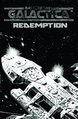 United States' cover art
 -
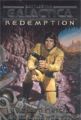 United Kingdom cover art

Notes
- According to Richard Hatch, Redemption was not intended as the final book in the series. Hatch wrote books seven and eight as a two-part story, with Redemption ending on a deliberate cliffhanger. Legal disputes over publishing rights resulted in the rights being lost before book eight could be published. Whether the eighth book, which Hatch completed, will ever see publication remains unknown.[citation needed]
- The novel's title operates on multiple levels: Baltar's redemption through posthumous service, humanity's redemption from the plague through sacrifice and cooperation, and the potential redemption (or damnation) represented by Cassiopeia's son and his ambiguous destiny.
- Baltar's spectral appearances represent a significant evolution of his character arc across the series. Having achieved genuine remorse and sacrificial death in Destiny, he continues his journey of atonement from beyond the grave, actively working to save the colonials he once betrayed.
- The plague storyline creates deliberate parallels to the original discovery of Commander Cain—both instances where hope of salvation brings instead a more complex and dangerous reality requiring difficult choices and sacrifices.
- Gar'Tokk's death and resurrection through Borellian Noman spiritual practices expands the series' exploration of diverse human evolutionary paths and religious traditions within the colonial survivor community.
- Count Iblis's revelation as the father of Cassiopeia's son provides a dark twist on the series' ongoing exploration of Kobollian bloodlines, destiny, and the corruption of the House of Kobol that drives much of Iblis's motivation throughout the novels.
- The epilogue's reference to Baltar and Iblis nearly colliding on the astral plane suggests ongoing cosmic conflicts beyond the physical realm, with implications for the unpublished eighth novel's planned storyline.
- Apollo's willingness to be the first to receive the untested cure mirrors his father Adama's leadership style—leading through personal example and shared sacrifice rather than commanding from safety.
- The cure's location aboard a Cylon basestar in Iblis's experimental archives creates a thematic connection between the series' three major antagonistic forces: the Cylons as military threat, Iblis as spiritual/existential threat, and disease as an impersonal but equally deadly threat.
References
- ↑ 1.0 1.1 Hatch, Richard; Linaweaver, Brad (2005). Redemption. iBooks, Inc., p. 3.
- ↑ 2.0 2.1 Hatch, Richard; Linaweaver, Brad (2005). Redemption. iBooks, Inc., p. 6.
- ↑ Hatch, Richard; Linaweaver, Brad (2005). Redemption. iBooks, Inc., p. 92.
- ↑ Hatch, Richard; Linaweaver, Brad (2005). Redemption. iBooks, Inc., p. 127.
- ↑ 5.0 5.1 Hatch, Richard; Linaweaver, Brad (2005). Redemption. iBooks, Inc., p. 139.
- ↑ 6.0 6.1 Hatch, Richard; Linaweaver, Brad (2005). Redemption. iBooks, Inc., p. 136.
- ↑ Hatch, Richard; Linaweaver, Brad (2005). Redemption. iBooks, Inc., p. 137.
- ↑ 8.0 8.1 Hatch, Richard; Linaweaver, Brad (2005). Redemption. iBooks, Inc., p. 184.
- ↑ Hatch, Richard; Linaweaver, Brad (2005). Redemption. iBooks, Inc., p. 196.
- ↑ Hatch, Richard; Linaweaver, Brad (2005). Redemption. iBooks, Inc., p. 197.
- ↑ 11.0 11.1 11.2 Hatch, Richard; Linaweaver, Brad (2005). Redemption. iBooks, Inc., p. 198.
- ↑ 12.0 12.1 Hatch, Richard; Linaweaver, Brad (2005). Redemption. iBooks, Inc., p. 131.
- ↑ Hatch, Richard; Linaweaver, Brad (2005). Redemption. iBooks, Inc., p. 152.
- ↑ Hatch, Richard; Linaweaver, Brad (2005). Redemption. iBooks, Inc., p. 154.
- ↑ Hatch, Richard; Linaweaver, Brad (2005). Redemption. iBooks, Inc., p. 155.
- ↑ Hatch, Richard; Linaweaver, Brad (2005). Redemption. iBooks, Inc., p. 156.
- ↑ Hatch, Richard; Linaweaver, Brad (2005). Redemption. iBooks, Inc., p. 199.