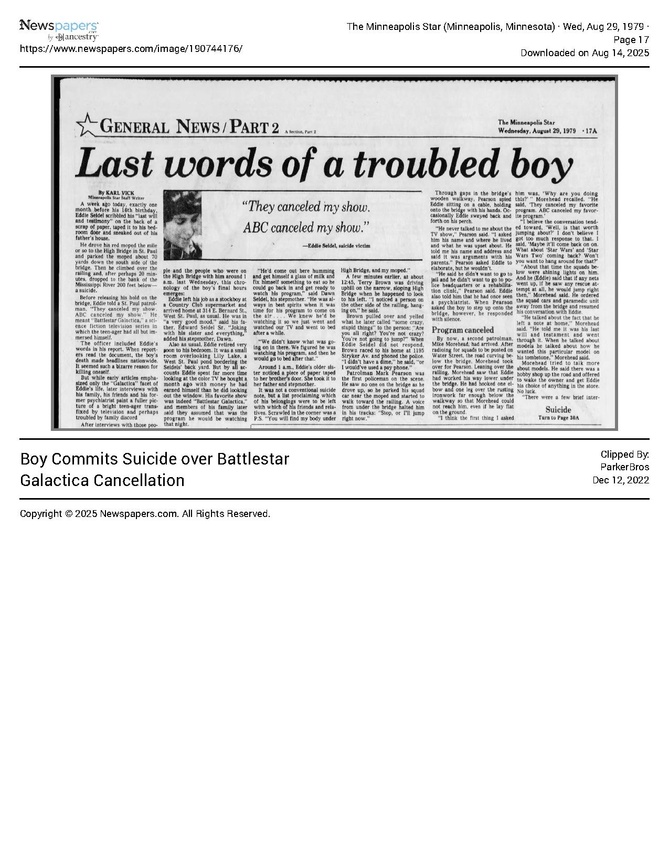
Source:Last Words of a Troubled Boy
More actions
| |||||

Last Words of a Troubled Boy
editBy Karl Vick, Minneapolis Star Staff Writer Wednesday, August 29, 1979
A week ago today, exactly one month before his 16th birthday, Eddie Seidel scribbled his "last will and testimony" on the back of a scrap of paper, taped it to his bedroom door and sneaked out of his father's house.
He drove his red moped the mile or so to the High Bridge in St. Paul and parked the moped about 70 yards down the south side of the bridge. Then he climbed over the railing and, after perhaps 20 minutes, dropped to the bank of the Mississippi River 200 feet below - a suicide.
Before releasing his hold on the bridge, Eddie told a St. Paul patrolman, "They canceled my show. ABC canceled my show." He meant "Battlestar Galactica," a science fiction television series in which the teen-ager had all but immersed himself.
The officer included Eddie's words in his report. When reporters read the document, the boy's death made headlines nationwide. It seemed such a bizarre reason for killing oneself.
But while early articles emphasized only the "Galactica" facet of Eddie's life, later interviews with his family, his friends and his former psychiatrist paint a fuller picture of a bright teen-ager transfixed by television and perhaps troubled by family discord.
After interviews with those people and the people who were on the High Bridge with him around 1 a.m. last Wednesday, this chronology of the boy's final hours emerges:
Eddie left his job as a stockboy at a Country Club supermarket and arrived home at 314 E. Bernard St., West St. Paul, as usual. He was in "a very good mood," said his father, Edward Seidel Sr. "Joking with his sister and everything," added his stepmother, Dawn.
Also as usual, Eddie retired very soon to his bedroom. It was a small room overlooking Lily Lake, a West St. Paul pond bordering the Seidels' back yard. But by all accounts Eddie spent far more time looking at the color TV he bought a month ago with money he had earned himself than he did looking out the window. His favorite show was indeed "Battlestar Galactica," and members of his family later said they assumed that was the program he would be watching that night.
"He'd come out here humming and get himself a glass of milk and fix himself something to eat so he could go back in and get ready to watch his program," said Dawn Seidel, his stepmother. "He was always in best spirits when it was time for his program to come on the air.... We knew he'd be watching it so we just went and watched our TV and went to bed after a while.
"We didn't know what was going on in there. We figured he was watching his program, and then he would go to bed after that."
Around 1 a.m., Eddie's older sister noticed a piece of paper taped to her brother's door. She took it to her father and stepmother. It was not a conventional suicide note, but a list proclaiming which of his belongings were to be left with which of his friends and relatives. Scrawled in the corner was a P.S. "You will find my body under High Bridge, and my moped."
A few minutes earlier, at about 12:45, Terry Brown was driving uphill on the narrow, sloping High Bridge when he happened to look to his left. "I noticed a person on the other side of the railing, hanging on," he said.
Brown pulled over and yelled what he later called "some crazy, stupid things" to the person: "Are you all right? You're not crazy? You're not going to jump?" When Eddie Seidel did not respond, Brown raced to his home at 1195 Stryker Av. and phoned the police. "I didn't have a dime," he said, "or I would've used a pay phone."
Patrolman Mark Pearson was the first policeman on the scene. He saw no one on the bridge as he drove up, so he parked his squad car near the moped and started to walk toward the railing. A voice from under the bridge halted him in his tracks: "Stop, or I'll jump right now."
Through gaps in the bridge's wooden walkway, Pearson spied Eddie sitting on a cable, holding onto the bridge with his hands. Occasionally Eddie swayed back and forth on his perch.
"He never talked to me about the TV show," Pearson said. "I asked him his name and where he lived and what he was upset about. He told me his name and address and said it was arguments with his parents." Pearson asked Eddie to elaborate, but he wouldn't.
"He said he didn't want to go to jail and he didn't want to go to police headquarters or a rehabilitation clinic," Pearson said. Eddie also told him that he had once seen a psychiatrist. When Pearson asked the boy to step up onto the bridge, however, he responded with silence.
By now, a second patrolman, Mike Morehead, had arrived. After radioing for squads to be posted on Water Street, the road curving below the bridge, Morehead took over for Pearson. Leaning over the railing, Morehead saw that Eddie had worked his way lower under the bridge. He had hooked one elbow and one leg over the rusting ironwork far enough below the walkway so that Morehead could not reach him, even if he lay flat on the ground.
"I think the first thing I asked him was, 'Why are you doing this?'" Morehead recalled. "He said, 'They canceled my favorite program. ABC canceled my favorite program.'"
"I believe the conversation tended toward, 'Well, is that worth jumping about?' I don't believe I got too much response to that. I said, 'Maybe it'll come back on. What about 'Star Wars' and 'Star Wars Two' coming back? Won't you want to hang around for that?'"
"About that time the squads below were shining lights on him. And he (Eddie) said that if any nets went up, if he saw any rescue attempt at all, he would jump right then," Morehead said. He ordered the squad cars and paramedic unit away from the bridge and resumed his conversation with Eddie.
"He talked about the fact that he left a note at home," Morehead said. "He told me it was his last will and testament and went through it. When he talked about models he talked about how he wanted this particular model on his tombstone," Morehead said. Morehead tried to talk more about models. He said there was a hobby shop up the road and offered to wake the owner and get Eddie his choice of anything in the store. No luck.
"There were a few brief interludes where I talked him out," the patrolman said. "He gave us his name, he gave us his address. When he gave us his phone number, he said, 'Don't bother to call. I'll be gone before you can call anybody.'"
"I believe it was about this time that he said, 'It's too late now. I'm going to do it.'... We weren't having much luck at all. I've talked to a couple of jumpers before. Two have jumped... of all of them, he was the most determined. He didn't appear to be drunk. He didn't appear to be high. He never got extremely emotional. In fact, he seemed rather calm."
"The only time he got emotional at all was after he counted to 10. Then he said something to the effect that he was sorry and he hoped God would forgive him. And then he disappeared into the darkness."
The paramedics got to his body within 10 seconds. Eddie had landed 20 feet up the hill above Water Street. There were few signs of external injuries, but there was no sign of life either. Eddie was declared dead at the scene. About 10 minutes later, Eddie's father and stepmother arrived and a friend on the paramedic squad broke the news to him: "I knew it was your son, Ed. He looked just like you."
The Seidels did not talk at length with Pearson or Morehead that night, so they did not get an accurate account of Eddie's last words, particularly what he had said about his favorite TV show.
Father asks why
edit"The version we got was 'I canceled my program, Battlestar Galactica,'" Seidel said. "And we thought: Is this something he ordered in the mail or something? Could it be a pamphlet? It could be he canceled this out because he knew he was going to do it (suicide). And we couldn't figure that out."
It was almost a week before Seidel heard that Eddie had told Officer Pearson that he had fought with his parents. Seidel knew that no fight had taken place. Later, he would say, "That's what snowed us! He was so happy when he came home that night."
But he was left groping on the night of Eddie's death; he said, "I asked myself why 10 thousand times that night. I blamed myself. I said, 'What did I do wrong? What didn't I do? Why did he do it?'"
"I couldn't get any reason - until we did go down and read the police report of the actual words that were said between him and Officer Morehead. That convinced me right there."
Both Edward and Dawn Seidel are certain that the program's cancellation motivated the suicide. "If you put all the reasons together through the years... everything's starting to fall into place," Seidel said. "He definitely did run into a problem mind-wise, getting so heavy into this thing that nothing else meant anything in this world more than that did."
Eddie had other interests - he had every record The Beatles ever made - but there is no question that he was a devout, even rabid, fan of television's latest science fiction offering. He had been a fan of "Star Trek" when he was younger. He had made audio tapes of the television shows and printed up memo pads with a "Captain's Log" letterhead.
Reaching for fantasy
editHis mother, Marilyn, remembers his playing "Star Trek" with his friends. She, too, believes Eddie killed himself over "Galactica." "Very definitely," she said. "Very, very definitely. From the time he was little, TV was very big with him. He didn't care whether it was made up or what. It was something that he truly enjoyed. It was almost that he was reaching out for the world to change, that it would be a fantasy, that it would be a Battlestar Galactica."
Eddie joined an adoring line of other science fiction aficionados when "Galactica" took the TV industry by storm in the fall of 1978. Forsaking "Star Trek" reruns, he taped "Galactica" programs, and bought the soundtrack album from the motion picture. "When he'd come home he would go right to his room and (within) not even five minutes we would hear 'Battlestar Galactica' - the music," said his stepmother.
Eddie had his room painted dark blue to more resemble deep space and filled it with every model and poster that had anything to do with "Galactica." The latest was a plastic model of the "Galactica" world's terrain. He threw a tantrum when a hobby shop took too long with his special order for it, and scoured the Twin Cities to find another hobby store that stocked it.
Eddie asked in his will that this model be placed on his tombstone. His parents doubted the plastic would stand up to the weather, so the model was placed in his casket instead.
Eddie's parents have been divorced since 1977. He lived with his mother until six months ago when he moved in with Dawn and Edward Seidel. They called Eddie a "happy-go-lucky kid." They say he decided to kill himself because "Battlestar" didn't appear on his TV set the night of his death.
"Sure, that was the night that they canceled it," his father said. "It was supposed to come on and it didn't. And that's what snapped his mind," said Dawn Seidel. "And that was the end of his world right there. That damn, blasted program - and (remember) the first word he said to the police when they first got to the bridge."
However, "Galactica" last aired Aug. 4, and was never broadcast on Tuesdays. Eddie had known of the cancellation (announced April 23) at least since July 23, when he called ABC to plead that it be continued. He called on other occasions as well, according to Dawn Seidel.
(Julie Hoover, ABC vice president for standards and practices, said that in the case of the "Battlestar" cancellation, there were many appeals from youths to the department that receives complaints from the public. But she said no caller sounded "desperate." If one had, she said, the staff member taking the call would have notified department superiors.)
Dr. Jack V. Wallinga would seize on Officer Pearson's report of Eddie's last words to build a story of an unhappy home life. Wallinga, a child psychiatrist, treated Eddie from December 1975 to April 1976. He states: "I don't think it was the TV."
Seidel hired Wallinga after he caught Eddie getting high by sniffing gasoline. (Seidel granted written permission for Wallinga to review his file on Eddie with The Star.)
The psychiatrist calls Eddie "a pretty sad-looking little boy who spoke up all right and could smile." In IQ tests he landed in the 90th percentile (very bright but short of genius) and "projective" tests revealed "a very empty, sort of depressed guy, especially in the relationship with his father."
Wallinga said Eddie was unhappy three years ago with the large amount of time his father spent working on the family's new home. "Dad didn't play any sports with Eddie. He was too busy working on the house," Wallinga said.
At the time, Seidel and Eddie's mother, Marilyn, were moving toward a February 1977, divorce. Both worked, and Eddie felt neglected, according to Wallinga. The parents' occasional fighting also distressed the boy, and he turned to getting high for escape, said Wallinga.
(Although there is no indication that Eddie experimented with drugs after seeing Wallinga, Officer Pearson said the youth told him on the bridge that he had swallowed pills from the family medicine cabinet in an unsuccessful suicide attempt earlier on the night of his death. The Ramsey County Medical Examiner's office has not completed blood tests, but chief investigator James Essling said he feels there is almost no chance the pills affected Eddie's reasoning.)
Angry school drawing
editDespite his high IQ scores, Eddie was held back in fifth grade and his ninth grade marks were only a little above average. He graded highest in math and science, subjects his father said Eddie tried harder in because his most recent ambition was to be an astronaut. Eddie had hated school, Seidel said, but was looking forward to attending senior high because it offered more elective courses. A sketch Eddie drew for Wallinga showed a school in flames. "That's a fairly angry drawing," the doctor said.
Wallinga also noted that Eddie was born with a congenital hip "problem" and spent a year of his infancy in a body cast. "The cast puts you into a shell," Wallinga said. "Touching, handling, that can be care that babies need."
Before concluding his treatment, Wallinga urged the parents to spend more time with Eddie, and instructed them to return for more counseling if matters worsened. "It sounds like (matters) did," he said Tuesday. "I think this was an empty boy in an empty marriage."
About television, Wallinga said Eddie was a "Star Trek" fan and threw tantrums if his TV time was cut down, but TV "wasn't prominent then. It was what he turned to when he was bored and nothing was going on."
"He didn't have the resources or support to make it through adolescence, which is a high-risk time for suicide, when you might not see far enough into the future when things might change."
Neither Edward nor Marilyn Seidel were told of Wallinga's theories, but both asserted earlier in separate interviews that their divorce only faintly affected their son emotionally. They do not blame television, or ABC, but they feel that the box in the bedroom contributed directly to Eddie's death.
"If people would read this article and realize what an impact TV has on children, particularly if they don't have outside interests," said Marilyn Seidel. "I know what TV does to family life. You don't do as much. You sit there in front of that dumb thing."
Digital Scan
edit