


Ancient Kobolian: Galleon
Galactica type battlestar
From the only original and legitimate Battlestar Wiki: the free-as-in-beer, non-corporate, open-content encyclopedia, analytical reference, and episode guide on all things Battlestar Galactica. Accept neither subpar substitutes nor subpar clones.
More languages
More actions
| Galactica type battlestar | |||
|---|---|---|---|

| |||
| [show/hide spoilers] Spoilers hidden in infobox by default only. | |||
| Race: | Colonial | ||
| Type: | Military | ||
| FTL: | Yes (at least 2 drives[1]) | ||
| Propulsion: | * 6 sublight engines * 40 maneuvering engines (in 10 clusters of 4)[2] | ||
| Crew: | 5,000 | ||
| Capacity: | |||
| CO: | {{{co}}} | ||
| XO: | {{{xo}}} | ||
| Role: | Battleship/carrier | ||
| Weapons: | {{{weapons}}} | ||
| Armaments: | * 24-50 primary batteries (configuration-dependent) * ~514 dual-barrelled point-defense batteries * ~12 missile tubes | ||
| Defenses: | {{{def}}} | ||
| Aircraft: | * Full Viper compliment * Full Raptor compliment | ||
| Aviation facilities: | * 2x flight pods * 2x flight decks: 617 m (2,025 ft) each * 80 Viper launch tubes | ||
| Emblem: | [[File:{{{patch}}}|175px|Ship's patch]] | ||
| Other Images: | Gallery | ||
| Dimensions | |||
| Length: | 4719.95ft (1438.64m)[3] | ||
| Width: | 1761.29ft (536.84m)[4] | ||
| Height: | 601.43ft (183.32m) | ||
| Weight: | {{{weight}}} | ||
| Wingspan: | {{{wingspan}}} | ||
| Other: | The dimensions above are from Lee Stringer, who built Galactica CG model. VFX Sequence Designer Adam "Mojo" Lebowitz gave the length as 4740 feet (1444.8m).[5] The reason for this twenty-foot discrepancy is unknown. | ||
| Cost: | {{{construction}}} | ||
| Construction Time: | {{{construction}}} | ||
| Hull Size: | {{{hull size}}} | ||
| Hull: | {{{hull}}} | ||
| FTL Cooldown: | {{{ftl cooldown}}} turns | ||
| Speed: | {{{speed}}} m/s | ||
| Turn Rate: | {{{turn rate}}}°/turn | ||
| Armor Total: | {{{armor total}}} | ||
| Armor Left: | {{{armor left}}} | ||
| Armor Right: | {{{armor right}}} | ||
| Armor Front: | {{{armor front}}} | ||
| Armor Rear: | {{{armor rear}}} | ||
| Armor Top: | {{{armor top}}} | ||
| Armor Bottom: | {{{armor bottom}}} | ||
| DRADIS Range: | {{{dradis range}}} m | ||
| Processing Power: | {{{processing power}}} | ||
| Munition Slots: | {{{munitions}}} | ||
| Munition Cooldown Period: | {{{munition cooldown}}} turns | ||
| Squadron Slots: | {{{squadrons}}} | ||
| Squadron Size: | {{{squadron size}}} | ||
| Special Abilities: | {{{special abilities}}} | ||
| Additional Information | |||

|
This article discusses the Re-imagined Series battlestar class. For other meanings of Galactica, see Galactica (disambiguation).
|
|
The Galactica-type battlestar[6], erroneously known as a Jupiter-class in apocrypha works, is a Colonial capital ship that combines the functions of an aircraft carrier and a battleship[7]. It was designed and deployed after the outbreak of hostilities between the Cylons and Colonials. A few ships of this class remain in service over 40 years after the end of the Cylon War; however, most were retired shortly after the War ended.
Overview
edit
The class was designed and deployed by the Colonial Fleet in the early days of the First Cylon War, quite possibly as part of the Articles of Colonization, with 12 ships initially being built by, and representing, each of the Colonies (TRS: "Miniseries"). They included Galactica, Columbia, Athena, and Archeron. They formed the lead ships of Cylon War-era Battlestar Groups, and were represented in almost every major engagement of the War.
The original battlestars were space-going leviathans of more than 4,700 feet (1,440 meters) in length, designed to tackle the Cylon threat head on. They featured powerful gun batteries that ran up the center of the hull, numerous point defense turrets, and many missile silos, but their main show of force came from the multiple Viper stacks housed in the flight pods, which held up to a thousand Vipers. Initially, these stacks ran multiple stories, but were removed as the war died down (TRS: "Blood and Chrome" and "Razor Flashbacks").
Unfortunately, the class didn't hold up well to the Cylon threat, with only Galactica, Athena, and a third unnamed ship surviving the war. [8] Despite this, newer Galactica-type ships were built, with newer technologies, which still remained in service at the time of the Fall of the Colonies. However, Galactica was never upgraded, and remained in its Cylon War outfit at the time of its retirement 40 years after the war. [9]
Eventually, the class is phased out in favor of the smaller Valkyrie type battlestars, and the newer Mercury class battlestars, however was inadvertently survived by Galactica for nearly 5 years after the Fall of the Colonies.
Layout
editThe design common to Galactica and its sister ships can be broken down into two main sections: the main hull and the twin flight pods.
Main hull
editThis comprises the bulk of a battlestar and can itself be divided into three sections:
- The fore section: Also known as the "alligator head," contains much of the living and crew areas, including the CIC, War Room, observation deck, , crew quarters, comfort facilities, pilots' rec room, sickbay, and numerous airlocks. This section also includes the main water tanks and water transfer hatches.
- The mid section: Contains the main flight decks, flight pod retraction mechanisms, and service areas for the transfer of planes and pilots from flight pod, to flight pod. This section also houses the main gun batteries, missile launch tubes and support systems and corresponding ammunition stores (TRS: "Miniseries").
- The stern section: Contains the ship's engine room, engine pods, FTL drives, and auxiliary facilities needed to maintain the ship's propulsion.
Flight pods
edit- Main article: Flight pod
The flight pods serve as the most critical feature of the battlestar. They are designed to launch and retrieve support ships such as Vipers and Raptors, as well as various other support craft such as Thera Sita, and even Colonial One. The pods on Galactica type are designed to retract into the main body of the ship, primarily for FTL operations, and support ship transfers. Under normal operations, the pods are expanded out to provide a safe landing and support area for the ship's CAP. The pods also feature airlocks that can be used to dock the entire battlestar to a drydock or an orbital station for the safe transfer of personnel and equipment.
Each flight pod comprises two main decks for flight operations: the upper landing bay, which extends the full length of the pod, and the lower launch bays, which provide some 40 launch tubes per pod. The hangar deck, located under the landing bay, is used for maintenance, repair, refueling, rearming, and launch operations and runs the length of the flight pod.
Landing approaches are made from the stern. The preferred approach is a slow run into the landing bay, prior to making a vertical landing on a defined landing area (TRS: "Act of Contrition"). However, in emergencies, combat landings can be made, in which a craft approaches and lands at high speed on its landing skids (TRS: "Miniseries").
Orthographics
edit-
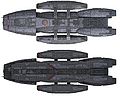 Top and bottom of Galactica.
 -
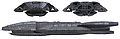 Front, back, and side of Galactica.
 -
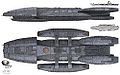 Size comparison to Nimitz.
Specifications
editPropulsion
edit
- Main article: Propulsion in the Re-imagined Series
A Galactica-type battlestar relies on six sublight engines for primary thrust, alongside 40 maneuvering engines in 10 clusters of 4 situated at key points around the ship. The primary sublight engines are arranged with four main units at the stern, one on each corner with an additional two units in the center [10] A Galactica-type can run with only the four corner engines engaged to save fuel, but normally runs with all six. The sublight engines generate so much thrust, that despite its massive bulk, Galactica can reach flank speeds from a standstill almost instantaneously, as demonstrated during the Battle of the Colony (Daybreak, Part II)
Despite their massive size, battlestars are extremely maneuverable and can dock with space stations such as Ragnar Anchorage. Battlestars are not designed for atmospheric flight, although their hulls can manage a tenuous upper atmospheric storm like that surrounding the gas giant Ragnar (TRS: "Miniseries") and can survive a jump and subsequent freefall into the atmosphere of a habitable planet (TRS: "Exodus, Part II"). A battlestar's FTL systems are capable of accurate jumps, capable of placing it safely in the midst of an asteroid field and of placing it in synchronous orbit above a relatively close planet (TRS: "The Hand of God"), a dense fleet of ships (TRS: "Scattered"), or a planetary atmosphere. However, they are grossly inferior to Cylon systems in terms of safe range (TRS: "Kobol's Last Gleaming, Part I").
Endurance
editBattlestars are intended to operate for long periods without re-supplying. Their water purification capabilities alone are so efficient that, barring an emergency or unforeseen event, a battlestar can operate "for several years before replenishing" (TRS: "Water"). They also appear capable of undertaking large-scale repairs following battle damage (TRS: Miniseries, "Water"). They have ammunition-manufacturing capabilities in the armory (TRS: "Epiphanies") and may have small general fabrication facilities (TRS: "Litmus"). In terms of food supplies, canned goods and vegetable stores are kept in titanium lockers (TRS: "Final Cut"). Battlestars are capable of continuing combat operations despite suffering massive damage, as evidenced by Galactica's continuing effectiveness at defending the fleet years after the first Cylon attack and following several punishing engagements (TRS: "He That Believeth in Me").
Computer systems
edit- Main article: Computers in the Re-imagined Series
The twelve original battlestars deliberately avoided the use of networked primary computer systems during the Cylon War, as Cylon forces were adept at infiltrating and subverting such systems (TRS: "Miniseries").
On Galactica, in the post-Cylon War era, these primary computers remained isolated by practice on order of its last pre-Holocaust commanding officer, William Adama. This no-networks practice saved Galactica from the fate of its sister battlestars in the Fall of the Twelve Colonies as Galactica's no-network order meant that the CNP, installed in almost all Colonial Fleet vessels at the time, could not be used aboard Galactica as the CNP was designed for use with a computer network.
In one dire instance in the early months of their exodus, Galactica networks its primary computers temporarily to aid in computation speeds for jump calculations needed to find the missing civilian Fleet (TRS: "Scattered"), but it is not without consequence. One or more computers are cracked during a Cylon attack with a Cylon virus, which proves resistant to removal and (weeks later) threatens the operation of the battlestar until the computers' hard drives are erased and restored from pre-Fall backup sets (TRS: "Flight of the Phoenix").
Armament
edit

- Main article: Weapons in the Re-imagined Series
- 24 or 50 (depending on configuration) (First Cylon War (TRS: "Blood and Chrome")) large antiship gun turrets (mounting 2 guns apiece) [11]
- These are mounted on the dorsal and ventral surfaces of the main hull and the ventral surface of the bow. The two guns on each turret fire in tandem. They have been shown to be quite effective against targets like basestars (TRS: "Resurrection Ship, Part II"). These large guns are able to use both high-explosive anti-capital ship shells and FlaK ammunition. Additionally, the guns are able to engage in coordinated barrage strategies, such as salvo (and presumably, volley) fire.

- 514 smaller point-defense turrets (mounting 2 guns apiece)[12]
- These are mounted on the flight pods and other surfaces. Each barrel fires explosive rounds in bursts.
- Multiple nuclear warheads[13]
- Deployed from 12 launch tubes mounted in the dorsal main hull (TRS: "The Eye of Jupiter").
- Even the latest Viper Mark VIIs remain compatible with this class's launch and recovery facilities.
Crew
editDuring the First Cylon War, Galactica-type battlestars housed at least 5,000 crew and staff members (for a fully operational ship), with many of these being support personnel such as Viper pilots and Viper technicians. That number is drastically reduced following the Armistice, with many mustering out of service, and advancements in technology eliminating the need for certain service positions (for example, manned gun batteries). By the Fall of the Twelve Colonies, these and the newer Mercury-class battlestars have a crew of no more than 2,500 to 3,000 people. In Galactica's case, it is suggested the ship is understaffed due to its decommissioning; however, the crew is still able to operate the battlestar, even in a time of war, with little to no loss of function[16].
Life support
editApproximately twelve oxygen re-circulation units are mounted throughout the ships of this class, which replenish oxygen as well as remove ("scrub") carbon dioxide from the air. These devices work continuously (TRS: "Final Cut").
Corridors and Causeways
edit
Various corridors and causeways interconnect various rooms and areas aboard ship, lined with various panels, including intercommunication phones and other instrumentation.
Each hatch connecting a corridor to a room is typically labeled from the outside, and features unique identification markers to communicate positioning and direction aboard ship.
Fire alarm panels are placed for easy access in the event of a fire aboard ship. Gaius Baltar uses one such panel to temporarily evacuate the medlab in his attempt to erase manufactured evidence (TRS: "Six Degrees of Separation").
Ships In Class
edit

Notes
edit- In the tenth chapter of The Science of Battlestar Galactica, Galactica is referred to as a Jupiter-class battlestar by Gary Hutzel. This, however, is in direct contradiction to numerous on-screen props and set pieces, which either note these as either a Galactica class battlestar or Battlestar class. While Jupiter-class was adopted by Battlestar Galactica Deadlock in its storyline, it is in its own separate continuity that is not directly contributed to by the original creatives, despite its being a licensed work.
References
edit- ↑ Tigh: "Engineering/Combat. Please spin up FTL drives One and Two." (TRS: "Miniseries")
- ↑ Originally sourced to Zoic without explanation.
- ↑ These dimensions (in meters) were derived from the CG model and posted by Lee Stringer on the StarshipBuilder.com forums, which are no longer available. They are the most precise so far. The width with pods extended and the height are quoted here verbatim; the length was calculated by adding the posted dimension for the front of the ship (766.04m) to the posted dimension for the back (672.6m). The full set as provided by Lee Stringer is as follows: "Width (Pods out) 536.84m (Pods In) 352.34m Engines Max 359.38m Head Max 334.58m Length: Front (Main body) 730.65m (Antenee) 766.04m Back 672.6m (using the center of the two arms as the middle) Height (Armor/Mainbody) 181.825m (Details) 183.315m".
- ↑ This is from flight pod to flight pod while they are extended.
- ↑ Blog comment by Adam "Mojo" Lebowitz.
- ↑ This is a Battlestar Wiki descriptive term.
- ↑ The September 2006 Maxim issue contained a photoshoot, including this picture showing the weapons control room in the CIC. A printout on the table reads "Galactica class battlestar". This appears again in "Rapture" when William Adama arms the nuclear ordnance for deployment during a stand-off regarding the The Temple of Hopes.
- ↑ The series bible implies that the Athena was one of only three ships of Galactica's class to survive the war. As such it is likely that the Athena was one of the battlestars involved in "Operation Raptor Talon".
- ↑ Aaron Doral's comment at the start of the Miniseries, that Galactica is the "last of her kind," suggests that other Galactica type battlestars still in service use equipment that may be entirely different, regardless of the external configuration. Doral could also be referring to the lack of computer networks on Galactica as opposed to the rest of the fleet, which still indicates hardware upgrades during the vessels' lifetimes.
- ↑ Early episodes show that each engine unit has a singular thruster, yet Galactica in Daybreak Part II is shown to have a mix of small and large thrusters within each engine unit. This is likely a continuity error.
- ↑ These are rail guns (Battlestar Galactica RPG) 1 and 2 mark the position of these guns, with 8 on the dorsal and 12 on the ventral hull (of which 8 are mounted on the bow). Note that 2 turrets on either side of the bow are partially obscured and not marked in image 1.
- ↑ Number of the guns on the CGI model by Zoic, does not account for dorsally mounted and ventrally mounted guns
- ↑ As of the episode "Bastille Day," Galactica was equipped with five nuclear warheads. This may be lower than the typical number, since Galactica was in the process of being decommissioned and had already had most of its ammunition removed. If this is the case, we must conclude that Galactica was unable to reload its supply of nuclear arms at Ragnar Anchorage (a sensible proposition, given the ease with which purported arms smuggler Leoben Conoy was able to gain access to the facility).
- ↑ After the destruction of 20 Vipers during the Cylon attack, Galactica was still able to muster a 40-Viper strong defensive screen by combining their remaining squadron of Mk. VII Vipers with a full squadron of Mk. II Vipers from a museum exhibit in the starboard flight pod. This suggests that Galactica, with a single operational flight pod, was fielding two squadrons from it, and that when fully operational it could have fielded an additional two squadrons from the starboard pod.
- ↑ At the time of the Cylon attack, Galactica was apparently equipped with at least eight.
- ↑ According to a crew tally, Galactica is staffed by approximately 2,700 people at the time of its decommissioning. The full crew complement would be higher as has been indicated as roughly twice as high by some sources.