


|
For information on the battlestars of the Re-imagined Series, see Galactica type battlestar and Mercury class battlestar. For information on the battlestar seen in the 2003 Video Game, see Galactica (2003 Video Game).
|
|
| Battlestar | |||
|---|---|---|---|

| |||
| [show/hide spoilers] Spoilers hidden in infobox by default only. | |||
| Race: | Colonial | ||
| Type: | Military | ||
| FTL: | Yes | ||
| Propulsion: | 2 x FTL engines, 2 x sublight engines, 2 x Solium main energizers (TOS: "Fire in Space") | ||
| Crew: | 496 - 1,012 | ||
| Capacity: | |||
| CO: | {{{co}}} | ||
| XO: | {{{xo}}} | ||
| Role: | Carrier / battleship hybrid | ||
| Weapons: | 15 x laser batteries, 12 x Solonite air-to-air missiles, 1 x Heavy Mega Pulsar Cannons, 75 Viper fighters, 12 Landram armoured ground vehicles, Six unarmed shuttlecraft [citation needed] | ||
| Armaments: | {{{arm}}} | ||
| Defenses: | {{{def}}} | ||
| Aircraft: | {{{aircraft}}} | ||
| Aviation facilities: | {{{facilities}}} | ||
| Emblem: | [[File:{{{patch}}}|175px|Ship's patch]] | ||
| Other Images: | Gallery | ||
| Length: | (approx): 4,143-4,166ft (1,263-1,255m) | ||
| Width: | (approx): 1,672ft (510m) (flight pod to flight pod) | ||
| Height: | |||
| Weight: | |||
| Wingspan: | {{{wingspan}}} | ||
| Other: | Flight Pods Length (approx): 1,977ft (603m) Width (approx): 351ft (107m) | ||
| Cost: | {{{construction}}} | ||
| Construction Time: | {{{construction}}} | ||
| Hull Size: | {{{hull size}}} | ||
| Hull: | {{{hull}}} | ||
| FTL Cooldown: | {{{ftl cooldown}}} turns | ||
| Speed: | {{{speed}}} m/s | ||
| Turn Rate: | {{{turn rate}}}°/turn | ||
| Armor Total: | {{{armor total}}} | ||
| Armor Left: | {{{armor left}}} | ||
| Armor Right: | {{{armor right}}} | ||
| Armor Front: | {{{armor front}}} | ||
| Armor Rear: | {{{armor rear}}} | ||
| Armor Top: | {{{armor top}}} | ||
| Armor Bottom: | {{{armor bottom}}} | ||
| DRADIS Range: | {{{dradis range}}} m | ||
| Processing Power: | {{{processing power}}} | ||
| Munition Slots: | {{{munitions}}} | ||
| Munition Cooldown Period: | {{{munition cooldown}}} turns | ||
| Squadron Slots: | {{{squadrons}}} | ||
| Squadron Size: | {{{squadron size}}} | ||
| Special Abilities: | {{{special abilities}}} | ||
| Additional Information | |||
Battlestars are warships built by the The Twelve Colonies of Man (colloquially known as "Colonials") in direct response to the generational war with the Cylons.
Overview
editThe first battlestars were introduced into Colonial forces around 500 yahren into the war, and proved formidable when placed against the technically-superior Cylon basestars. Many battlestars were totally destroyed during significant battles.
Known Battlestars
editThe battlestars[1] specifically mentioned in the Original Series are:
- Acropolis - mentioned in connection with the attack at Cimtar, and so assumed to be one of the battlestars seen near the moon
- Atlantia - destroyed by the Cylons at Cimtar (TOS: "Saga of a Star World")
- Columbia[2] - destroyed by the Cylons at Cimtar (TOS: "The Gun on Ice Planet Zero, Part I", "The Gun on Ice Planet Zero")
- Galactica
- Pacifica - mentioned in connection with the attack at Cimtar, and so assumed to be one of the battlestars seen near the moon
- Pegasus - presumed destroyed at the Battle of Gamoray (TOS: "The Living Legend, Part II", "The Living Legend")
- Rycon - destroyed at the Battle of Cosmora Archipelago (TOS: "Take the Celestra")
- Triton - mentioned in connection with the attack at Cimtar, and so assumed to be one of the battlestars seen near the moon
Myth of the Twelve Battlestars
editFor contrast, in the Re-imagined Series continuity, it is stated at the start of the Miniseries that twelve battlestars were initially built during the Cylon War. However, in the years of and after the Cylon War, an additional 120 battlestars of various classes were built in that continuity. Like its Original Series counterparts, almost all of these battlestars are destroyed in an elaborate Cylon subterfuge.
Capabilities
edit-
 Turrets in recessed bays along the outermost side of the launch bays (TOS: "Saga of a Star World").
 -
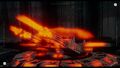 A laser turret firing (TOS: "Saga of a Star World").
 -
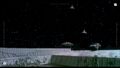 A rotating, not-recessed surface laser turret (TOS: "Saga of a Star World").


Notes on Dimensions and Scale
editThe length and beam figures given here are based on research carried out by Todd Boyce, a computer animator. There are many differing claims to the actual size of the original battlestars, ranging from some 2,000 feet[4] (the accepted length in a number of gaming systems) through to 2-3 miles in overall length.
Interviews with series creator Glen A. Larson and John Dykstra, the Visual Effects supervisor for the Original Series stated that the original Galactica was around a mile (1.6km) long. If the scale of the master model used for filming was set at 1/960, then the overall length of Galactica and her sister ships would be some 6,080ft (1,853m) - or one nautical mile. However, there is no confirmation available that 1/960 (1 inch = 80ft) was in fact the scale of the model, and the figures have thus been "back engineered" to fit the case. (It should be noted that Dykstra admitted that "[e]verything has to be exaggerated and the fill ratio of the screen has to be higher".[4])

In undertaking his work, Boyce utilized an established baseline for his calculations: the full-size mock-up of a Viper built for filming purposes. This mock-up measured some 28.5ft (9m) in length and a wingspan of some 12.5ft (4m), and formed a means by which Boyce could take key shots from various episodes, combine them with a scale model of Galactica and extrapolate a reasonably-consistent set of measurements. Thus: using film footage alone, Boyce was able to determine the length of Galactica to be some 4,143ft (1,263m), while use of a scale model produced a figure of some 4,166ft (1,270m): an acceptable difference of some 23ft (7m). What is more, these measurements appear consistent with the overall size of the Viper launch tubes, calculated at some 16ft (5m) in diameter, based on the wingspan of the full-size mock-up and images of Vipers being launched.
Given this degree of similarity in final calculations, these figures have been adopted here as the probable dimensions of the Original Series battlestars. However, in using these figures, it should be noted that:
- Boyce also used a Cylon Raider as a benchmark for his calculations, and produced an overall length for Galactica at between 12,818ft (3,907m) and 21,210ft (6,465m) (2.4 and 4 miles). However, these measurements can be discounted on the grounds that:
- They are initially based on assumed data: a shot of a Cylon Raider apparently "overflying" a Colonial Viper. However, no vertical separation distance between the two can be calculated, leading to a completely arbitrary figure (39ft/12m) for the wingspan of the Raider
- These figures would yield launch tubes between some 50ft (15m) and 82ft (25m) in diameter - which is clearly not supported by film of Viper launches.
- Boyce also used close-up shots of Viper launches to try and calculate the size of Galactica, and arrived at a figure of 2,712ft (827m), with the flight pods measuring 1,294ft (394m). However, these figures cannot be taken at face value, as they would render the Viper launch tubes with a 10.4ft (3m) diameter, making them too small to contain Vipers.
Note: As Boyce used the mock-up Viper he made a fatal assumption of it being exactly in scale with the actual on screen SFX model. That is unfortunately not the case. The mock-up Viper is smaller and less detailed, hence, cheaper and easier to construct. The difference is (exactly) 10% resulting in a length of 10 m and a wingspan of 4.5-5 m. This brings the Battlestar to about 1400 m. As BSG was made in light of Star Wars there is the possibility that it's size was intended to be the same as a Stardestoyer (1.5 km).
Note by the researcher: The research page points out that there are proportional differences between the mock-up and the studio model of the Viper, and that the mock-up is used because it had definitive dimensions whereas the filming miniature does not. The studio model is longer in proportion, but it is not necessarily taller or wider (which a second line of research investigated). More definitive research on the matter would need to take place before any claims such as it being "10% larger" could be verified since there are many factors to consider.
Likewise, a Raider overflying a Viper, while not a truly accurate means of measurement, does in fact set the largest dimensions the Raider could possibly be and is therefore useful in the research in demonstrating how the blueprint dimensions did not correspond with the on-screen evidence, at least in that shot. The 39ft measurement is the largest it could be in that shot which is far smaller than the mock-up would indicate. It should also be pointed out that a 39ft wingspan for the raider would yield an approximately 7ft wide cockpit - a bit tight for three Cylon Centurions to fit in.
Ultimately these are not "fatal assumptions" in the research, nor can research be "thrown out" since it is impossible to determine a truly accurate measurement of the ship with multiple valid sources of conflicting evidence. The research page clearly indicates that the reader is to decide for themselves what the results mean, and that like most science fiction shows, the effects are not suited to this kind of scrutiny.
Updated Notes on Dimensions
editThe one missing piece of information in studies like the one above is the actual diameter of the launch tube openings on the studio miniature. As someone who has spent years studying the filming model, and has designed and helped to build a very precise replica of it that is currently on display at the EMPSFM Science Fiction Museum in Seattle, Washington (see External Links section), I know these openings were 1/4 inch in diameter.
Having drawn the studio miniature in precise detail, including in 3D, I determined that a 27-28 foot Viper fits inside the tubes quite nicely if the studio model scales out to one nautical mile in length. In fact, the tubes scale out to 20 feet in diameter. Anything smaller would clip the wings of the Vipers. Don't forget there are pipes, bulkheads, and other details inside the round tubes that require clearance as well. So, I'm not quite sure how you could work it out if the ship were to be substantially smaller. Also, this value does coincide with John Dykstra's estimate that was quoted in vintage magazine articles of the period.
Charles Adams, StarshipBuilder.com
About The Filming Model
editThe ship model for Galactica was 6 feet in length and weighed 60 pounds. The model was built from various parts from hundreds of cannibalized plastic model kits, such as those from mini-scaled battleships, land vehicles and planes from the World War II era, to the point that "the crew had the feeling that, if it hadn't been for World War II, Galactica (the model) would not have been possible".[4]
Notes
edit- According to Encyclopedia Galactica, a non-canonical piece of merchandise published in 1979:
Battlestars are constructed in planetary orbit. Battlestars have a maximum range of 500 light-yahren before refueling, although this can be affected by high-speed maneuvering and the use of weapons, which are powered by the same fuel source as the engines.
Battlestars contain eight squadrons of Vipers, in addition to being armed with "banks of turret-mounted laser cannon, strategically mounted to defend most vital areas of the ship from head-on attack" and "space-to-space torpedoes" capable of destroying larger enemy craft.
For shielding, battlestars use a "powerful radiation field" capable of deflecting most laser attacks and heavy armor plating to dampen explosive ordnance, like torpedoes or missiles. Furthermore, battlestars are split into segments that can be sealed should the hull be compromised, so the entire ship is not lost.
For propulsion, battlestars "are powered to sub-light speeds by twin solium energizers that convert matter directly into propulsive force. Tylium thrusters boost the ship past the light barrier; on full power, speeds of light times ten have been attained."
Battlestars are crewed by 500 people and consists of various facilities, "including a 100 bed life-station, a fully equipped rejuvenation center and a variable-gravity gymnasium".[5]
References
edit- ↑ The Costume Department at New West has indicated that three further battlestars may have been referenced had the show been renewed: the Solaria, Cerberus and Prometheus. This information, however, is not canonical.
- ↑ Many fans consider Columbia to be the battlestar class name. However, this is fan fiction: No substantiated class name has been given by official sources to the battlestars of the Original Series.
- ↑ Kraus, Bruce (1979). Encyclopedia Galactica, p. 19.
- ↑ 4.0 4.1 4.2 Meyers, Richard (August 1978). "Get Ready For... BATTLE STAR "GALACTICA"". Starlog: 52-53.
- ↑ Kraus, Bruce (1979). Encyclopedia Galactica, p. 19-20.
| Battlestar | |||
|---|---|---|---|

| |||
| [show/hide spoilers] Spoilers hidden in infobox by default only. | |||
| Race: | Colonial | ||
| Type: | Military | ||
| FTL: | Yes (at least 2 drives[1]) | ||
| Propulsion: | * 6 sublight engines * 40 maneuvering engines (in 10 clusters of 4)[2] | ||
| Crew: | 5,000 | ||
| Capacity: | |||
| CO: | {{{co}}} | ||
| XO: | {{{xo}}} | ||
| Role: | Battleship/carrier | ||
| Weapons: | {{{weapons}}} | ||
| Armaments: | * 24-50 primary batteries (configuration-dependent) * ~514 dual-barrelled point-defense batteries * ~12 missile tubes | ||
| Defenses: | {{{def}}} | ||
| Aircraft: | * Full Viper compliment * Full Raptor compliment | ||
| Aviation facilities: | * 2x flight pods * 2x flight decks: 617 m (2,025 ft) each * 80 Viper launch tubes | ||
| Emblem: | [[File:{{{patch}}}|175px|Ship's patch]] | ||
| Other Images: | Gallery | ||
| Dimensions | |||
| Length: | 4719.95ft (1438.64m)[3] | ||
| Width: | 1761.29ft (536.84m)[4] | ||
| Height: | 601.43ft (183.32m) | ||
| Weight: | {{{weight}}} | ||
| Wingspan: | {{{wingspan}}} | ||
| Other: | The dimensions above are from Lee Stringer, who built Galactica CG model. VFX Sequence Designer Adam "Mojo" Lebowitz gave the length as 4740 feet (1444.8m).[5] The reason for this twenty-foot discrepancy is unknown. | ||
| Cost: | {{{construction}}} | ||
| Construction Time: | {{{construction}}} | ||
| Hull Size: | {{{hull size}}} | ||
| Hull: | {{{hull}}} | ||
| FTL Cooldown: | {{{ftl cooldown}}} turns | ||
| Speed: | {{{speed}}} m/s | ||
| Turn Rate: | {{{turn rate}}}°/turn | ||
| Armor Total: | {{{armor total}}} | ||
| Armor Left: | {{{armor left}}} | ||
| Armor Right: | {{{armor right}}} | ||
| Armor Front: | {{{armor front}}} | ||
| Armor Rear: | {{{armor rear}}} | ||
| Armor Top: | {{{armor top}}} | ||
| Armor Bottom: | {{{armor bottom}}} | ||
| DRADIS Range: | {{{dradis range}}} m | ||
| Processing Power: | {{{processing power}}} | ||
| Munition Slots: | {{{munitions}}} | ||
| Munition Cooldown Period: | {{{munition cooldown}}} turns | ||
| Squadron Slots: | {{{squadrons}}} | ||
| Squadron Size: | {{{squadron size}}} | ||
| Special Abilities: | {{{special abilities}}} | ||
| Additional Information | |||
|
|
This article discusses the Re-imagined Series battlestar class. For other meanings of Galactica, see Galactica (disambiguation).
|
|
The Galactica-type battlestar[6], erroneously known as a Jupiter-class in apocrypha works, is a Colonial capital ship that combines the functions of an aircraft carrier and a battleship[7]. It was designed and deployed after the outbreak of hostilities between the Cylons and Colonials. A few ships of this class remain in service over 40 years after the end of the Cylon War; however, most were retired shortly after the War ended.
Overview
edit
The class was designed and deployed by the Colonial Fleet in the early days of the First Cylon War, quite possibly as part of the Articles of Colonization, with 12 ships initially being built by, and representing, each of the Colonies (TRS: "Miniseries"). They included Galactica, Columbia, Athena, and Archeron. They formed the lead ships of Cylon War-era Battlestar Groups, and were represented in almost every major engagement of the War.
The original battlestars were space-going leviathans of more than 4,700 feet (1,440 meters) in length, designed to tackle the Cylon threat head on. They featured powerful gun batteries that ran up the center of the hull, numerous point defense turrets, and many missile silos, but their main show of force came from the multiple Viper stacks housed in the flight pods, which held up to a thousand Vipers. Initially, these stacks ran multiple stories, but were removed as the war died down (TRS: "Blood and Chrome" and "Razor Flashbacks").
Unfortunately, the class didn't hold up well to the Cylon threat, with only Galactica, Athena, and a third unnamed ship surviving the war. [8] Despite this, newer Galactica-type ships were built, with newer technologies, which still remained in service at the time of the Fall of the Colonies. However, Galactica was never upgraded, and remained in its Cylon War outfit at the time of its retirement 40 years after the war. [9]
Eventually, the class is phased out in favor of the smaller Valkyrie type battlestars, and the newer Mercury class battlestars, however was inadvertently survived by Galactica for nearly 5 years after the Fall of the Colonies.
Layout
editThe design common to Galactica and its sister ships can be broken down into two main sections: the main hull and the twin flight pods.
Main hull
editThis comprises the bulk of a battlestar and can itself be divided into three sections:
- The fore section: Also known as the "alligator head," contains much of the living and crew areas, including the CIC, War Room, observation deck, , crew quarters, comfort facilities, pilots' rec room, sickbay, and numerous airlocks. This section also includes the main water tanks and water transfer hatches.
- The mid section: Contains the main flight decks, flight pod retraction mechanisms, and service areas for the transfer of planes and pilots from flight pod, to flight pod. This section also houses the main gun batteries, missile launch tubes and support systems and corresponding ammunition stores (TRS: "Miniseries").
- The stern section: Contains the ship's engine room, engine pods, FTL drives, and auxiliary facilities needed to maintain the ship's propulsion.
Flight pods
edit- Main article: Flight pod
The flight pods serve as the most critical feature of the battlestar. They are designed to launch and retrieve support ships such as Vipers and Raptors, as well as various other support craft such as Thera Sita, and even Colonial One. The pods on Galactica type are designed to retract into the main body of the ship, primarily for FTL operations, and support ship transfers. Under normal operations, the pods are expanded out to provide a safe landing and support area for the ship's CAP. The pods also feature airlocks that can be used to dock the entire battlestar to a drydock or an orbital station for the safe transfer of personnel and equipment.
Each flight pod comprises two main decks for flight operations: the upper landing bay, which extends the full length of the pod, and the lower launch bays, which provide some 40 launch tubes per pod. The hangar deck, located under the landing bay, is used for maintenance, repair, refueling, rearming, and launch operations and runs the length of the flight pod.
Landing approaches are made from the stern. The preferred approach is a slow run into the landing bay, prior to making a vertical landing on a defined landing area (TRS: "Act of Contrition"). However, in emergencies, combat landings can be made, in which a craft approaches and lands at high speed on its landing skids (TRS: "Miniseries").
Orthographics
edit-
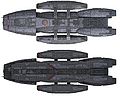 Top and bottom of Galactica.
 -
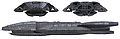 Front, back, and side of Galactica.
 -
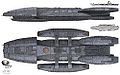 Size comparison to Nimitz.


Specifications
editPropulsion
edit
- Main article: Propulsion in the Re-imagined Series
A Galactica-type battlestar relies on six sublight engines for primary thrust, alongside 40 maneuvering engines in 10 clusters of 4 situated at key points around the ship. The primary sublight engines are arranged with four main units at the stern, one on each corner with an additional two units in the center [10] A Galactica-type can run with only the four corner engines engaged to save fuel, but normally runs with all six. The sublight engines generate so much thrust, that despite its massive bulk, Galactica can reach flank speeds from a standstill almost instantaneously, as demonstrated during the Battle of the Colony (Daybreak, Part II)
Despite their massive size, battlestars are extremely maneuverable and can dock with space stations such as Ragnar Anchorage. Battlestars are not designed for atmospheric flight, although their hulls can manage a tenuous upper atmospheric storm like that surrounding the gas giant Ragnar (TRS: "Miniseries") and can survive a jump and subsequent freefall into the atmosphere of a habitable planet (TRS: "Exodus, Part II"). A battlestar's FTL systems are capable of accurate jumps, capable of placing it safely in the midst of an asteroid field and of placing it in synchronous orbit above a relatively close planet (TRS: "The Hand of God"), a dense fleet of ships (TRS: "Scattered"), or a planetary atmosphere. However, they are grossly inferior to Cylon systems in terms of safe range (TRS: "Kobol's Last Gleaming, Part I").
Endurance
editBattlestars are intended to operate for long periods without re-supplying. Their water purification capabilities alone are so efficient that, barring an emergency or unforeseen event, a battlestar can operate "for several years before replenishing" (TRS: "Water"). They also appear capable of undertaking large-scale repairs following battle damage (TRS: Miniseries, "Water"). They have ammunition-manufacturing capabilities in the armory (TRS: "Epiphanies") and may have small general fabrication facilities (TRS: "Litmus"). In terms of food supplies, canned goods and vegetable stores are kept in titanium lockers (TRS: "Final Cut"). Battlestars are capable of continuing combat operations despite suffering massive damage, as evidenced by Galactica's continuing effectiveness at defending the fleet years after the first Cylon attack and following several punishing engagements (TRS: "He That Believeth in Me").
Computer systems
edit- Main article: Computers in the Re-imagined Series
The twelve original battlestars deliberately avoided the use of networked primary computer systems during the Cylon War, as Cylon forces were adept at infiltrating and subverting such systems (TRS: "Miniseries").
On Galactica, in the post-Cylon War era, these primary computers remained isolated by practice on order of its last pre-Holocaust commanding officer, William Adama. This no-networks practice saved Galactica from the fate of its sister battlestars in the Fall of the Twelve Colonies as Galactica's no-network order meant that the CNP, installed in almost all Colonial Fleet vessels at the time, could not be used aboard Galactica as the CNP was designed for use with a computer network.
In one dire instance in the early months of their exodus, Galactica networks its primary computers temporarily to aid in computation speeds for jump calculations needed to find the missing civilian Fleet (TRS: "Scattered"), but it is not without consequence. One or more computers are cracked during a Cylon attack with a Cylon virus, which proves resistant to removal and (weeks later) threatens the operation of the battlestar until the computers' hard drives are erased and restored from pre-Fall backup sets (TRS: "Flight of the Phoenix").
Armament
edit

- Main article: Weapons in the Re-imagined Series
- 24 or 50 (depending on configuration) (First Cylon War (TRS: "Blood and Chrome")) large antiship gun turrets (mounting 2 guns apiece) [11]
- These are mounted on the dorsal and ventral surfaces of the main hull and the ventral surface of the bow. The two guns on each turret fire in tandem. They have been shown to be quite effective against targets like basestars (TRS: "Resurrection Ship, Part II"). These large guns are able to use both high-explosive anti-capital ship shells and FlaK ammunition. Additionally, the guns are able to engage in coordinated barrage strategies, such as salvo (and presumably, volley) fire.

- 514 smaller point-defense turrets (mounting 2 guns apiece)[12]
- These are mounted on the flight pods and other surfaces. Each barrel fires explosive rounds in bursts.
- Multiple nuclear warheads[13]
- Deployed from 12 launch tubes mounted in the dorsal main hull (TRS: "The Eye of Jupiter").
- Even the latest Viper Mark VIIs remain compatible with this class's launch and recovery facilities.
Crew
editDuring the First Cylon War, Galactica-type battlestars housed at least 5,000 crew and staff members (for a fully operational ship), with many of these being support personnel such as Viper pilots and Viper technicians. That number is drastically reduced following the Armistice, with many mustering out of service, and advancements in technology eliminating the need for certain service positions (for example, manned gun batteries). By the Fall of the Twelve Colonies, these and the newer Mercury-class battlestars have a crew of no more than 2,500 to 3,000 people. In Galactica's case, it is suggested the ship is understaffed due to its decommissioning; however, the crew is still able to operate the battlestar, even in a time of war, with little to no loss of function[16].
Life support
editApproximately twelve oxygen re-circulation units are mounted throughout the ships of this class, which replenish oxygen as well as remove ("scrub") carbon dioxide from the air. These devices work continuously (TRS: "Final Cut").
Corridors and Causeways
edit
Various corridors and causeways interconnect various rooms and areas aboard ship, lined with various panels, including intercommunication phones and other instrumentation.
Each hatch connecting a corridor to a room is typically labeled from the outside, and features unique identification markers to communicate positioning and direction aboard ship.
Fire alarm panels are placed for easy access in the event of a fire aboard ship. Gaius Baltar uses one such panel to temporarily evacuate the medlab in his attempt to erase manufactured evidence (TRS: "Six Degrees of Separation").
Ships In Class
edit

Notes
edit- In the tenth chapter of The Science of Battlestar Galactica, Galactica is referred to as a Jupiter-class battlestar by Gary Hutzel. This, however, is in direct contradiction to numerous on-screen props and set pieces, which either note these as either a Galactica class battlestar or Battlestar class. While Jupiter-class was adopted by Battlestar Galactica Deadlock in its storyline, it is in its own separate continuity that is not directly contributed to by the original creatives, despite its being a licensed work.
References
edit- ↑ Tigh: "Engineering/Combat. Please spin up FTL drives One and Two." (TRS: "Miniseries")
- ↑ Originally sourced to Zoic without explanation.
- ↑ These dimensions (in meters) were derived from the CG model and posted by Lee Stringer on the StarshipBuilder.com forums, which are no longer available. They are the most precise so far. The width with pods extended and the height are quoted here verbatim; the length was calculated by adding the posted dimension for the front of the ship (766.04m) to the posted dimension for the back (672.6m). The full set as provided by Lee Stringer is as follows: "Width (Pods out) 536.84m (Pods In) 352.34m Engines Max 359.38m Head Max 334.58m Length: Front (Main body) 730.65m (Antenee) 766.04m Back 672.6m (using the center of the two arms as the middle) Height (Armor/Mainbody) 181.825m (Details) 183.315m".
- ↑ This is from flight pod to flight pod while they are extended.
- ↑ Blog comment by Adam "Mojo" Lebowitz.
- ↑ This is a Battlestar Wiki descriptive term.
- ↑ The September 2006 Maxim issue contained a photoshoot, including this picture showing the weapons control room in the CIC. A printout on the table reads "Galactica class battlestar". This appears again in "Rapture" when William Adama arms the nuclear ordnance for deployment during a stand-off regarding the The Temple of Hopes.
- ↑ The series bible implies that the Athena was one of only three ships of Galactica's class to survive the war. As such it is likely that the Athena was one of the battlestars involved in "Operation Raptor Talon".
- ↑ Aaron Doral's comment at the start of the Miniseries, that Galactica is the "last of her kind," suggests that other Galactica type battlestars still in service use equipment that may be entirely different, regardless of the external configuration. Doral could also be referring to the lack of computer networks on Galactica as opposed to the rest of the fleet, which still indicates hardware upgrades during the vessels' lifetimes.
- ↑ Early episodes show that each engine unit has a singular thruster, yet Galactica in Daybreak Part II is shown to have a mix of small and large thrusters within each engine unit. This is likely a continuity error.
- ↑ These are rail guns (Battlestar Galactica RPG) 1 and 2 mark the position of these guns, with 8 on the dorsal and 12 on the ventral hull (of which 8 are mounted on the bow). Note that 2 turrets on either side of the bow are partially obscured and not marked in image 1.
- ↑ Number of the guns on the CGI model by Zoic, does not account for dorsally mounted and ventrally mounted guns
- ↑ As of the episode "Bastille Day," Galactica was equipped with five nuclear warheads. This may be lower than the typical number, since Galactica was in the process of being decommissioned and had already had most of its ammunition removed. If this is the case, we must conclude that Galactica was unable to reload its supply of nuclear arms at Ragnar Anchorage (a sensible proposition, given the ease with which purported arms smuggler Leoben Conoy was able to gain access to the facility).
- ↑ After the destruction of 20 Vipers during the Cylon attack, Galactica was still able to muster a 40-Viper strong defensive screen by combining their remaining squadron of Mk. VII Vipers with a full squadron of Mk. II Vipers from a museum exhibit in the starboard flight pod. This suggests that Galactica, with a single operational flight pod, was fielding two squadrons from it, and that when fully operational it could have fielded an additional two squadrons from the starboard pod.
- ↑ At the time of the Cylon attack, Galactica was apparently equipped with at least eight.
- ↑ According to a crew tally, Galactica is staffed by approximately 2,700 people at the time of its decommissioning. The full crew complement would be higher as has been indicated as roughly twice as high by some sources.
|
|
For the unnamed original class, to which Galactica belongs, see Galactica type battlestar.
|
|
| Mercury class battlestar | |||
|---|---|---|---|

| |||
| [show/hide spoilers] Spoilers hidden in infobox by default only. | |||
| Race: | Colonial | ||
| Type: | Military | ||
| FTL: | Yes | ||
| Propulsion: | * 8x sublight engines * Maneuvering thrusters | ||
| Crew: | Approx. 2,500 | ||
| Capacity: | |||
| CO: | {{{co}}} | ||
| XO: | {{{xo}}} | ||
| Role: | Carrier / Battleship | ||
| Weapons: | {{{weapons}}} | ||
| Armaments: | * 34x primary batteries (30x twin turrets, 4x fixed twin mounts) * Numerous point-defense cannons * Missile tubes | ||
| Defenses: | * Electronic countermeasures * Flak | ||
| Aircraft: | * Full Viper Mk. VII compliment * Full Raptor compliment | ||
| Aviation facilities: | * 2x flight pods * 4x flight decks * 80x Viper launch tubes * 2x Raptor launch tubes * Viper construction facilities | ||
| Emblem: | [[File:{{{patch}}}|175px|Ship's patch]] | ||
| Other Images: | Gallery | ||
| Dimensions | |||
| Length: | 5872 feet (1789.8m)[1] | ||
| Width: | {{{width}}} | ||
| Height: | {{{height}}} | ||
| Weight: | {{{weight}}} | ||
| Wingspan: | {{{wingspan}}} | ||
| Other: | {{{otherdi}}} | ||
| Cost: | {{{construction}}} | ||
| Construction Time: | {{{construction}}} | ||
| Hull Size: | {{{hull size}}} | ||
| Hull: | {{{hull}}} | ||
| FTL Cooldown: | {{{ftl cooldown}}} turns | ||
| Speed: | {{{speed}}} m/s | ||
| Turn Rate: | {{{turn rate}}}°/turn | ||
| Armor Total: | {{{armor total}}} | ||
| Armor Left: | {{{armor left}}} | ||
| Armor Right: | {{{armor right}}} | ||
| Armor Front: | {{{armor front}}} | ||
| Armor Rear: | {{{armor rear}}} | ||
| Armor Top: | {{{armor top}}} | ||
| Armor Bottom: | {{{armor bottom}}} | ||
| DRADIS Range: | {{{dradis range}}} m | ||
| Processing Power: | {{{processing power}}} | ||
| Munition Slots: | {{{munitions}}} | ||
| Munition Cooldown Period: | {{{munition cooldown}}} turns | ||
| Squadron Slots: | {{{squadrons}}} | ||
| Squadron Size: | {{{squadron size}}} | ||
| Special Abilities: | {{{special abilities}}} | ||
| Additional Information | |||
Mercury class battlestars are advanced Colonial capital warships/carriers of the Colonial Fleet, top-of-the-line vessels at the time of the Fall of the Twelve Colonies.
Overview
editApparently introduced some years after the First Cylon War, the Mercury class was designed to replace the aging Galactica type battlestars. It featured newer technologies, more automation, and could carry more Viper and Raptor support ships than its older predecessors. Despite the increase in capabilities, the Colonials seem to have more interest in producing the smaller Valkyrie types over the Mercury class, relegating the Mercury to a flagship/command role.
Layout
editGenerally speaking, this class compares to the older Galactica type battlestars in terms of overall specifications.
Main hull
edit- The fore section: Also known as the "alligator head," contains much of the living -and crew areas, including the CIC.
- The mid section: Contains the main flight decks, and aircraft service areas.
- The stern section: Contains the ship's engine pods, FTL drives, and engineering facilities needed to maintain the ship's propulsion.
Flight pods
edit- Main article: Flight pod
The Mercury class sports four flight pods of a newer and more advanced design. Two dorsal, and two ventral pods, with advanced gravity systems keeping them in sync. Vipers and Raptors are able to land both "right side up" and "upside down" in relation to the ship. The dual pods allow for greater Viper recovery during combat. The ships' hangar deck and launch tubes are located in between the "right side up," and "upside down" flight decks, and feature the same layout and design as seen on the older Galactica type battlestars. Despite advancements, these pods are still able to launch older Vipers, such as the Mk. II's. The Mercury-class also possesses Raptor launch tubes alongside its Viper launch tubes, enabling faster launch of scout craft compared to older battlestars.
The pods are also kept stationary and do not retract into the hull, allowing these vessels to jump out of a battle zone faster than their older counterparts (TRS: "The Captain's Hand").
Orthographics
edit


Specifications
editPropulsion
edit- Main article: Propulsion in the Re-imagined Series
Mercury class ships are equipped with 8 sublight engines attached to the outer hull, and group into clusters of four along the ventral and dorsal surfaces of the ship. These ships also feature maneuvering thrusters placed at key points on the ship, including two main thrusters on the forward section of the alligator head.
Computer systems
edit- Main article: Computers in the Re-imagined Series
Unlike their older counterparts, the Mercury class features advanced computer systems, including the Command Navigation Program developed by computer scientist Dr. Gaius Baltar. Designed to assist in advanced navigation techniques, the program was uploaded to all ships of this class sometime before the Fall of The Colonies. During the attacks, the Cylons were able to gain command privileges over the battlestar's functions and shut them down through a backdoor placed in this program.
Armament
edit

- Main article: Weapons in the Re-imagined Series
- 34 automated antiship gun turrets (mounting 2 guns apiece).
- Gun batteries on the Mercury class are distributed all over the ship (TRS: "The Captain's Hand"), with the greatest concentration of large turrets found along the side of the ship, within the valley created by the upper and lower halves of the hull, and along the flight pods. Four are mounted on the underside of the upper hull on the ship's bow, below which sits four non-turreted large guns; these form the main forward batteries. Six turrets are mounted on each underside of the alligator head, grouped in pairs. There are also three turrets on the side of each flight pod, and two more turrets are mounted on the front and back of each flight pod. This amounts to a total of thirty-four main gun batteries. The turreted guns of the Mercury class have a higher rate of fire than Galactica's main guns when operating in flak mode, as demonstrated during a skirmish with Cylon War-era raiders (TRS: "Razor"). However, unlike Galactica, the Mercury class possesses no dorsal or ventral batteries, requiring it to angle its broadsides to the enemy in order to maximize the use of its firepower.
- Numerous smaller point-defense turrets, located in between hull plates.
- Numerous missile tubes.
- Electronic Counter-Measure (ECM) defense systems (TRS: "Resurrection Ship, Part II")
- Numerous Viper space superiority fighters.
- An example of this class, Pegasus, carries a complement of 50 Raptors and 200 Viper Mark VII fighters (8 squadrons and two reserve squadrons color coded blue, red, green, yellow, orange, purple, black, white, and reserve squadrons gold and silver) [2].
- The Mercury class battlestar has production facilities to build new Viper Mark VIIs from basic resources (TRS: "Scar").
- Numerous Raptor multi-role vehicles.
Crew
editThe standard crew complement of a Mercury class battlestar is in excess of 2,500 (TRS: "Pegasus," "Razor"). Advancement in Colonial technology have made many positions manned on older vessels (such as gun batteries) automated, increasing response time and efficiency (though said batteries can be manually operated in the event of systems failure). Mercury class ships may be bigger than these older vessels, but they only need half the crew to operate then Galactica type battlestars during the First Cylon War.
Ships In Class
editNotes
edit
The shape of the Mercury class resembles the Original Series battlestar closer than the Re-imagined Series' Galactica. It has eight engine pods, compared to Galactica's six. The pods aboard the Mercury class battlestar appear more directly integrated with its rear section, and its flight pods share the original angular shape.
The visual effects artist of the re-imagined Pegasus, Jose A. Perez, has commented that, "The new design was somewhat of a cross between the look of the original-series battlestars, and yet with elements of the new one. Aside from that, it has mostly hull plating (to absorb more damage), as opposed to the Galactica which shows more ribbing." Mr. Perez also commented that, "The harder edges (of the Pegasus) were intentional as well, to match the interior style of the sets more."
References
edit- ↑ Blog comment by Adam "Mojo" Lebowitz.
- ↑ Intelligence Debrief: Cylon Basestar, "Battlestar Galactica: The Official Magazine," June/July 2006, page 56.
 |
Sources for this page may be located at: |
| Valkyrie type battlestar | |||
|---|---|---|---|

| |||
| [show/hide spoilers] Spoilers hidden in infobox by default only. | |||
| Race: | Colonial | ||
| Type: | Military | ||
| FTL: | Yes | ||
| Propulsion: | * 4x sublight engines * 13x RCS thrusters | ||
| Crew: | Unknown | ||
| Capacity: | |||
| CO: | {{{co}}} | ||
| XO: | {{{xo}}} | ||
| Role: | Capital battleship/carrier | ||
| Weapons: | {{{weapons}}} | ||
| Armaments: | * 20x small dual guns * 33x large dual guns * Point defense CIWS * ~6x Missile tubes | ||
| Defenses: | {{{def}}} | ||
| Aircraft: | * Vipers Mk. II/III/VII * Raptors * Atmospheric Shuttles | ||
| Aviation facilities: | * 2x flight pods * 2x flight decks * 6x Viper launch tubes | ||
| Emblem: | [[File:{{{patch}}}|175px|Ship's patch]] | ||
| Other Images: | Gallery | ||
| Dimensions | |||
| Length: | 2129.27ft (649m)[1] | ||
| Width: | 771ft (235m)[2] | ||
| Height: | 226.38ft (69m)[3] | ||
| Weight: | {{{weight}}} | ||
| Wingspan: | {{{wingspan}}} | ||
| Other: | {{{otherdi}}} | ||
| Cost: | {{{construction}}} | ||
| Construction Time: | {{{construction}}} | ||
| Hull Size: | {{{hull size}}} | ||
| Hull: | {{{hull}}} | ||
| FTL Cooldown: | {{{ftl cooldown}}} turns | ||
| Speed: | {{{speed}}} m/s | ||
| Turn Rate: | {{{turn rate}}}°/turn | ||
| Armor Total: | {{{armor total}}} | ||
| Armor Left: | {{{armor left}}} | ||
| Armor Right: | {{{armor right}}} | ||
| Armor Front: | {{{armor front}}} | ||
| Armor Rear: | {{{armor rear}}} | ||
| Armor Top: | {{{armor top}}} | ||
| Armor Bottom: | {{{armor bottom}}} | ||
| DRADIS Range: | {{{dradis range}}} m | ||
| Processing Power: | {{{processing power}}} | ||
| Munition Slots: | {{{munitions}}} | ||
| Munition Cooldown Period: | {{{munition cooldown}}} turns | ||
| Squadron Slots: | {{{squadrons}}} | ||
| Squadron Size: | {{{squadron size}}} | ||
| Special Abilities: | {{{special abilities}}} | ||
| Additional Information | |||
The Valkyrie type battlestar was already in use during the First Cylon War. The class is still in service and actively deployed over forty years later, before the Fall of the Colonies, and appear to make up a majority of the Colonial Fleet.
Overview
editThe Valkyrie type was deployed alongside a Galactica-type battlestar nearly fifty years before the Fall of the Colonies during the First Cylon War. At the time, they appeared to function as a support vessel in battlestar groups, and not as flagships (TRS: "Blood and Chrome"). In the years since, the type has become a forerunner in the Colonial Fleet, apparently outnumbering the Mercury class and remaining Galactica type battlestars. This type of battlestar is among the smallest ships in service in the post-war fleet, carrying fewer Vipers and Raptors than their larger counterparts. Despite this, their crews are not afraid to tackle threats head on, as three of them were seen attempting to engage Cylon basestars over Caprica before fleet communications went down (TRS: "The Plan").
Layout
editMain hull
editMeasuring over 700 meters long, the Valkyrie type was about half the size of a Galactica-type battlestar. Overall, it shares the common battlestar design, consisting of an "alligator head," mid-section with flight pods attached, and aft the propulsion section, housing the main sublight engines. Possibly because of its smaller size, much of its main layout is exposed or semi-exposed on the underside of the ship, the FTL drive being the most prominent (TRS: "The Plan"). Physically, it was far more "jagged" than other battlestar classes, with sharp edges offset by curved lines. The hull was covered with batteries, missile launchers, and numerous hatches, giving it a sharp and streamlined but functional look.
Flight Pods
edit
- Main article: Flight pod
The flight pods on the Valkyrie type serve the same purpose as with its larger counterparts. However, they are not able to carry as many planes, or allow larger vessels to dock inside, as with Galactica type or Mercury class. Despite being a Cylon War era design, the flight pods do not retract on this type, not even for FTL jumps.
The hangar deck facilities are smaller, and situated between the flight deck and the Viper launch tubes which run parallel to the pods. Having only three tubes per pod, the Valkyrie type has significantly less launching capabilities than its larger counterparts in the fleet. However, this doesn't preclude them from being assertively deployed, and may suggest a more offensively oriented approach to Viper launches as well as rapid deployment and recovery of CAPs. The tubes are also significantly longer than those of other battlestars. There are three separate points where Vipers could be lowered from the hangar into the tubes. It is possible that this allows for a much higher rate of launch (TRS: "Hero" and "The Plan").
Orthographics
edit


Specifications
editPropulsion
edit- Main article: Propulsion in the Re-imagined Series
Ships of the Valkyrie type have four sublight engines attached to the ventral side of the ship at the rear. There are also maneuvering thrusters placed in strategic positions along the hull.
Computer systems
edit- Main article: Computers in the Re-imagined Series
The computer systems on the Valkyrie type were presumably non-networked in the early years of service. However, sometime during the forty years since the end of the Cylon War, these systems were upgraded, networked, and thus became accessible through the compromised Command Navigation Program like nearly all other ships in the Colonial Fleet. Thanks to this, the Cylons were able to take control of the battlestar's systems and shut them down before their attack.
Armament
edit

- Main article: Weapons in the Re-imagined Series
- 20 small dual mounted turrets.
- 33 heavy dual turrets capable of firing missiles.
- Unknown number of point defense guns.
- At least 6 ship-to-ship missiles silos
- The Valkyrie type has more weapons per square meter than any other class. Equipped with 20 small turrets, and 33 heavier (though much smaller than on other classes) ones, it has a huge number of guns. Presumably, there are an unknown number of point defense guns that would be located between the armor plating, much like the Mercury class. This class appears to rely more on missile weapons than other classes, with at least the larger turrets being capable of firing small anti-fighter missiles, and with at least 6 silos containing ship to ship missiles.
- Small compliment of Viper space superiority fighters.
- Size and disposition of the typical Valkyrie type airwing is never stated. However, in "The Plan", Valkyrie has at least 20 Vipers nearby. Yet, this is not evidence that this represents the full airwing.
- Small compliment of Raptor multi-role vehicles.
Capabilities
editAlthough a small hull (compared to battlestars like Pegasus or Galactica) these ships were heavily used. The type may have served a role similar to cruisers in modern navies, as they are shown being used for a number of missions, including patrols, covert operations, and even planetary protection. The smaller size, mass production, and apparent range of abilities presumably meant that it was perfect for a peacetime fleet, as they would be cheaper to produce than the larger Mercury class or Galactica types. The vulnerable FTL drive on the ventral hull suggest that the Valkyrie type was intended for a defensive role with other battlestars and Vipers protecting it, as offensive roles would risk destruction of its FTL drive. They may also have lacked the ability to produce Vipers, unlike the Mercury class.
Ships In Class
editNotes
edit- In "Razor," a few Valkyrie types can be seen at the Scorpion Fleet Shipyards with what would appear to be a roll bar above the engine section. This feature is not present during the Cylon attack on the shipyards, leading to speculation that the ships seen with the roll bar were in fact different to those seen without it.
- The Science of Battlestar Galactica names two battlestars as being docked at the Scorpion Fleet Shipyards during the attack. These ships, Bellerophon and Ramses, were thus likely examples of the Valkyrie type.
References
edit| Orion class battlestar | |||
|---|---|---|---|

| |||
| [show/hide spoilers] Spoilers hidden in infobox by default only. | |||
| Race: | Colonial | ||
| Type: | Military | ||
| FTL: | Yes | ||
| Propulsion: | * 4x main sublight engines * maneuvering engines. | ||
| Crew: | 150, minus pilot complement | ||
| Capacity: | |||
| CO: | {{{co}}} | ||
| XO: | {{{xo}}} | ||
| Role: | Battleship, carrier, stealth reconnaissance | ||
| Weapons: | {{{weapons}}} | ||
| Armaments: | * 12x primary guns * ~32x missile CIWS * ~4x missile tubes | ||
| Defenses: | * Flak * DRADIS absorbent hull plating | ||
| Aircraft: | * Small Viper Mk. III detachment * Small Raptor detachment | ||
| Aviation facilities: | * 1x flight deck * 18x Viper launch tubes | ||
| Emblem: | [[File:{{{patch}}}|175px|Ship's patch]] | ||
| Other Images: | Gallery | ||
| Length: | {{{length}}} | ||
| Width: | {{{width}}} | ||
| Height: | {{{height}}} | ||
| Weight: | {{{weight}}} | ||
| Wingspan: | {{{wingspan}}} | ||
| Other: | {{{otherdi}}} | ||
| Cost: | {{{construction}}} | ||
| Construction Time: | {{{construction}}} | ||
| Hull Size: | {{{hull size}}} | ||
| Hull: | {{{hull}}} | ||
| FTL Cooldown: | {{{ftl cooldown}}} turns | ||
| Speed: | {{{speed}}} m/s | ||
| Turn Rate: | {{{turn rate}}}°/turn | ||
| Armor Total: | {{{armor total}}} | ||
| Armor Left: | {{{armor left}}} | ||
| Armor Right: | {{{armor right}}} | ||
| Armor Front: | {{{armor front}}} | ||
| Armor Rear: | {{{armor rear}}} | ||
| Armor Top: | {{{armor top}}} | ||
| Armor Bottom: | {{{armor bottom}}} | ||
| DRADIS Range: | {{{dradis range}}} m | ||
| Processing Power: | {{{processing power}}} | ||
| Munition Slots: | {{{munitions}}} | ||
| Munition Cooldown Period: | {{{munition cooldown}}} turns | ||
| Squadron Slots: | {{{squadrons}}} | ||
| Squadron Size: | {{{squadron size}}} | ||
| Special Abilities: | {{{special abilities}}} | ||
| Additional Information | |||
The Orion class battlestar was first developed and deployed sometime before or during the First Cylon War. Also known as a "pocket battlestar," "half-pint," or grimly as "one-way wonders," the class was specifically designed for special operations and covert missions.[1] These vessels were approximately quarter the size of full battlestars like Galactica and incorporated the latest stealth technology available during the First Cylon War (TRS: "Blood and Chrome").
The Orion class appears to be among the smaller ships in the Colonial Fleet, dwarfed even by the Valkyrie type. It may be the smallest known battlestar class to see service during the First Cylon War.
Design Philosophy
editThe Orion class was developed for missions deemed too dangerous for larger, more valuable battlestars. Their nickname "one-way wonders" reflected the grim reality that these ships were often assigned to extremely hazardous operations with low survival expectations.[2] The design philosophy emphasized functionality and stealth capabilities over crew comfort, resulting in vessels that could operate deep in enemy territory but at the cost of habitability.
Layout and Design
editThe Orion class featured a distinctive submarine-like design that was long, dark, and forbidding. Unlike bigger battlestars, the class did not share the same layout and design principles, instead being built into one main, streamlined body with torpedo-like tubes for launching Vipers positioned in the bow.[3]
- The upper section: The upper section of the class features the main and secondary batteries, as well as a large conning tower, which features a forward looking viewing area. The class's engine room and sublight engines are housed in the back, above the landing bay. Two more sublight engines are housed in detached cowlings off the main boosters.
- The lower section: The lower sections contain the main landing bay, Viper launch tubes, main communications tower assembly, fuel tanks, and houses another conning tower with forward facing viewing area.
- Command and Control: The ship's CIC maintained a stealthier, more submarine-like feel compared to larger battlestars, with blue LEDs glowing coolly in the dark rather than the standard lighting found on other Colonial vessels.[4]
The Orion class features very little in the way of creature comforts, and suffers from dark, cramped, wet, and humid conditions. Numerous exposed pipes line the halls and CIC, which leave little standing and sitting room, leaving many of the crew to work in tight spots. This cramped design reflected the Colonial Fleet's adaptation to prolonged warfare and resource constraints during the later stages of the First Cylon War.
Stealth Capabilities
edit
At least one Orion class ship, Osiris, was outfitted with a unique reflective metallic hull which acts as an inhibitor to Cylon DRADIS, and can operate in "stealth mode" within detection range for a short period without being seen. However, as soon as the ship powered its weapons and launched its fighters, the ship immediately became visible to enemy scanners, with the corresponding DRADIS signatures giving away the ship's position.[5] It is not known if this is a standard feature, or a special, one-off design.
Specifications
editPropulsion
edit- Main article: Propulsion in the Re-imagined Series
The Orion class features four main sublight boosters, two of which are housed in separate cowlings off the aft upper section. The class also features RCS thrusters at key points along the fore and aft hulls. These sublight engines are further augmented with an FTL engine capable of 12-league jumps.[6] The overall propulsion design, together with the small size of the Orion class ships, makes the class highly maneuverable, an important aspect of its defensive abilities.
Endurance
editUnlike larger battlestars, the Orion class is not intended to be used on extended duration missions without the aid of a corresponding battlestar group. The class features limited weapons, which restrict its ability to fight Cylon capital ships. The battlestar Osiris lasted only a few minutes in combat with a much larger basestar before taking critical damage, demonstrating the class's vulnerability when faced with superior firepower (TRS: "Blood and Chrome").[7]
Armament
edit- Main article: Weapons in the Re-imagined Series
Ships of this class are moderately armed, with at least thirty-two point defense batteries, twelve primary gun turrets, and multiple nuclear missile vertical launch systems, along with Raptors and the potential for a handful of Vipers. The Orion class ships are not normally outfitted with planes, and usually take on a complement from other battlestars. Compared with a basestar, the potential Viper complement is outnumbered ten to one by Raiders.[8]
Aircraft Operations
edit
The Orion class was designed to operate specialized Viper Mark III fighters equipped for both space combat and ground air support missions. These Mark III Vipers were sleeker than standard models, with bigger wings designed specifically for the class's special operations role.[9]
The ship's aft landing bay posed significant operational challenges. The flight deck was positioned directly behind the engines and was notably short, requiring precise timing and skill from pilots. Incoming craft risked becoming "ramp roast" if they came in too slow, or smashing into the reinforced bulkhead if they came in too fast. The bay was equipped with magnetic arrestors to help stop incoming Raptors and Vipers.[10]
Crew
editThe typical crew complement of an Orion class ship is about 150, excluding Viper pilots on detachment from other battlestars. The cramped conditions meant that operations were more constrained than on full-sized battlestars, with crew members often working in tight spaces with limited amenities.
Operational History
editGhost Fleet Operations
editDuring the later stages of the First Cylon War, at least some Orion class vessels were incorporated into the Colonial Fleet's secret "ghost fleet"―ships that were officially reported as destroyed but continued to operate covertly in Cylon-controlled space. This fleet was assembled over more than a year as part of an effort to strike at the Cylons when and where they were least expecting it.[11]
The ghost fleet concept involved taking Colonial warships that had been heavily damaged but could be salvaged, then officially declaring them destroyed while secretly repairing them for covert operations. Personnel assigned to ghost fleet vessels witnessed their own death certificates, emphasizing the complete secrecy of their operations and their official non-existence (TRS: "Blood and Chrome").[12]
Ships In Class
editProduction Notes
editIn the pre-production script for Blood and Chrome, the Orion class vessel is referred to as Reliant rather than Osiris, and contains significantly more detail about the class's design philosophy, operational limitations, and crew conditions than appears in the final production.[13] The script emphasizes the class's role as expendable assets for high-risk missions, reflected in their grim nickname "one-way wonders."
References
edit- ↑ Blood and Chrome pre-production script dated 30 November 2010, pgs. 45-46
- ↑ Blood and Chrome pre-production script dated 30 November 2010, pg. 45
- ↑ Blood and Chrome pre-production script dated 30 November 2010, pg. 56
- ↑ Blood and Chrome pre-production script dated 30 November 2010, pg. 56
- ↑ Blood and Chrome pre-production script dated 30 November 2010, pg. 56
- ↑ Blood and Chrome pre-production script dated 30 November 2010, pg. 52
- ↑ Blood and Chrome pre-production script dated 30 November 2010, pg. 58
- ↑ Blood and Chrome pre-production script dated 30 November 2010, pg. 58
- ↑ Blood and Chrome pre-production script dated 30 November 2010, pg. 53
- ↑ Blood and Chrome pre-production script dated 30 November 2010, pgs. 46-47
- ↑ Blood and Chrome pre-production script dated 30 November 2010, pg. 53
- ↑ Blood and Chrome pre-production script dated 30 November 2010, pg. 54
- ↑ Blood and Chrome pre-production script dated 30 November 2010, pg. 45


.jpg)


.jpg)


